INSERM, U897, Bordeaux, France.
PLoS One. 2011;6(12):e29480. doi: 10.1371/journal.pone.0029480. Epub 2011 Dec 28.
Herpes simplex virus (HSV) reactivation has been identified as a possible risk factor for Alzheimer's disease (AD) and plasma amyloid-beta (Aβ) levels might be considered as possible biomarkers of the risk of AD. The aim of our study was to investigate the association between anti-HSV antibodies and plasma Aβ levels.
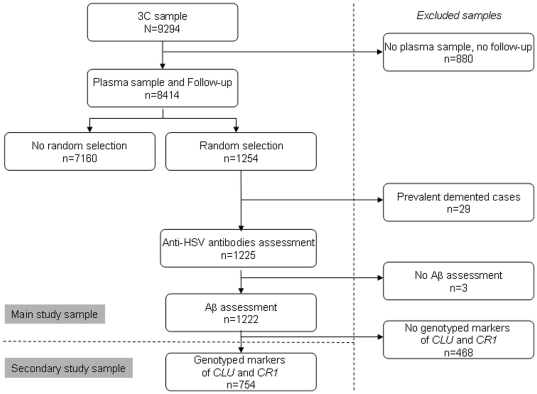
The study sample consisted of 1222 subjects (73.9 y in mean) from the Three-City cohort. IgM and IgG anti-HSV antibodies were quantified using an ELISA kit, and plasma levels of Aβ(1-40) and Aβ(1-42) were measured using an xMAP-based assay technology. Cross-sectional analyses of the associations between anti-HSV antibodies and plasma Aβ levels were performed by multi-linear regression.
After adjustment for study center, age, sex, education, and apolipoprotein E-e4 polymorphism, plasma Aβ(1-42) and Aβ(1-40) levels were specifically inversely associated with anti-HSV IgM levels (β = -20.7, P=0.001 and β = -92.4, P=0.007, respectively). In a sub-sample with information on CLU- and CR1-linked SNPs genotyping (n=754), additional adjustment for CR1 or CLU markers did not modify these associations (adjustment for CR1 rs6656401, β = -25.6, P=0.002 for Aβ(1-42) and β = -132.7, P=0.002 for Aβ(1-40;) adjustment for CLU rs2279590, β = -25.6, P=0.002 for Aβ(1-42) and β = -134.8, P=0.002 for Aβ(1-40)). No association between the plasma Aβ(1-42)-to-Aβ(1-40) ratio and anti-HSV IgM or IgG were evidenced.
High anti-HSV IgM levels, markers of HSV reactivation, are associated with lower plasma Aβ(1-40) and Aβ(1-42) levels, which suggest a possible involvement of the virus in the alterations of the APP processing and potentially in the pathogenesis of AD in human.
单纯疱疹病毒(HSV)的激活已被确定为阿尔茨海默病(AD)的一个可能风险因素,而血浆淀粉样蛋白-β(Aβ)水平可能被视为 AD 风险的潜在生物标志物。本研究的目的是探讨抗 HSV 抗体与血浆 Aβ 水平之间的关系。
研究样本包括来自三城市队列的 1222 名受试者(平均年龄 73.9 岁)。使用 ELISA 试剂盒定量检测 IgM 和 IgG 抗 HSV 抗体,使用 xMAP 为基础的检测技术测量血浆 Aβ(1-40)和 Aβ(1-42)水平。通过多元线性回归分析抗 HSV 抗体与血浆 Aβ 水平之间的关联。
在调整研究中心、年龄、性别、教育程度和载脂蛋白 E-e4 多态性后,血浆 Aβ(1-42)和 Aβ(1-40)水平与抗 HSV IgM 水平呈特异性负相关(β=-20.7,P=0.001 和 β=-92.4,P=0.007)。在具有 CLU 和 CR1 相关 SNP 基因分型信息的亚样本中(n=754),进一步调整 CR1 或 CLU 标志物并不能改变这些关联(调整 CR1 rs6656401,β=-25.6,P=0.002 与 Aβ(1-42)和 β=-132.7,P=0.002 与 Aβ(1-40);调整 CLU rs2279590,β=-25.6,P=0.002 与 Aβ(1-42)和 β=-134.8,P=0.002 与 Aβ(1-40))。未发现抗 HSV IgM 与血浆 Aβ(1-42)/Aβ(1-40)比值之间存在关联。
高抗 HSV IgM 水平,提示 HSV 再激活的标志物,与较低的血浆 Aβ(1-40)和 Aβ(1-42)水平相关,这表明病毒可能参与了 APP 加工的改变,并可能参与了人类 AD 的发病机制。