Department of Psychiatry, Yale University School of Medicine, New Haven, Connecticut 06519, USA.
Biol Psychiatry. 2012 Jul 1;72(1):57-64. doi: 10.1016/j.biopsych.2011.11.022. Epub 2012 Jan 3.
Cumulative adversity and stress are associated with risk of psychiatric disorders. While basic science studies show repeated and chronic stress effects on prefrontal and limbic neurons, human studies examining cumulative stress and effects on brain morphology are rare. Thus, we assessed whether cumulative adversity is associated with differences in gray matter volume, particularly in regions regulating emotion, self-control, and top-down processing in a community sample.
One hundred three healthy community participants, aged 18 to 48 and 68% male, completed interview assessment of cumulative adversity and a structural magnetic resonance imaging protocol. Whole-brain voxel-based-morphometry analysis was performed adjusting for age, gender, and total intracranial volume.
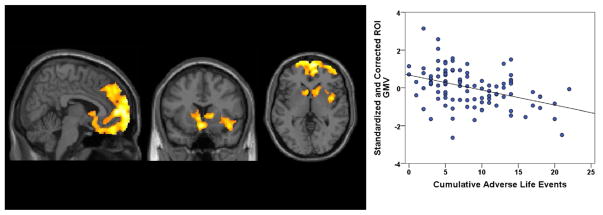
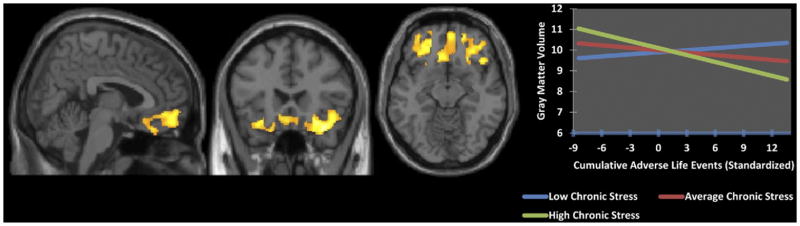
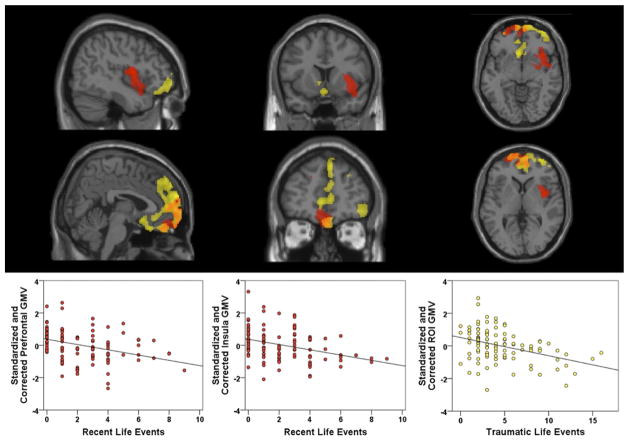
Cumulative adversity was associated with smaller volume in medial prefrontal cortex (PFC), insular cortex, and subgenual anterior cingulate regions (familywise error corrected, p < .001). Recent stressful life events were associated with smaller volume in two clusters: the medial PFC and the right insula. Life trauma was associated with smaller volume in the medial PFC, anterior cingulate, and subgenual regions. The interaction of greater subjective chronic stress and greater cumulative life events was associated with smaller volume in the orbitofrontal cortex, insula, and anterior and subgenual cingulate regions.
Current results demonstrate that increasing cumulative exposure to adverse life events is associated with smaller gray matter volume in key prefrontal and limbic regions involved in stress, emotion and reward regulation, and impulse control. These differences found in community participants may serve to mediate vulnerability to depression, addiction, and other stress-related psychopathology.
累积逆境和压力与精神障碍的风险相关。虽然基础科学研究表明,反复和慢性应激对前额叶和边缘神经元有影响,但人类研究中很少有关于累积应激和对大脑形态影响的研究。因此,我们评估了累积逆境是否与灰质体积的差异有关,特别是在调节情绪、自我控制和自上而下处理的区域。
103 名年龄在 18 至 48 岁之间、68%为男性的健康社区参与者完成了累积逆境的访谈评估和结构磁共振成像协议。全脑基于体素形态计量学分析在调整年龄、性别和总颅内体积后进行。
累积逆境与内侧前额叶皮质(PFC)、岛叶和扣带回前下区体积减小有关(校正全脑错误率,p<0.001)。近期生活应激事件与内侧 PFC 和右侧岛叶两个区域的体积减小有关。生活创伤与内侧 PFC、扣带回前下区和扣带回下区的体积减小有关。主观慢性应激较大和累积生活事件较多的交互作用与眶额皮质、岛叶和扣带回前下区的体积减小有关。
目前的结果表明,累积暴露于不良生活事件的增加与参与应激、情绪和奖励调节以及冲动控制的关键前额叶和边缘区域的灰质体积减小有关。在社区参与者中发现的这些差异可能有助于介导抑郁、成瘾和其他与应激相关的精神病理学的易感性。