Bandyopadhyay Dipanjan, Bandyopadhyay Ramtanu, Paul Rudrajit, Roy Deeptarka
Department of Medicine, Medical College Kolkata, Kolkata, India.
J Glob Infect Dis. 2011 Oct;3(4):329-33. doi: 10.4103/0974-777X.91052.
In a developing country, infectious disease remains the most important cause of fever, but the noncommunicable diseases, like malignancy, are fast becoming important differential diagnoses. An important clinical problem is the cases labeled as fever of unknown origin (FUO), which often evade diagnosis.
The present study was undertaken to find the cause of FUO in a tertiary care hospital of eastern India.
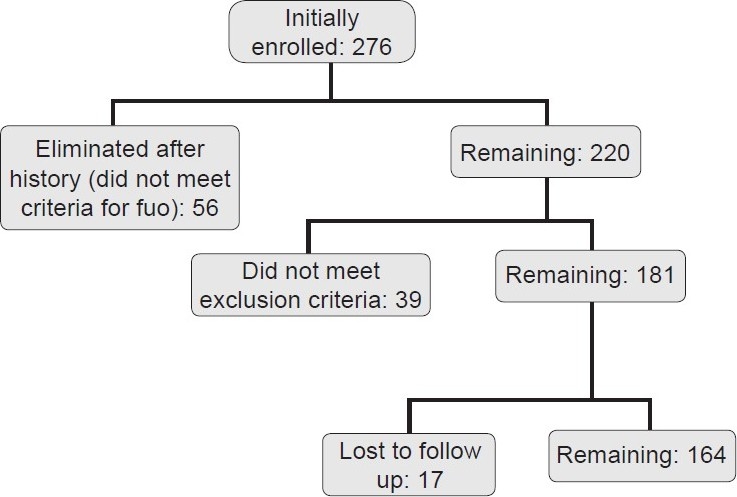
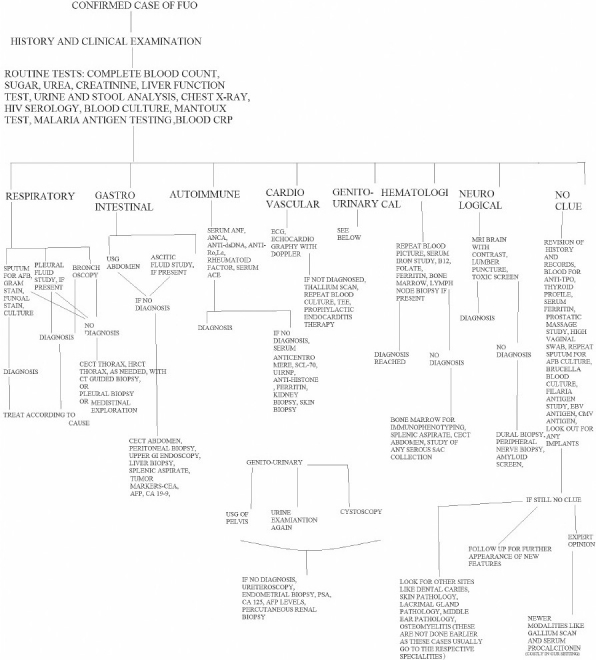
This is a prospective study of inpatients, with regard to both clinical signs and investigations.
The main diagnosis in the end was tuberculosis, closely followed by hematological malignancy. A substantial number of cases remained undiagnosed despite all investigations. The provisional diagnosis matched with the final in around two thirds of the cases. While for younger patients leukemia was a significant diagnosis, for older ones, extra-pulmonary tuberculosis was a main concern.
In India, infectious disease still remains the most important cause of fever. Thus the initial investigations should always include tests for that purpose in a case of FUO.
Geographic variations and local infection profiles should always be considered when investigating a case of FUO. However, some of the cases always elude diagnosis, although the patients may respond to empirical therapy.
在一个发展中国家,传染病仍然是发热的最重要原因,但非传染性疾病,如恶性肿瘤,正迅速成为重要的鉴别诊断对象。一个重要的临床问题是被标记为不明原因发热(FUO)的病例,这些病例常常难以诊断。
本研究旨在印度东部一家三级护理医院中找出不明原因发热的病因。
这是一项针对住院患者的临床症状和检查的前瞻性研究。
最终的主要诊断是结核病,其次是血液系统恶性肿瘤。尽管进行了所有检查,仍有相当数量的病例未得到诊断。大约三分之二的病例初步诊断与最终诊断相符。对于年轻患者,白血病是一个重要诊断,而对于老年患者,肺外结核是主要关注点。
在印度,传染病仍然是发热的最重要原因。因此,在不明原因发热的病例中,初始检查应始终包括针对该目的的检测。
在调查不明原因发热病例时,应始终考虑地理差异和当地感染情况。然而,尽管患者可能对经验性治疗有反应,但仍有一些病例始终无法确诊。