Department of Internal Medicine, University Hospital Basel, Peterplatz 1, Basel, 4003, Switzerland.
Crit Care. 2012 Jan 7;16(1):R2. doi: 10.1186/cc10600.
The accurate prediction of acute kidney injury (AKI) in patients with acute heart failure (AHF) is an unmet clinical need. Neutrophil gelatinase-associated lipocalin (NGAL) is a novel sensitive and specific marker of AKI.
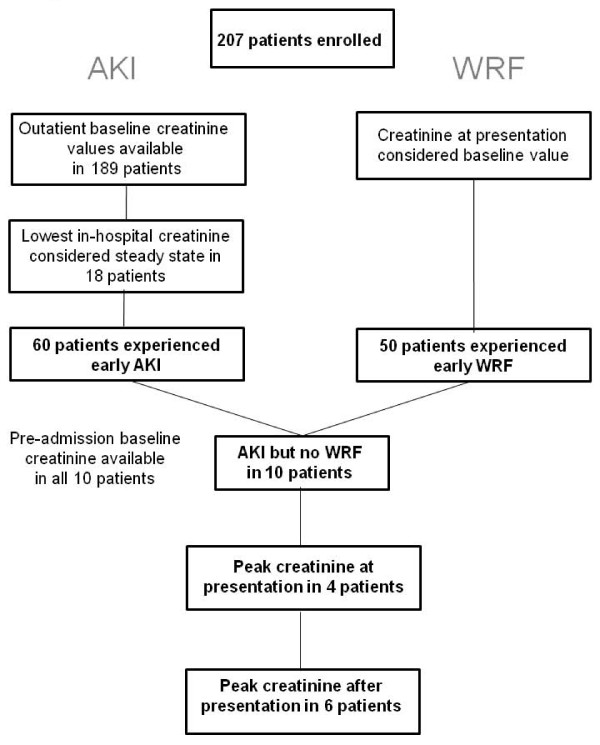
A total of 207 consecutive patients presenting to the emergency department with AHF were enrolled. Plasma NGAL was measured in a blinded fashion at presentation and serially thereafter. The potential of plasma NGAL levels to predict AKI was assessed as the primary endpoint. We defined AKI according to the AKI Network classification.
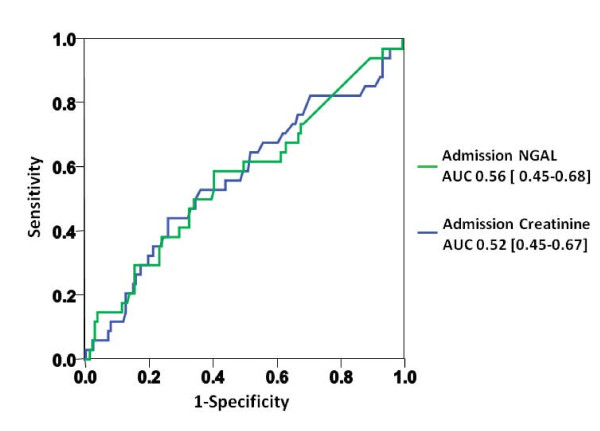
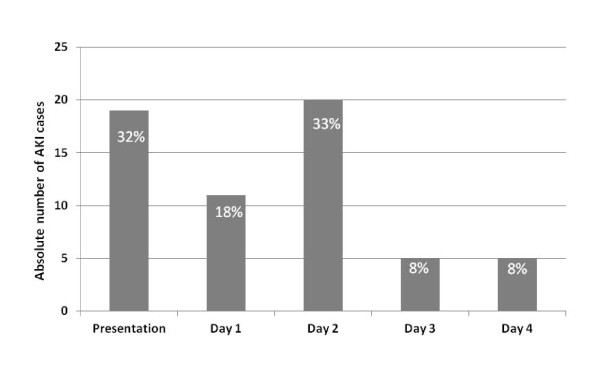
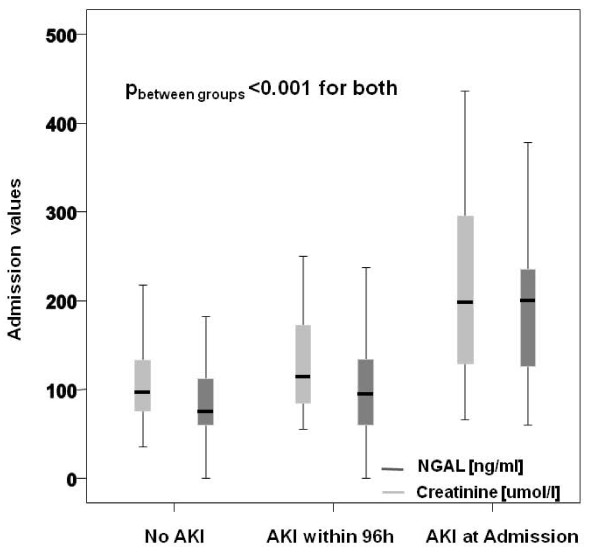
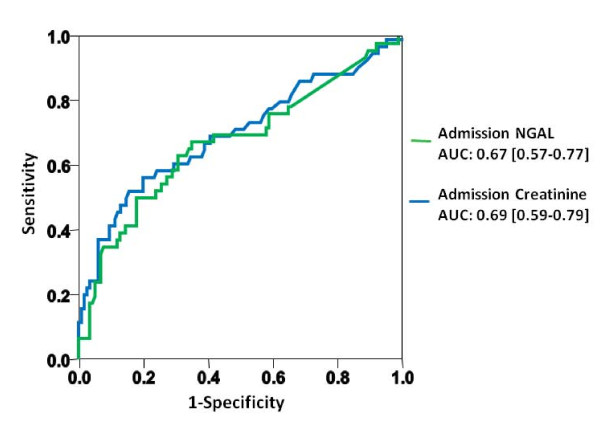
Overall 60 patients (29%) experienced AKI. These patients were more likely to suffer from pre-existing chronic cardiac or kidney disease. At presentation, creatinine (median 140 (interquartile range (IQR), 91 to 203) umol/L versus 97 (76 to 132) umol/L, P<0.01) and NGAL (114.5 (IQR, 67.1 to 201.5) ng/ml versus 74.5 (60 to 113.9) ng/ml, P<0.01) levels were significantly higher in AKI compared to non-AKI patients. The prognostic accuracy for measurements obtained at presentation, as quantified by the area under the receiver operating characteristic curve was mediocre and comparable for the two markers (creatinine 0.69; 95%CI 0.59 to 0.79 versus NGAL 0.67; 95%CI 0.57 to 0.77). Serial measurements of NGAL did not further increase the prognostic accuracy for AKI. Creatinine, but not NGAL, remained an independent predictor of AKI (hazard ratio (HR) 1.12; 95%CI 1.00 to 1.25; P=0.04) in multivariable regression analysis.
Plasma NGAL levels do not adequately predict AKI in patients with AHF.
准确预测急性心力衰竭(AHF)患者的急性肾损伤(AKI)是一项未满足的临床需求。中性粒细胞明胶酶相关脂质运载蛋白(NGAL)是 AKI 的一种新型敏感和特异标志物。
共纳入 207 例因 AHF 就诊于急诊科的连续患者。以盲法在就诊时及随后连续测量血浆 NGAL。以血浆 NGAL 水平预测 AKI 的能力为主要终点进行评估。我们根据 AKI 网络分类定义 AKI。
共有 60 例患者(29%)发生 AKI。这些患者更有可能患有先前存在的慢性心脏或肾脏疾病。就诊时,AKI 患者的肌酐(中位数 140(四分位距(IQR),91 至 203)μmol/L 比非 AKI 患者的 97(76 至 132)μmol/L,P<0.01)和 NGAL(114.5(IQR,67.1 至 201.5)ng/ml 比非 AKI 患者的 74.5(60 至 113.9)ng/ml,P<0.01)水平显著更高。以受试者工作特征曲线下面积(AUC)量化的就诊时测量的预后准确性中等,两种标志物相当(肌酐 0.69;95%CI 0.59 至 0.79 与 NGAL 0.67;95%CI 0.57 至 0.77)。NGAL 的连续测量并未进一步提高 AKI 的预后准确性。多变量回归分析显示,肌酐(HR 1.12;95%CI 1.00 至 1.25;P=0.04)而非 NGAL 是 AKI 的独立预测因子。
在 AHF 患者中,血浆 NGAL 水平不能充分预测 AKI。