Matsa Ramprasad, Ashley Emma, Sharma Vivek, Walden Andrew P, Keating Liza
Crit Care. 2014 Jul 1;18(4):R137. doi: 10.1186/cc13958.
Neutrophil gelatinase-associated lipocalin (NGAL) has been demonstrated to be a useful early diagnostic biomarker of acute kidney injury (AKI) where the timing of the insult is certain. However, NGAL is not well validated in adult critical care practice because of indeterminate timing of injury. Therefore, we sought to establish the predictive ability of both urine and plasma NGAL to detect AKI in ICU patients.
This prospective observational study was performed in a busy large district general hospital mixed surgical-medical ICU in Reading, UK. Consecutive adult admissions to the ICU, with absence of chronic kidney disease, renal transplant or AKI as defined by RIFLE criteria were included. Blood and urine specimens were collected at admission and every 24 hours until 72 hours and tested for NGAL. The purpose of the study was to assess whether urinary NGAL (uNGAL) or plasma NGAL (pNGAL) can predict the occurrence of AKI at an earlier point of time than the conventional markers, that is creatinine and urine output as is used in RIFLE criteria.
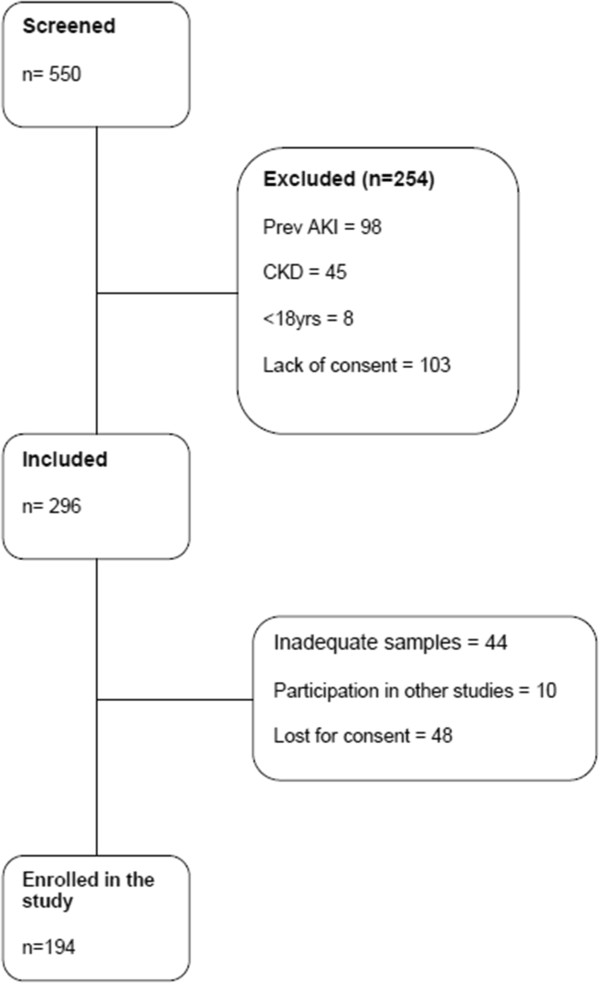
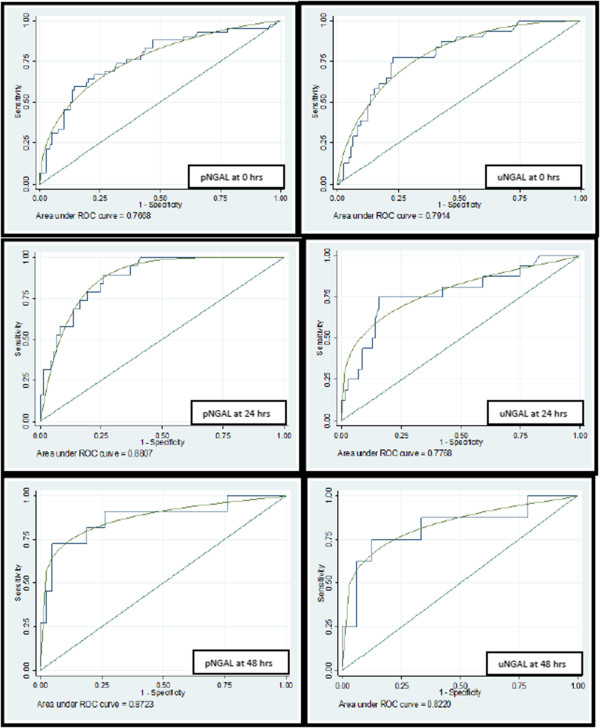
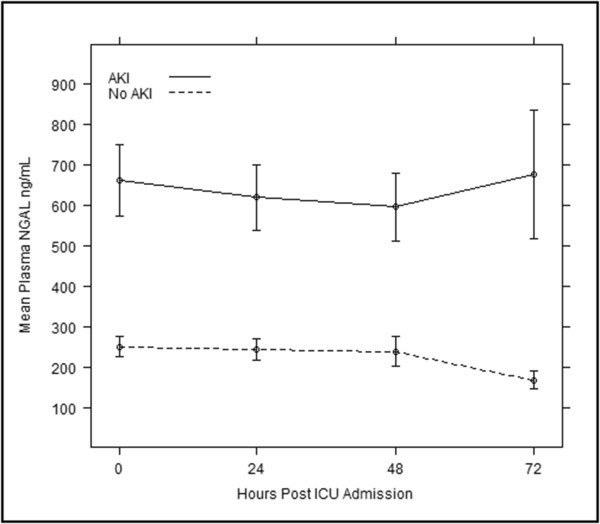
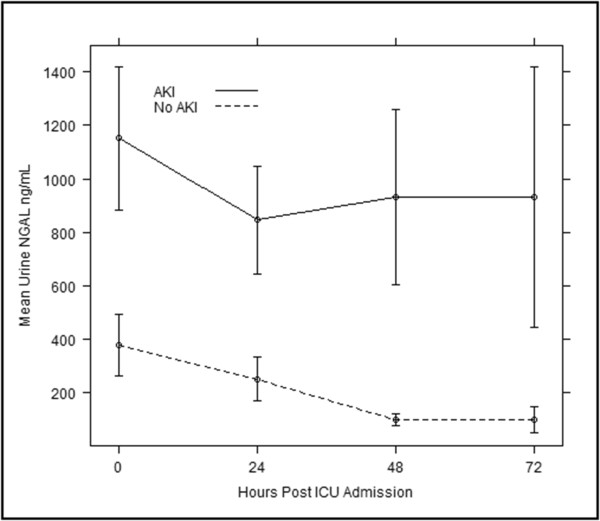
Over a 12-month period, 194 patients were enrolled. In total, 59 (30.4%) patients developed AKI. The admission pNGAL and uNGAL were significantly higher in the patients who developed AKI compared to the non-AKI patients (436 ng/mL (240, 797) versus 168 ng/mL (121.3, 274.3) P <0.001 and 342 ng/mL (61.5, 1,280) versus 34.5 ng/mL (11.5, 107.75) P <0.001 respectively). Hospital mortality was higher in the AKI group (17% versus 4%). Plasma NGAL performed fairly on admission (AUROC 0.77) and thereafter performance improved at 24 and 48 hours (AUROC 0.88 and 0.87) following ICU admission. Urine NGAL had a fair predictive value on admission (AUROC 0.79) and at 24 hours (AUROC 0.78) and was good at 48 hours (AUROC 0.82).
In critically ill patients without pre-existing kidney disease, both pNGAL and uNGAL measured at admission can predict AKI (defined by RIFLE criteria) occurrence up to 72 hours post-ICU admission and their performance (AUROC) was fair. The accuracy of NGAL appeared to improve slightly as patients progressed through their ICU stay. Serial measurements of NGAL (both pNGAL and uNGAL) may be of added value in an ICU setting to predict the occurrence of AKI.
中性粒细胞明胶酶相关脂质运载蛋白(NGAL)已被证明是急性肾损伤(AKI)的一种有用的早期诊断生物标志物,前提是损伤时间明确。然而,由于损伤时间不确定,NGAL在成人重症监护实践中尚未得到充分验证。因此,我们试图确定尿液和血浆NGAL检测ICU患者AKI的预测能力。
这项前瞻性观察性研究在英国雷丁一家繁忙的大型地区综合医院的外科-内科混合重症监护病房进行。纳入连续入住ICU的成年患者,这些患者不存在慢性肾脏病、肾移植或RIFLE标准定义的AKI。入院时及之后每24小时采集血样和尿样,直至72小时,并检测NGAL。本研究的目的是评估尿NGAL(uNGAL)或血浆NGAL(pNGAL)是否能比传统标志物(即RIFLE标准中使用的肌酐和尿量)更早地预测AKI的发生。
在12个月的时间里,共纳入194例患者。总共有59例(30.4%)患者发生了AKI。发生AKI的患者入院时的pNGAL和uNGAL显著高于未发生AKI的患者(分别为436 ng/mL(240,797)对168 ng/mL(121.3,274.3),P<0.001;342 ng/mL(61.5,1280)对34.5 ng/mL(11.5,107.75),P<0.001)。AKI组的医院死亡率更高(17%对4%)。血浆NGAL入院时表现尚可(曲线下面积(AUROC)为0.77),此后在ICU入院后24小时和48小时表现有所改善(AUROC分别为0.88和0.87)。尿NGAL入院时和24小时时具有一定的预测价值(AUROC分别为0.79和0.78),48小时时表现良好(AUROC为0.82)。
在没有基础肾脏疾病的重症患者中,入院时检测的pNGAL和uNGAL均可预测ICU入院后72小时内AKI(根据RIFLE标准定义)的发生,其表现(AUROC)尚可。随着患者在ICU住院时间的延长,NGAL的准确性似乎略有提高。在ICU环境中,连续测量NGAL(pNGAL和uNGAL)可能对预测AKI的发生具有附加价值。