Biomedical and Metabolic Imaging Branch, National Institute of Diabetes and Digestive and Kidney Diseases, NIH, Bethesda, MD, USA.
J Cardiovasc Magn Reson. 2012 Jan 6;14(1):1. doi: 10.1186/1532-429X-14-1.
We sought to investigate the relationship between infarct and dyssynchrony post- myocardial infarct (MI), in a porcine model. Mechanical dyssynchrony post-MI is associated with left ventricular (LV) remodeling and increased mortality.
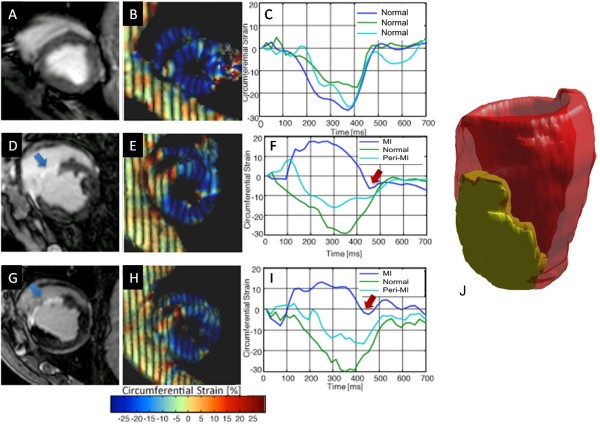
Cine, gadolinium-contrast, and tagged cardiovascular magnetic resonance (CMR) were performed pre-MI, 9 ± 2 days (early post-MI), and 33 ± 10 days (late post-MI) post-MI in 6 pigs to characterize cardiac morphology, location and extent of MI, and regional mechanics. LV mechanics were assessed by circumferential strain (eC). Electro-anatomic mapping (EAM) was performed within 24 hrs of CMR and prior to sacrifice.
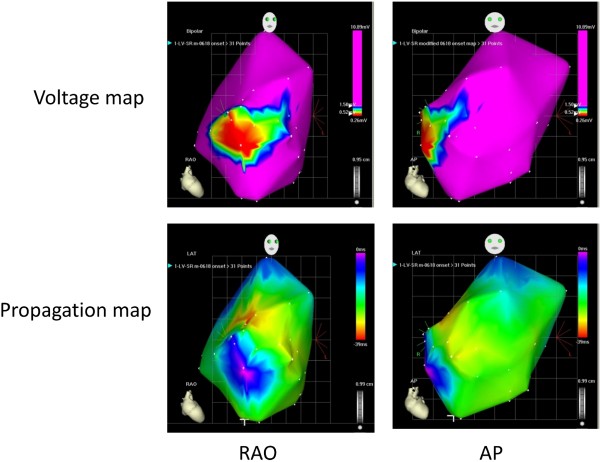
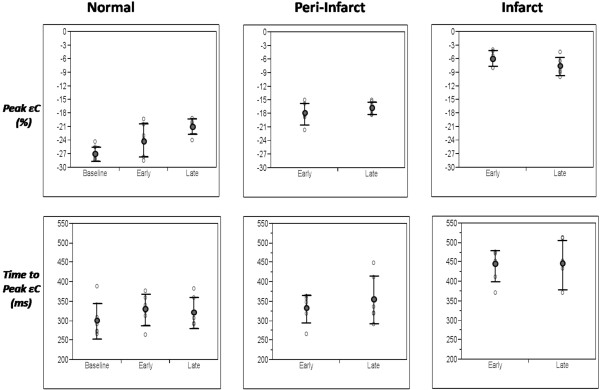
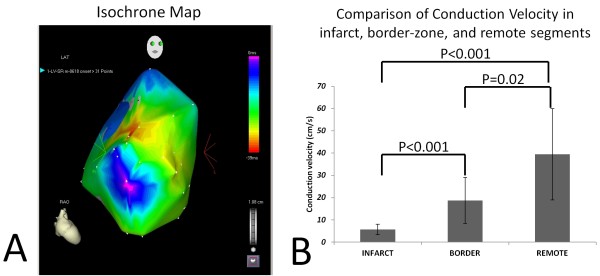
Mean infarct size was 21 ± 4% of LV volume with evidence of post-MI remodeling. Global eC significantly decreased post MI (-27 ± 1.6% vs. -18 ± 2.5% (early) and -17 ± 2.7% (late), p < 0.0001) with no significant change in peri-MI and MI segments between early and late time-points. Time to peak strain (TTP) was significantly longer in MI, compared to normal and peri-MI segments, both early (440 ± 40 ms vs. 329 ± 40 ms and 332 ± 36 ms, respectively; p = 0.0002) and late post-MI (442 ± 63 ms vs. 321 ± 40 ms and 355 ± 61 ms, respectively; p = 0.012). The standard deviation of TTP in 16 segments (SD16) significantly increased post-MI: 28 ± 7 ms to 50 ± 10 ms (early, p = 0.012) to 54 ± 19 ms (late, p = 0.004), with no change between early and late post-MI time-points (p = 0.56). TTP was not related to reduction of segmental contractility. EAM revealed late electrical activation and greatly diminished conduction velocity in the infarct (5.7 ± 2.4 cm/s), when compared to peri-infarct (18.7 ± 10.3 cm/s) and remote myocardium (39 ± 20.5 cm/s).
Mechanical dyssynchrony occurs early after MI and is the result of delayed electrical and mechanical activation in the infarct.
我们旨在研究心肌梗死后梗死和不同步性之间的关系,为此构建了猪模型。心肌梗死后的机械不同步与左心室(LV)重构和死亡率增加有关。
在 6 头猪中,在心肌梗死前(MI)、9±2 天(早期 MI)和 33±10 天(晚期 MI)进行心脏电影、钆对比和标记心血管磁共振(CMR),以描述心脏形态、MI 的位置和范围以及局部力学。通过周向应变(eC)评估 LV 力学。CMR 后 24 小时内进行电解剖映射(EAM)并在牺牲前进行。
平均梗死面积为 LV 体积的 21±4%,伴有梗死后重构的证据。MI 后,整体 eC 明显降低(-27±1.6%比-18±2.5%(早期)和-17±2.7%(晚期),p<0.0001),但早期和晚期之间 MI 段和周边段的 eC 无显著变化。MI 段达峰时间(TTP)明显长于正常和周边段,无论是在早期(440±40 ms 比 329±40 ms 和 332±36 ms,分别;p=0.0002)还是晚期 MI(442±63 ms 比 321±40 ms 和 355±61 ms,分别;p=0.012)。16 个节段 TTP 的标准差(SD16)在 MI 后明显增加:从 28±7 ms 增加到 50±10 ms(早期,p=0.012)到 54±19 ms(晚期,p=0.004),早期和晚期 MI 之间无变化(p=0.56)。TTP 与节段收缩力降低无关。EAM 显示,与周边梗死区(18.7±10.3 cm/s)和远隔心肌(39±20.5 cm/s)相比,梗死区晚期电活动和传导速度明显降低(5.7±2.4 cm/s)。
机械不同步在 MI 后早期发生,是梗死区延迟电和机械激活的结果。