Johns Hopkins University, 720 Rutland Avenue, Baltimore, MD 21210, USA.
J Am Soc Echocardiogr. 2011 Jul;24(7):808-14. doi: 10.1016/j.echo.2011.03.003. Epub 2011 Apr 20.
Cardiosphere-derived stem cell (CDC) transplantation can improve global left ventricular ejection fraction (LVEF) after myocardial infarction (MI). The aim of this study was to examine the effects of CDC transplantation on regional function and dyssynchrony after MI.
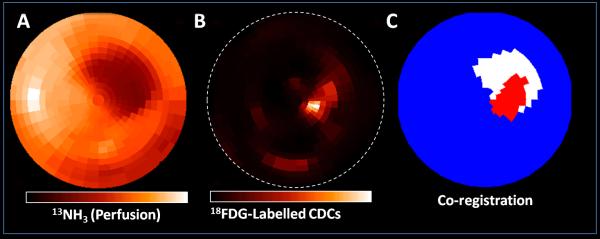
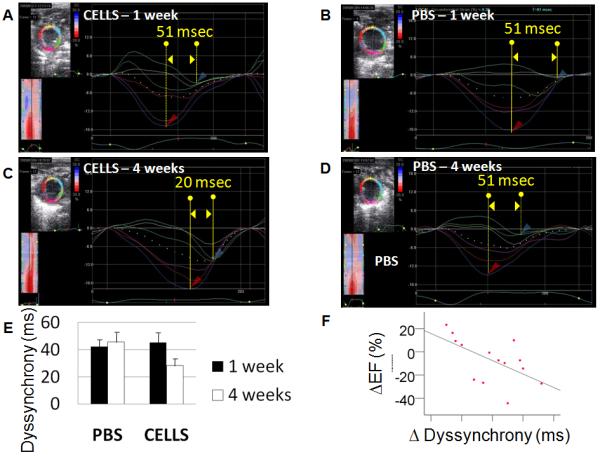
Two million rat CDCs (n = 7) or phosphate-buffered saline (n = 7) was injected into the infarct regions of Wistar Kyoto rats. Infarct size and CDC localization were evaluated by positron emission tomography (n = 7). Two-dimensional and strain echocardiography were performed at 1 and 4 weeks after MI. LVEF, circumferential strain, and time to peak circumferential strain were measured in the basal and apical short-axis views. Dyssynchrony was defined as the maximal difference of time to peak circumferential strain of opposing segments in each short-axis view. Engraftment was measured by quantitative polymerase chain reaction.
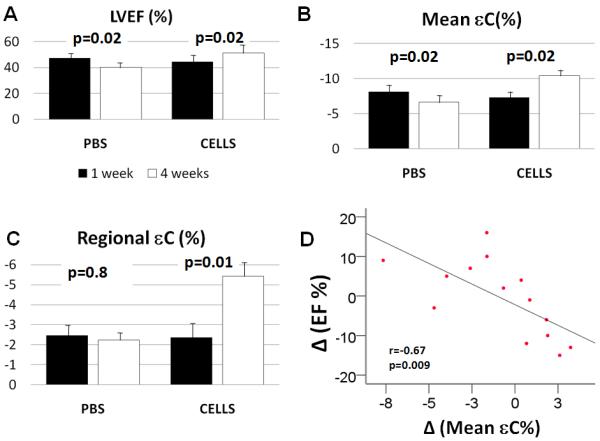
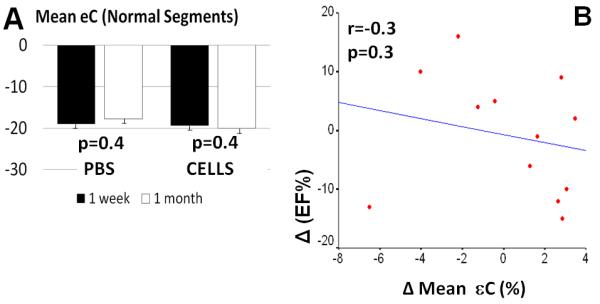
Positron emission tomography revealed that infarct size was 15.4 ± 3.6% of the left ventricle and that CDCs were localized to the infarct and border zone. CDC transplantation improved mean LVEF (45 ± 8% to 52 ± 7%, P = .02), mean circumferential strain (-7 ± 2% to -10 ± 1%, P = .02), and mean dyssynchrony (45 ± 10 to 28 ± 11 m sec, P = .04) of the infarct/peri-infarct zone from 1 to 4 weeks after MI, despite CDC engraftment of only 2.4 ± 3%. In contrast, mean LVEF (48 ± 5% to 40 ± 4%, P = .03) and mean circumferential strain (-8 ± 2% to -7 ± 1%, P = .02) of the infarcted region deteriorated, with no significant change in dyssynchrony (42 ± 12 vs 46 ± 13 m sec, P = .60) in the saline group during the same time period. Change in LVEF was correlated with change in circumferential strain (r = -0.8, P = .002) and dyssynchrony (r = 0.6, P = .02) of the infarct/peri-infarct region at 4 weeks after MI.
CDC therapy enhanced LVEF by improving circumferential strain and decreasing dyssynchrony of the infarct/peri-infarct region at 4 weeks, but not 1 week, after MI. Cellular resynchronization therapy using CDCs may be an alternative to traditional electrical cellular resynchronization therapy in post-MI dyssynchrony.
心脏球源性干细胞(CDC)移植可改善心肌梗死后的整体左心室射血分数(LVEF)。本研究旨在探讨 CDC 移植对 MI 后局部功能和不同步性的影响。
将 200 万个大鼠 CDC(n=7)或磷酸盐缓冲液(n=7)注入 Wistar Kyoto 大鼠的梗死区。正电子发射断层扫描(n=7)评估梗死面积和 CDC 定位。MI 后 1 周和 4 周进行二维和应变超声心动图检查。在基底和心尖短轴视图中测量 LVEF、周向应变和周向应变达峰时间。不同步性定义为每个短轴视图中相反节段的周向应变达峰时间的最大差异。通过定量聚合酶链反应测量嵌合体。
正电子发射断层扫描显示,梗死面积为左心室的 15.4±3.6%,CDC 定位于梗死区和边缘区。CDC 移植可改善 MI 后 1 至 4 周梗死/梗死周边区的平均 LVEF(45±8%至 52±7%,P=0.02)、平均周向应变(-7±2%至-10±1%,P=0.02)和平均不同步性(45±10 至 28±11 msec,P=0.04),尽管 CDC 嵌合体仅为 2.4±3%。相比之下,盐水组在同一时间内梗死区的平均 LVEF(48±5%至 40±4%,P=0.03)和平均周向应变(-8±2%至-7±1%,P=0.02)恶化,不同步性无明显变化(42±12 与 46±13 msec,P=0.60)。MI 后 4 周,LVEF 的变化与梗死/梗死周边区的周向应变(r=-0.8,P=0.002)和不同步性(r=-0.6,P=0.02)的变化相关。
在 MI 后 4 周,而非 1 周时,CDC 治疗通过改善梗死/梗死周边区的周向应变和减少不同步性来提高 LVEF。使用 CDC 的细胞再同步治疗可能是 MI 后不同步性的传统心脏电细胞再同步治疗的替代方法。