Centre for Sports Medicine and Human Performance, Brunel University, Uxbridge, Middlesex UB8 3PH, UK.
Exp Physiol. 2012 Mar;97(3):419-32. doi: 10.1113/expphysiol.2011.064238. Epub 2012 Jan 6.
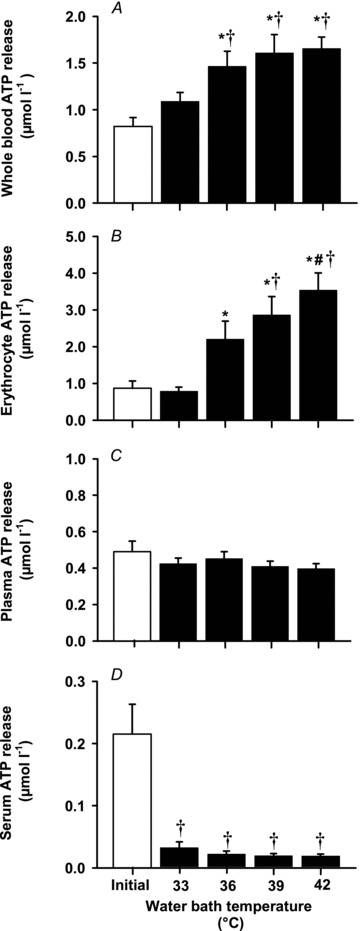
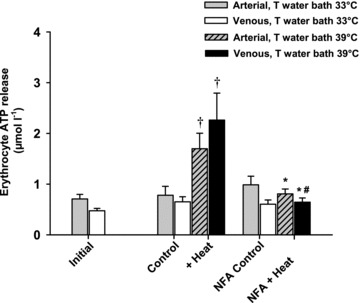
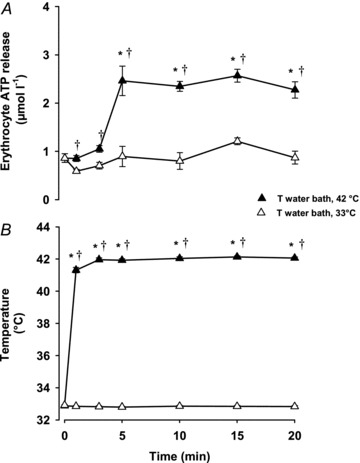
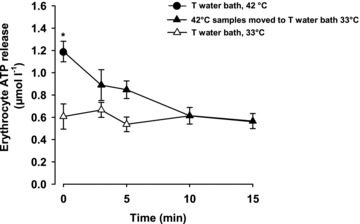
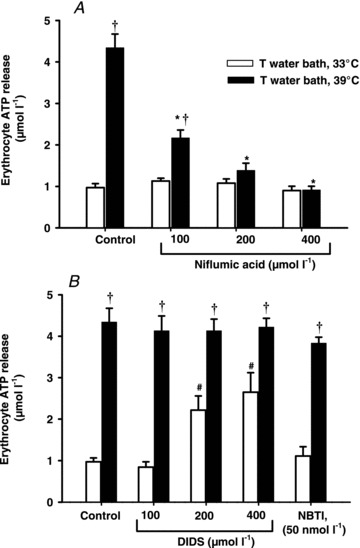
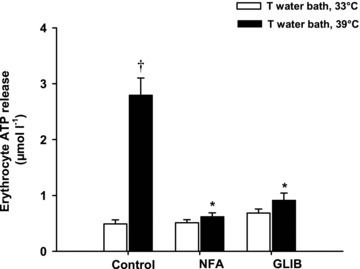
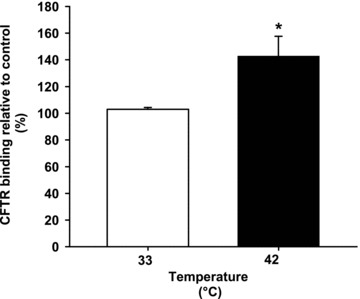
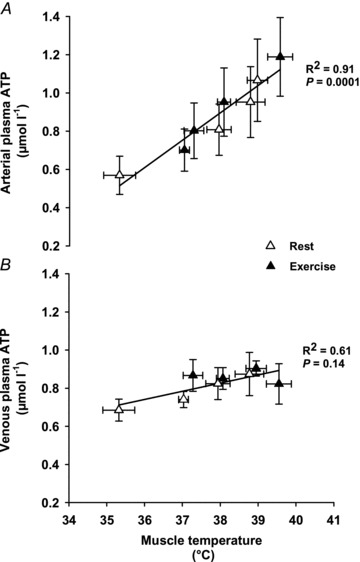
Human limb muscle and skin blood flow increases significantly with elevations in temperature, possibly through physiological processes that involve temperature-sensitive regulatory mechanisms. Here we tested the hypothesis that the release of the vasodilator ATP from human erythrocytes is sensitive to physiological increases in temperature both in vitro and in vivo, and examined potential channel/transporters involved. To investigate the source of ATP release, whole blood, red blood cells (RBCs), plasma and serum were heated in vitro to 33, 36, 39 and 42°C. In vitro heating augmented plasma or 'bathing solution' ATP in whole blood and RBC samples, but not in either isolated plasma or serum samples. Heat-induced ATP release was blocked by niflumic acid and glibenclamide, but was not affected by inhibitors of nucleoside transport or anion exchange. Heating blood to 42°C enhanced (P < 0.05) membrane protein abundance of cystic fibrosis transmembrane conductance regulator (CFTR) in RBCs. In a parallel in vivo study in humans exposed to whole-body heating at rest and during exercise, increases in muscle temperature from 35 to 40°C correlated strongly with elevations in arterial plasma ATP (r(2) = 0.91; P = 0.0001), but not with femoral venous plasma ATP (r(2) = 0.61; P = 0.14). In vitro, however, the increase in ATP release from RBCs was similar in arterial and venous samples heated to 39°C. Our findings demonstrate that erythrocyte ATP release is sensitive to physiological increases in temperature, possibly via activation of CFTR-like channels, and suggest that temperature-dependent release of ATP from erythrocytes might be an important mechanism regulating human limb muscle and skin perfusion in conditions that alter blood and tissue temperature.
人体四肢肌肉和皮肤的血流量会随着温度升高而显著增加,这可能是通过涉及温度敏感调节机制的生理过程实现的。在这里,我们检验了一个假设,即人红细胞中血管扩张剂 ATP 的释放对体外和体内的生理温度升高敏感,并研究了潜在的参与的通道/转运体。为了研究 ATP 释放的来源,我们将全血、红细胞(RBC)、血浆和血清在体外加热至 33、36、39 和 42°C。体外加热使全血和 RBC 样本中的血浆或“浴液”ATP 增加,但对单独的血浆或血清样本则没有作用。热诱导的 ATP 释放被 niflumic acid 和 glibenclamide 阻断,但不受核苷转运或阴离子交换抑制剂的影响。将血液加热至 42°C 增强了 RBC 中囊性纤维化跨膜电导调节剂(CFTR)的膜蛋白丰度(P<0.05)。在一项平行的人体研究中,在休息和运动期间对全身加热,肌肉温度从 35°C 升高到 40°C 与动脉血浆 ATP 的升高强烈相关(r²=0.91;P=0.0001),但与股静脉血浆 ATP 无关(r²=0.61;P=0.14)。然而,在体外,加热至 39°C 的动脉和静脉样本中,RBC 中 ATP 的释放增加相似。我们的发现表明,红细胞 ATP 的释放对生理温度升高敏感,可能通过激活 CFTR 样通道,并且表明红细胞中依赖温度的 ATP 释放可能是调节改变血液和组织温度条件下人体四肢肌肉和皮肤灌注的重要机制。