KIT Biomedical Research, Royal Tropical Institute, Amsterdam, The Netherlands.
PLoS One. 2012;7(1):e29108. doi: 10.1371/journal.pone.0029108. Epub 2012 Jan 3.
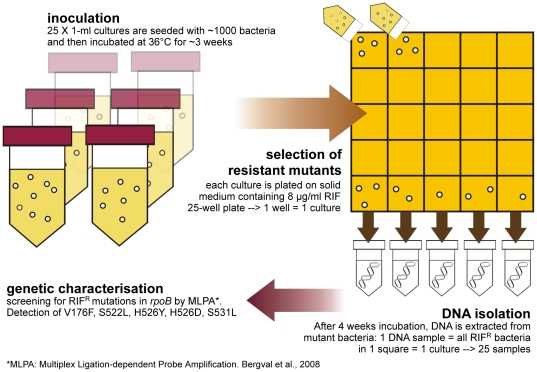
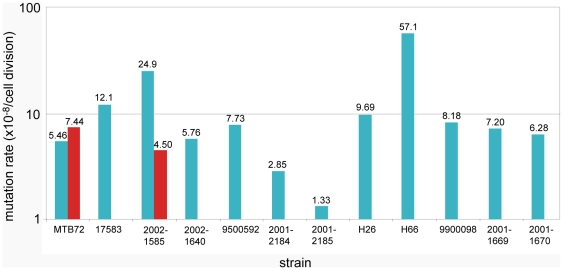
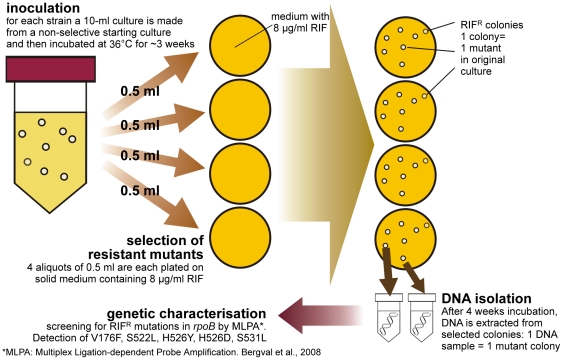
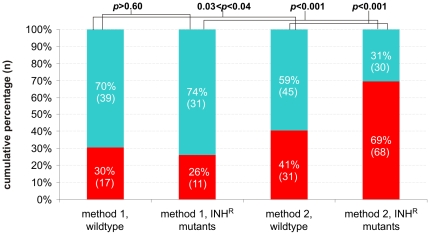
Both the probability of a mutation occurring and the ability of the mutant to persist will influence the distribution of mutants that arise in a population. We studied the interaction of these factors for the in vitro selection of rifampicin (RIF)-resistant mutants of Mycobacterium tuberculosis. We characterised two series of spontaneous RIF-resistant in vitro mutants from isoniazid (INH)-sensitive and -resistant laboratory strains and clinical isolates, representing various M. tuberculosis genotypes. The first series were selected from multiple parallel 1 ml cultures and the second from single 10 ml cultures. RIF-resistant mutants were screened by Multiplex Ligation-dependent Probe Amplification (MLPA) or by sequencing the rpoB gene. For all strains the mutation rate for RIF resistance was determined with a fluctuation assay. The most striking observation was a shift towards rpoB-S531L (TCG→TTG) mutations in a panel of laboratory-generated INH-resistant mutants selected from the 10-ml cultures (p<0.001). All tested strains showed similar mutation rates (1.33×10⁻⁸ to 2.49×10⁻⁷) except one of the laboratory-generated INH mutants with a mutation rate measured at 5.71×10⁻⁷, more than 10 times higher than that of the INH susceptible parental strain (5.46-7.44×10⁻⁸). No significant, systematic difference in the spectrum of rpoB-mutations between strains of different genotypes was observed. The dramatic shift towards rpoB-S531L in our INH-resistant laboratory mutants suggests that the relative fitness of resistant mutants can dramatically impact the distribution of (subsequent) mutations that accumulate in a M. tuberculosis population, at least in vitro. We conclude that, against specific genetic backgrounds, certain resistance mutations are particularly likely to spread. Molecular screening for these (combinations of) mutations in clinical isolates could rapidly identify these particular pathogenic strains. We therefore recommend that isolates are screened for the distribution of resistance mutations, especially in regions that are highly endemic for (multi)drug resistant tuberculosis.
发生突变的可能性和突变体的持续存在能力都会影响在一个种群中出现的突变体的分布。我们研究了这些因素在结核分枝杆菌体外选择利福平(RIF)耐药突变体中的相互作用。我们对来自异烟肼(INH)敏感和耐药的实验室菌株和临床分离株的两个系列自发 RIF 耐药体外突变体进行了特征描述,这些分离株代表了不同的结核分枝杆菌基因型。第一个系列是从多个平行的 1 毫升培养物中选择的,第二个系列是从单个 10 毫升培养物中选择的。用多重连接依赖性探针扩增(MLPA)或测序 rpoB 基因筛选 RIF 耐药突变体。用波动试验测定所有菌株的 RIF 耐药突变率。最引人注目的观察是,在用 10 毫升培养物选择的一组实验室产生的 INH 耐药突变体中,rpoB-S531L(TCG→TTG)突变的频率明显增加(p<0.001)。除了一个实验室产生的 INH 突变体的突变率测量值为 5.71×10⁻⁷,是 INH 敏感亲本菌株(5.46-7.44×10⁻⁸)的 10 多倍外,所有测试的菌株的突变率相似(1.33×10⁻⁸ 至 2.49×10⁻⁷)。在不同基因型的菌株之间,rpoB 突变谱没有明显的、系统的差异。在我们的 INH 耐药实验室突变体中,rpoB-S531L 的急剧增加表明,耐药突变体的相对适应性可以显著影响结核分枝杆菌种群中积累的(后续)突变的分布,至少在体外是这样。我们的结论是,在特定的遗传背景下,某些耐药突变更有可能传播。对临床分离株中这些(组合)突变的分子筛查可以快速识别这些特定的致病性菌株。因此,我们建议对分离株进行耐药突变分布的筛查,特别是在耐多药结核分枝杆菌高度流行的地区。