Department of Surgery, Seoul National University-Boramae hospital, Seoul, Korea.
Br J Cancer. 2012 Feb 14;106(4):733-9. doi: 10.1038/bjc.2011.592. Epub 2012 Jan 12.
Currently, serum biomarkers, which are sufficiently sensitive and specific for early detection and risk classification of gastric adenocarcinoma do not exist. Therefore, this study identified a panel of serum biomarkers for the diagnosis of gastric adenocarcinoma.
A 29-plex array platform with 29 biomarkers, consisting of 11 proteins discovered through proteomics and 18 previously known to be cancer-associated, was constructed. A test/training set consisting of 120 gastric adenocarcinoma and 120 control samples were examined. After 13 proteins were selected as candidate biomarkers, multivariate classification analyses were used to identify algorithms for diagnostic biomarker combinations. These algorithms were independently validated using a set of 95 gastric adenocarcinoma and 51 control samples.
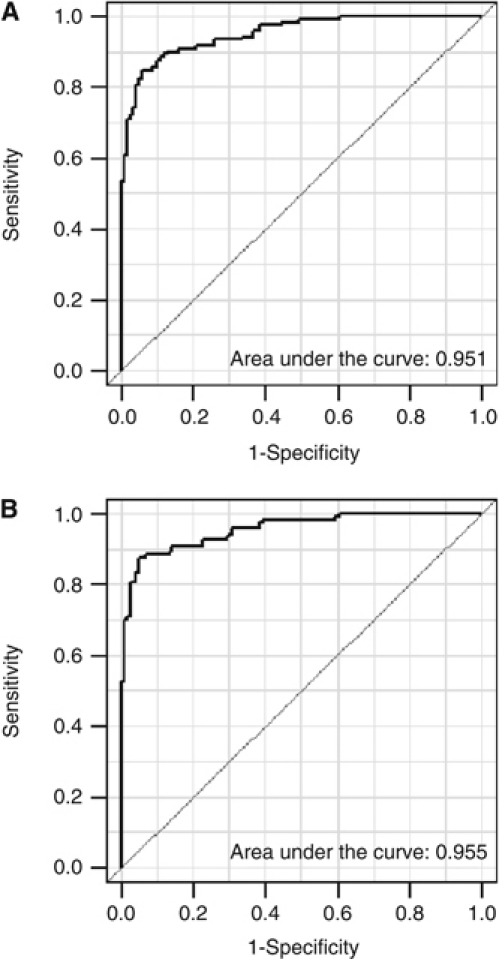
Epidermal growth factor receptor (EGFR), pro-apolipoprotein A1 (proApoA1), apolipoprotein A1, transthyretin (TTR), regulated upon activation, normally T-expressed and presumably secreted (RANTES), D-dimer, vitronectin (VN), interleukin-6, α-2 macroglobulin, C-reactive protein and plasminogen activator inhibitor-1 were selected as classifiers in the two algorithms. These algorithms differentiated between the majority of gastric adenocarcinoma and control serum samples in the training/test set with high accuracy (>88%). These algorithms also accurately classified in the validation set (>85%).
Two panels of combinatorial biomarkers, including EGFR, TTR, RANTES, and VN, are developed, which are less invasive method for the diagnosis of gastric adenocarcinoma. They could supplement clinical gastroscopic evaluation of symptomatic patients to enhance diagnostic accuracy.
目前,用于早期检测和风险分类的胃腺癌的血清生物标志物还不够敏感和特异。因此,本研究旨在确定一组用于诊断胃腺癌的血清生物标志物。
构建了一个包含 29 种生物标志物的 29 plex 阵列平台,其中包括通过蛋白质组学发现的 11 种蛋白质和 18 种先前已知与癌症相关的蛋白质。用包含 120 例胃腺癌和 120 例对照样本的测试/训练集进行检测。在选择了 13 种候选蛋白作为生物标志物后,使用多元分类分析来确定用于诊断生物标志物组合的算法。使用一组 95 例胃腺癌和 51 例对照样本对这些算法进行了独立验证。
表皮生长因子受体(EGFR)、载脂蛋白 A1 前体(proApoA1)、载脂蛋白 A1、转甲状腺素蛋白(TTR)、激活正常 T 表达和可能分泌的调节因子(RANTES)、D-二聚体、纤连蛋白(VN)、白细胞介素 6、α-2 巨球蛋白、C 反应蛋白和纤溶酶原激活物抑制剂 1 被选为两种算法中的分类器。这两种算法在训练/测试集上能以较高的准确性(>88%)区分大多数胃腺癌和对照血清样本,在验证集上也能准确分类(>85%)。
开发了两种组合生物标志物面板,包括 EGFR、TTR、RANTES 和 VN,这是一种侵袭性较小的胃腺癌诊断方法。它们可以补充有症状患者的临床胃镜评估,以提高诊断准确性。