Department of Product Safety, German Federal Institute for Risk Assessment (BfR), 10589 Berlin, Germany.
Toxicol Sci. 2012 Apr;126(2):457-68. doi: 10.1093/toxsci/kfs003. Epub 2012 Jan 12.
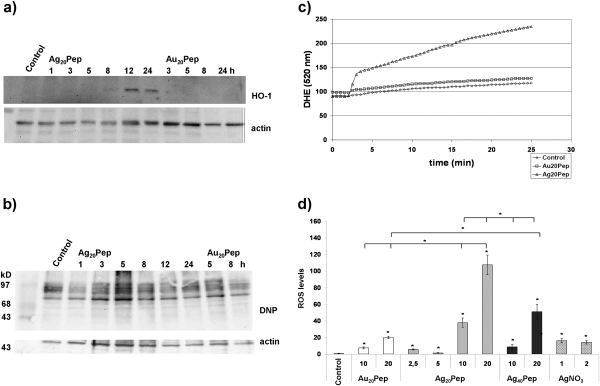
In the body, nanoparticles can be systemically distributed and then may affect secondary target organs, such as the central nervous system (CNS). Putative adverse effects on the CNS are rarely investigated to date. Here, we used a mixed primary cell model consisting mainly of neurons and astrocytes and a minor proportion of oligodendrocytes to analyze the effects of well-characterized 20 and 40 nm silver nanoparticles (SNP). Similar gold nanoparticles served as control and proved inert for all endpoints tested. SNP induced a strong size-dependent cytotoxicity. Additionally, in the low concentration range (up to 10 μg/ml of SNP), the further differentiated cultures were more sensitive to SNP treatment. For detailed studies, we used low/medium dose concentrations (up to 20 μg/ml) and found strong oxidative stress responses. Reactive oxygen species (ROS) were detected along with the formation of protein carbonyls and the induction of heme oxygenase-1. We observed an acute calcium response, which clearly preceded oxidative stress responses. ROS formation was reduced by antioxidants, whereas the calcium response could not be alleviated by antioxidants. Finally, we looked into the responses of neurons and astrocytes separately. Astrocytes were much more vulnerable to SNP treatment compared with neurons. Consistently, SNP were mainly taken up by astrocytes and not by neurons. Immunofluorescence studies of mixed cell cultures indicated stronger effects on astrocyte morphology. Altogether, we can demonstrate strong effects of SNP associated with calcium dysregulation and ROS formation in primary neural cells, which were detectable already at moderate dosages.
在体内,纳米颗粒可以被全身分布,然后可能会影响次级靶器官,如中枢神经系统(CNS)。迄今为止,很少有研究调查对中枢神经系统的潜在不良影响。在这里,我们使用了一个主要由神经元和星形胶质细胞组成,少部分为少突胶质细胞的混合原代细胞模型,来分析两种特征明确的 20nm 和 40nm 银纳米颗粒(SNP)的影响。类似的金纳米颗粒作为对照,被证明对所有测试终点均无活性。SNP 诱导了强烈的尺寸依赖性细胞毒性。此外,在低浓度范围(高达 10μg/ml 的 SNP)下,进一步分化的培养物对 SNP 处理更为敏感。对于详细的研究,我们使用低/中剂量浓度(高达 20μg/ml),发现了强烈的氧化应激反应。检测到活性氧(ROS)的形成,同时还有蛋白质羰基的形成和血红素加氧酶-1 的诱导。我们观察到急性钙反应,这明显先于氧化应激反应。抗氧化剂减少了 ROS 的形成,而钙反应不能被抗氧化剂缓解。最后,我们分别研究了神经元和星形胶质细胞的反应。与神经元相比,星形胶质细胞对 SNP 处理更为敏感。一致地,SNP 主要被星形胶质细胞摄取,而不是神经元。混合细胞培养的免疫荧光研究表明对星形胶质细胞形态有更强的影响。总之,我们可以证明 SNP 与钙失调和 ROS 形成有关,在原代神经细胞中已经可以检测到中等剂量的 SNP 就会产生强烈的影响。