Institute of Biological Sciences, Cell Biology and Biosystems Technology, University of Rostock, Rostock, Germany.
Environ Health Perspect. 2010 Oct;118(10):1363-9. doi: 10.1289/ehp.0901661. Epub 2010 May 10.
Nanomaterials are extensively used in industry and daily life, but little is known about possible health effects. An intensified research regarding toxicity of nanomaterials is urgently needed. Several studies have demonstrated that nanoparticles (NPs; diameter < 100 nm) can be transported to the central nervous system; however, interference of NPs with the electrical activity of neurons has not yet been shown.
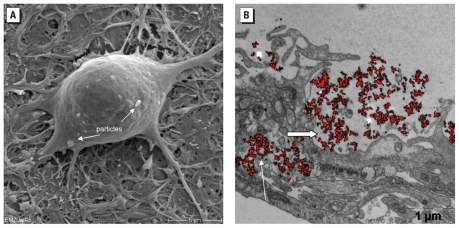
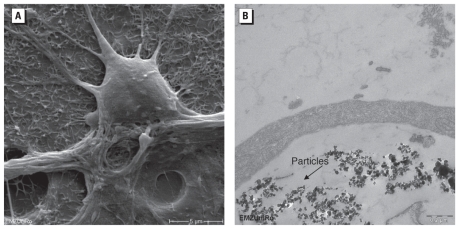
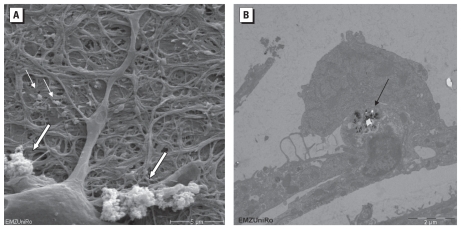
OBJECTIVES/METHODS: We investigated the acute electrophysiological effects of carbon black (CB), hematite (Fe2O3), and titanium dioxide (TiO2) NPs in primary murine cortical networks on microelectrode array (MEA) neurochips. Uptake of NPs was studied by transmission electron microscopy (TEM), and intracellular formation of reactive oxygen species (ROS) was studied by flow cytometry.
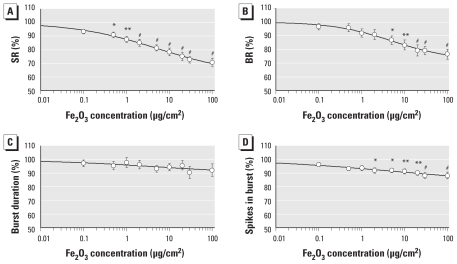
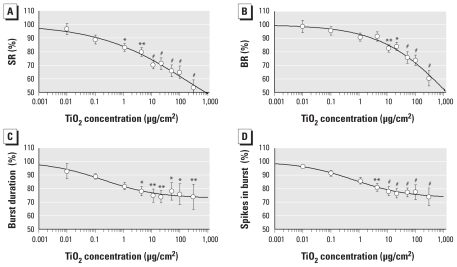
The multiparametric assessment of electrical activity changes caused by the NPs revealed an NP-specific and concentration-dependent inhibition of the firing patterns. The number of action potentials and the frequency of their patterns (spike and burst rates) showed a significant particle-dependent decrease and significant differences in potency. Further, we detected the uptake of CB, Fe2O3, and TiO2 into glial cells and neurons by TEM. Additionally, 24 hr exposure to TiO2 NPs caused intracellular formation of ROS in neuronal and glial cells, whereas exposure to CB and Fe2O3 NPs up to a concentration of 10 µg/cm2 did not induce significant changes in free radical levels.
NPs at low particle concentrations are able to exhibit a neurotoxic effect by disturbing the electrical activity of neuronal networks, but the underlying mechanisms depend on the particle type.
纳米材料在工业和日常生活中被广泛应用,但人们对其可能产生的健康影响知之甚少。因此,急需加强对纳米材料毒性的研究。有几项研究表明,纳米颗粒(直径<100nm)可以被转运到中枢神经系统;然而,纳米颗粒是否会干扰神经元的电活性尚未得到证实。
目的/方法:我们在微电极阵列(MEA)神经芯片上研究了碳黑(CB)、赤铁矿(Fe2O3)和二氧化钛(TiO2)纳米颗粒对原代鼠皮质网络的急性电生理影响。通过透射电子显微镜(TEM)研究了纳米颗粒的摄取,通过流式细胞术研究了细胞内活性氧(ROS)的形成。
纳米颗粒引起的电活动变化的多参数评估显示,纳米颗粒具有特定的浓度依赖性抑制放电模式的作用。动作电位的数量及其模式(尖峰和爆发率)的频率显示出明显的粒子依赖性下降和效力上的显著差异。此外,我们通过 TEM 检测到 CB、Fe2O3 和 TiO2 被摄取到神经胶质细胞和神经元中。此外,24 小时暴露于 TiO2 纳米颗粒会导致神经元和神经胶质细胞内形成 ROS,而暴露于 CB 和 Fe2O3 纳米颗粒至 10μg/cm2 的浓度不会导致自由基水平发生显著变化。
低浓度的纳米颗粒能够通过干扰神经元网络的电活动表现出神经毒性作用,但潜在的机制取决于颗粒类型。