CNRS, UMR 7194, Département de Préhistoire, Muséum national d'histoire naturelle, Paris, France.
PLoS One. 2011;7(1):e29581. doi: 10.1371/journal.pone.0029581. Epub 2012 Jan 5.
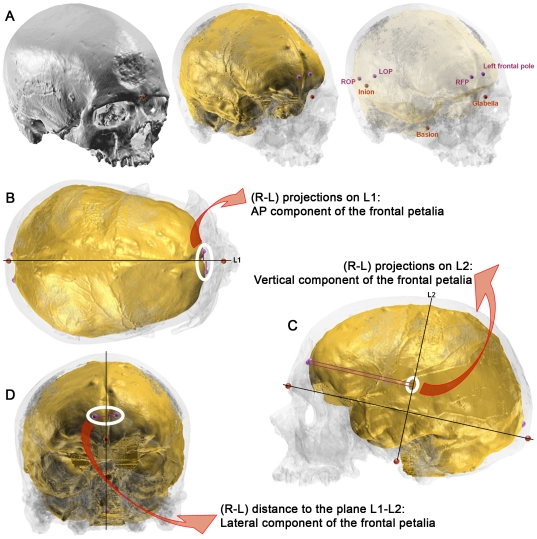
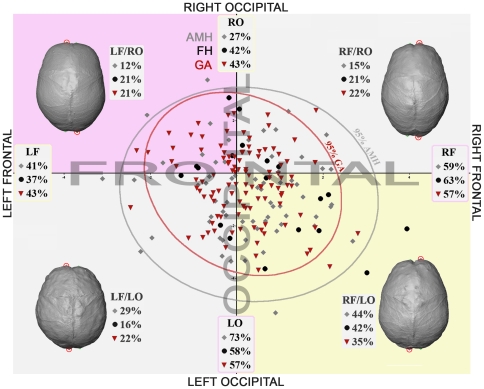
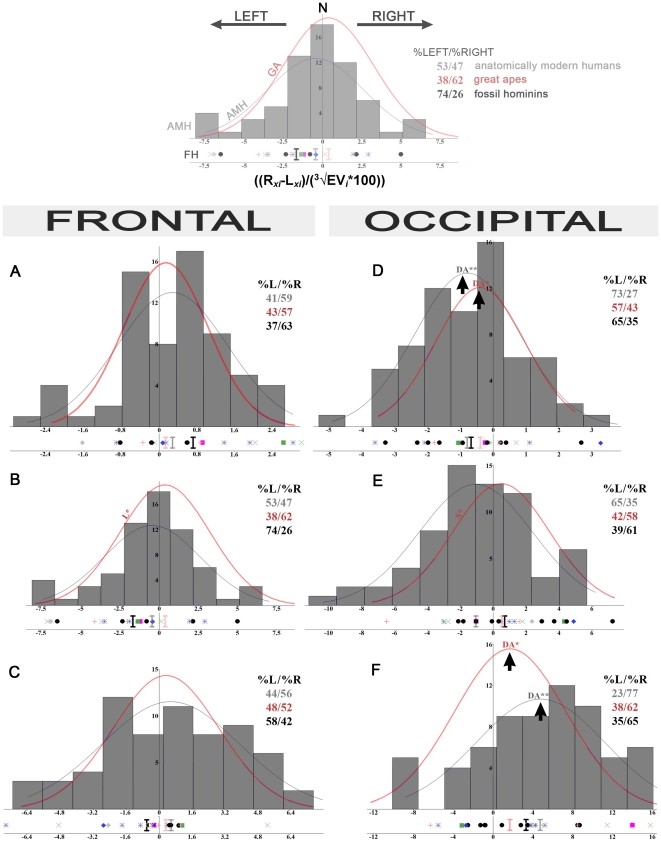
Anatomical asymmetries of the human brain are a topic of major interest because of their link with handedness and cognitive functions. Their emergence and occurrence have been extensively explored in human fossil records to document the evolution of brain capacities and behaviour. We quantified for the first time antero-posterior endocranial shape asymmetries in large samples of great apes, modern humans and fossil hominins through analysis of "virtual" 3D models of skull and endocranial cavity and we statistically test for departures from symmetry. Once based on continuous variables, we show that the analysis of these brain asymmetries gives original results that build upon previous analysis based on discrete traits. In particular, it emerges that the degree of petalial asymmetries differs between great apes and hominins without modification of their pattern. We indeed demonstrate the presence of shape asymmetries in great apes, with a pattern similar to modern humans but with a lower variation and a lower degree of fluctuating asymmetry. More importantly, variations in the position of the frontal and occipital poles on the right and left hemispheres would be expected to show some degree of antisymmetry when population distribution is considered, but the observed pattern of variation among the samples is related to fluctuating asymmetry for most of the components of the petalias. Moreover, the presence of a common pattern of significant directional asymmetry for two components of the petalias in hominids implicates that the observed traits were probably inherited from the last common ancestor of extant African great apes and Homo sapiens.These results also have important implications for the possible relationships between endocranial shape asymmetries and functional capacities in hominins. It emphasizes the uncoupling between lateralized activities, some of them well probably distinctive to Homo, and large-scale cerebral lateralization itself, which is not unique to Homo.
人类大脑的解剖学不对称性是一个备受关注的话题,因为它们与惯用手和认知功能有关。为了记录大脑容量和行为的进化,人们在人类化石记录中广泛探索了它们的出现和发生。我们首次通过对颅骨和颅腔的“虚拟”3D 模型进行分析,在大量的大型猿类、现代人类和化石原始人中量化了前后端内颅形状的不对称性,并对对称性的偏离进行了统计检验。一旦基于连续变量,我们就会发现,这些大脑不对称性的分析会产生基于离散特征的先前分析所无法得出的原始结果。特别是,结果表明,在不改变其模式的情况下,花瓣不对称程度在大型猿类和原始人之间有所不同。实际上,我们证明了大型猿类存在形状不对称性,其模式与现代人类相似,但变化较小,波动不对称性较低。更重要的是,当考虑种群分布时,左右半球额极和枕极位置的变化预计会表现出一定程度的反对称性,但观察到的样本变异模式与大多数花瓣成分的波动不对称性有关。此外,在人科动物中,两个花瓣成分存在共同的显著定向不对称模式,这表明观察到的特征可能是从现存非洲大猿和智人最后共同祖先那里遗传下来的。这些结果对于内颅形状不对称性与原始人类功能能力之间可能存在的关系也具有重要意义。这强调了侧化活动(其中一些可能是人类特有的)与大脑大规模侧化本身之间的不耦合,而大脑大规模侧化本身并不是人类所特有的。