Department of Human Evolution, Max Planck Institute for Evolutionary Anthropology, Leipzig, Germany.
Collège de France, 11 Place Marcelin Berthelot, 75005 Paris, France.
Sci Adv. 2020 Feb 14;6(7):eaax9935. doi: 10.1126/sciadv.aax9935. eCollection 2020 Feb.
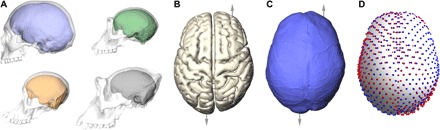
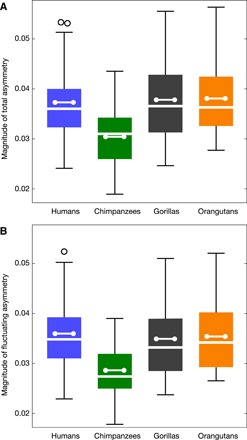
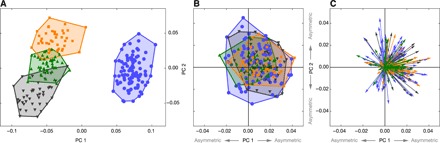
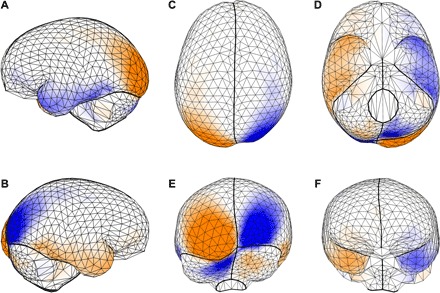
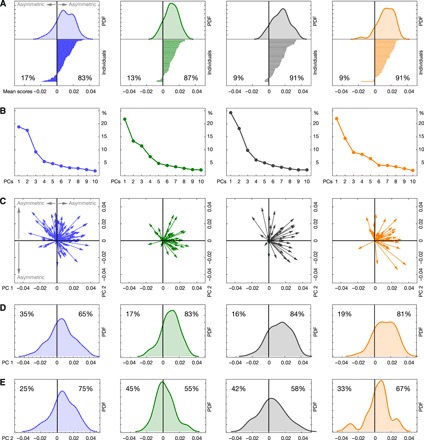
Brain lateralization is commonly interpreted as crucial for human brain function and cognition. However, as comparative studies among primates are rare, it is not known which aspects of lateralization are really uniquely human. Here, we quantify both pattern and magnitude of brain shape asymmetry based on endocranial imprints of the braincase in humans, chimpanzees, gorillas, and orangutans. Like previous studies, we found that humans were more asymmetric than chimpanzees, however so were gorillas and orangutans, highlighting the need to broaden the comparative framework for interpretation. We found that the average spatial asymmetry pattern, previously considered to be uniquely human, was shared among humans and apes. In humans, however, it was less directed, and different local asymmetries were less correlated. We, thus, found human asymmetry to be much more variable compared with that of apes. These findings likely reflect increased functional and developmental modularization of the human brain.
大脑偏侧性通常被解释为对人类大脑功能和认知至关重要。然而,由于灵长类动物之间的比较研究很少,因此尚不清楚哪些偏侧性方面是真正人类特有的。在这里,我们根据人类、黑猩猩、大猩猩和猩猩的脑壳内印痕,定量了大脑形状不对称的模式和幅度。与之前的研究一样,我们发现人类比黑猩猩更不对称,但大猩猩和猩猩也是如此,这突出表明需要扩大解释的比较框架。我们发现,以前被认为是人类特有的平均空间不对称模式在人类和类人猿中是共享的。然而,在人类中,它的方向性更弱,并且不同的局部不对称性相关性更低。因此,与类人猿相比,我们发现人类的不对称性变化更大。这些发现可能反映了人类大脑功能和发育模块化的增加。