Cardiovascular Institute & Fuwai Hospital, Chinese Academy of Medical Sciences, Peking Union Medical College, Beijing, China.
J Epidemiol. 2012;22(2):123-9. doi: 10.2188/jea.je20100175. Epub 2012 Jan 14.
We investigated the effects of marital status and education on the risk of acute myocardial infarction (AMI) in a large-scale case-control study in China.
This study was part of the INTER-HEART China case-control study. The main outcome measure was first AMI. Incident cases of AMI and control patients with no past history of heart disease were recruited. Controls were matching by age (±5 years) and sex. Marital status was combined into 2 categories: single and not single. Education level was classified into 2 categories: 8 years or less and more than 8 years.
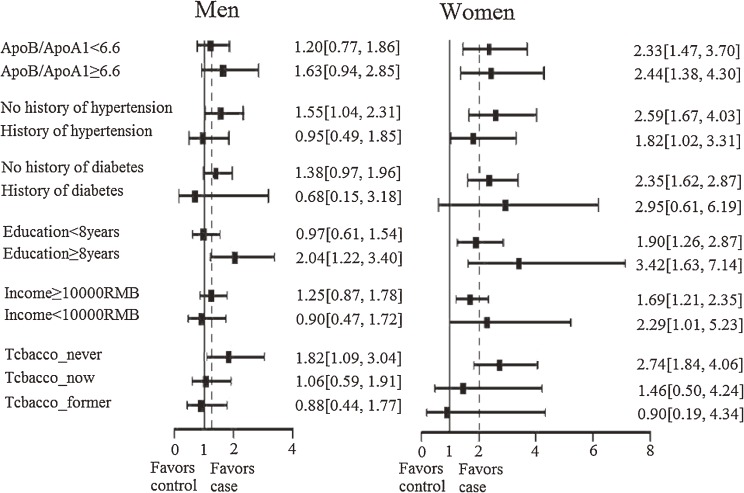
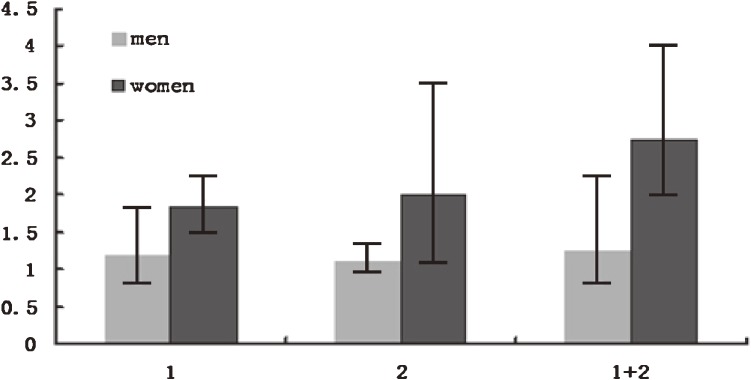
From 1999 to 2002, we recruited 2909 cases and 2947 controls from 17 cities. After adjustment for age, sex, BMI, psychosocial factors, lifestyle, other factors, and mutually for other risk factors, the odds ratio (OR) for AMI associated with being single was 1.51 (95% confidence interval: 1.18-1.93) overall, 1.19 (0.84-1.68; P = 0.072) in men and 2.00 (1.39-2.86; P < 0.0001) in women. The interaction of sex and marital status was statistically significant (P = 0.045). Compared with a high education level, a low education level increased the risk of AMI (1.45, 1.26-1.67); the odds ratios in men and women were 1.29 (1.09-1.52) and 1.55 (1.16-2.08), respectively. Single women with a low education level had a high risk of AMI (2.95, 1.99-4.37).
Being single was consistently associated with an increased risk for AMI, particularly in women. In addition, as compared with high education level, low education level was associated with a higher risk of AMI in both men and women.
我们在中国的一项大规模病例对照研究中,调查了婚姻状况和教育对急性心肌梗死(AMI)风险的影响。
这项研究是 INTER-HEART 中国病例对照研究的一部分。主要观察指标是首次 AMI。我们招募了 AMI 发病病例和无心脏病既往史的对照患者。对照患者按年龄(±5 岁)和性别进行匹配。婚姻状况分为两类:单身和非单身。教育程度分为两类:8 年及以下和超过 8 年。
2002 年从 1999 年至,我们从 17 个城市招募了 2909 例病例和 2947 例对照。在调整年龄、性别、BMI、心理社会因素、生活方式、其他因素以及相互调整其他危险因素后,单身与 AMI 相关的比值比(OR)总体为 1.51(95%置信区间:1.18-1.93),男性为 1.19(0.84-1.68;P=0.072),女性为 2.00(1.39-2.86;P<0.0001)。性别和婚姻状况之间的交互作用具有统计学意义(P=0.045)。与高教育程度相比,低教育程度增加了 AMI 的风险(1.45,1.26-1.67);男性和女性的比值比分别为 1.29(1.09-1.52)和 1.55(1.16-2.08)。低教育程度的单身女性发生 AMI 的风险较高(2.95,1.99-4.37)。
单身与 AMI 风险增加有关,特别是在女性中。此外,与高教育程度相比,低教育程度与男性和女性的 AMI 风险增加相关。