Laboratório de AIDS & Imunologia Molecular, Instituto Oswaldo Cruz, Rio de Janeiro, Brazil.
Virol J. 2012 Jan 16;9:19. doi: 10.1186/1743-422X-9-19.
Molecular epidemiological studies of HIV-1 in South America have revealed the occurrence of subtypes B, F1 and BF1 recombinants. Even so, little information concerning the HIV-1 molecular epidemiology in Bolivia is available. In this study we performed phylogenetic analyses from samples collected in Bolivia at two different points in time over a 10 year span. We analyzed these samples to estimate the trends in the HIV subtype and recombinant forms over time.
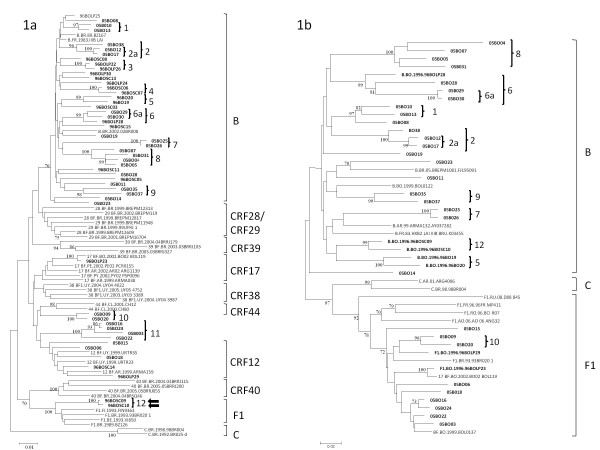
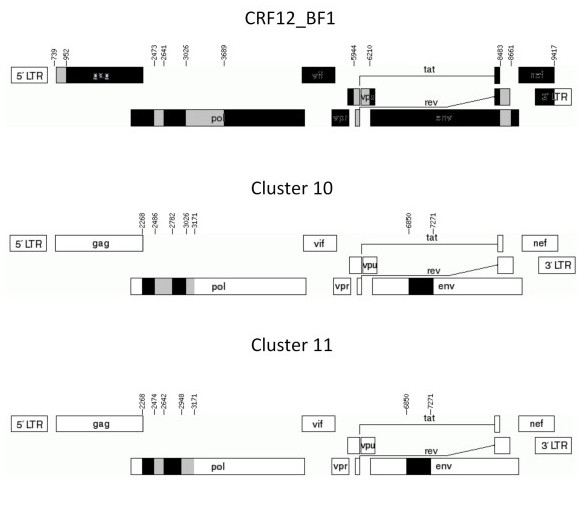
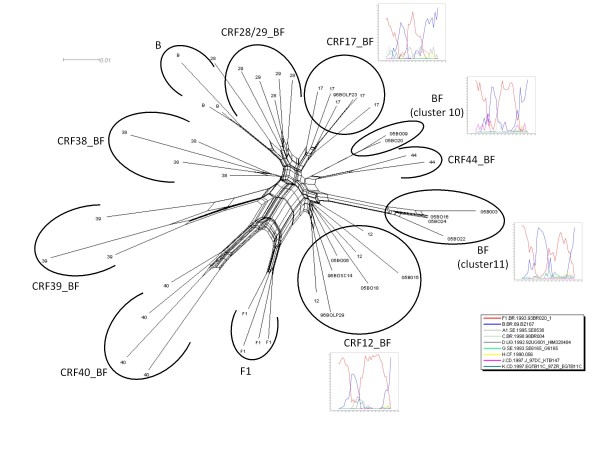
Fifty one HIV-1 positive samples were collected in Bolivia over two distinct periods (1996 and 2005). These samples were genetically characterized based on partial pol protease/reverse transcriptase (pr/rt) and env regions. Alignment and neighbor-joining (NJ) phylogenetic analyses were established from partial env (n = 37) and all pol sequences using Mega 4. The remaining 14 env sequences from 1996 were previously characterized based on HMA-env (Heteroduplex mobility assay). The Simplot v.3.5.1 program was used to verify intragenic recombination, and SplitsTree 4.0 was employed to confirm the phylogenetic relationship of the BF1 recombinant samples.
Phylogenetic analysis of both env and pol regions confirmed the predominance of "pure" subtype B (72.5%) samples circulating in Bolivia and revealed a high prevalence of BF1 genotypes (27.5%). Eleven out of 14 BF1 recombinants displayed a mosaic structure identical or similar to that described for the CRF12_BF variant, one sample was classified as CRF17_BF, and two others were F1pol/Benv. No "pure" HIV-1 subtype F1 or B" variant of subtype B was detected in the present study. Of note, samples characterized as CRF12_BF-related were depicted only in 2005.
HIV-1 genetic diversity in Bolivia is mostly driven by subtype B followed by BF1 recombinant strains from the CRF12_BF "family". No significant temporal changes were detected between the mid-1990s and the mid-2000s for subtype B (76.2% vs 70.0%) or BF1 recombinant (23.8% vs 30.0%) samples from Bolivia.
在南美洲进行的 HIV-1 分子流行病学研究显示,存在亚型 B、F1 和 BF1 重组体。即便如此,关于玻利维亚 HIV-1 分子流行病学的信息仍然很少。在这项研究中,我们对在玻利维亚两个不同时间点采集的样本进行了系统发育分析,跨度为 10 年。我们分析这些样本以估计 HIV 亚型和重组形式随时间的变化趋势。
在玻利维亚共收集了 51 份 HIV-1 阳性样本,分为两个不同时期(1996 年和 2005 年)。这些样本基于部分 pol 蛋白酶/逆转录酶(pr/rt)和 env 区进行了基因特征分析。使用 Mega 4 对部分 env(n = 37)和所有 pol 序列进行了对齐和邻接法(NJ)系统发育分析。来自 1996 年的其余 14 个 env 序列之前基于 HMA-env(异源双链迁移率分析)进行了特征分析。Simplot v.3.5.1 程序用于验证基因内重组,而 SplitsTree 4.0 用于确认 BF1 重组样本的系统发育关系。
env 和 pol 区域的系统发育分析均证实了在玻利维亚流行的“纯”亚型 B(72.5%)样本占主导地位,并显示出 BF1 基因型的高流行率(27.5%)。14 个 BF1 重组体中的 11 个显示出与 CRF12_BF 变体相同或相似的镶嵌结构,一个样本被归类为 CRF17_BF,另外两个是 F1pol/Benv。本研究未检测到“纯”HIV-1 亚型 F1 或 B“变体 B。值得注意的是,被描述为与 CRF12_BF 相关的样本仅在 2005 年出现。
玻利维亚的 HIV-1 遗传多样性主要由亚型 B 驱动,其次是来自 CRF12_BF“家族”的 BF1 重组株。在 1990 年代中期和 2000 年代中期,玻利维亚的亚型 B(76.2%对 70.0%)或 BF1 重组体(23.8%对 30.0%)样本未检测到明显的时间变化。