Laboratório de AIDS & Imunologia Molecular, Instituto Oswaldo Cruz-FIOCRUZ, Rio de Janeiro, Brazil.
Retrovirology. 2010 Mar 22;7:22. doi: 10.1186/1742-4690-7-22.
Although HIV-1 CRF12_BF and CRF38_BF are two epidemiologically important recombinant lineages circulating in Argentina and Uruguay, little is known about their population dynamics.
A total of 120 "CRF12_BF-like" and 20 "CRF38_BF-like" pol recombinant sequences collected in Argentina and Uruguay from 1997 to 2009 were subjected to phylogenetic and Bayesian coalescent-based analyses to estimate evolutionary and demographic parameters.
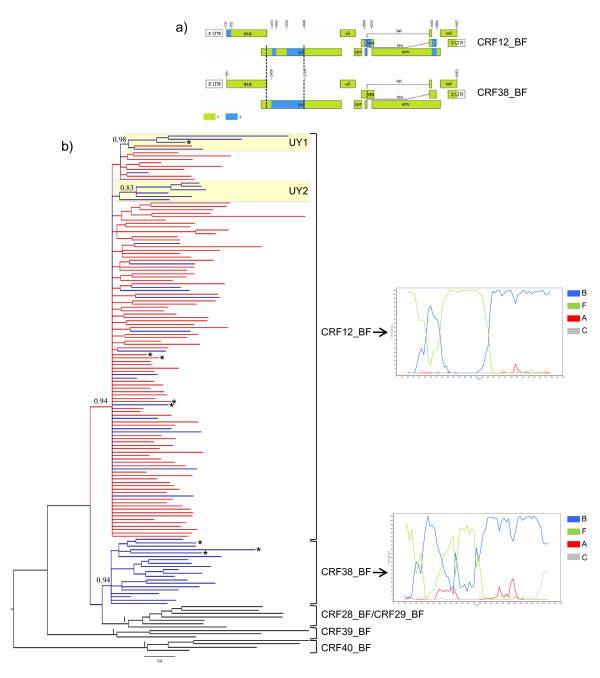
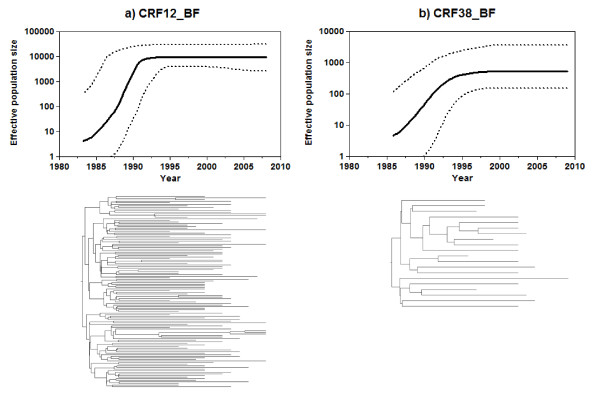
Phylogenetic analyses revealed that CRF12_BF viruses from Argentina and Uruguay constitute a single epidemic with multiple genetic exchanges among countries; whereas circulation of the CRF38_BF seems to be confined to Uruguay. The mean estimated substitution rate of CRF12_BF at pol gene (2.5 x 10⁻³ substitutions/site/year) was similar to that previously described for subtype B. According to our estimates, CRF12_BF and CRF38_BF originated at 1983 (1978-1988) and 1986 (1981-1990), respectively. After their emergence, the CRF12_BF and CRF38_BF epidemics seem to have experienced a period of rapid expansion with initial growth rates of around 1.2 year-1 and 0.9 year-1, respectively. Later, the rate of spread of these CRFs_BF seems to have slowed down since the mid-1990s.
Our results suggest that CRF12_BF and CRF38_BF viruses were generated during the 1980s, shortly after the estimated introduction of subtype F1 in South America (~1975-1980). After an initial phase of fast exponential expansion, the rate of spread of both CRFs_BF epidemics seems to have slowed down, thereby following a demographic pattern that resembles those previously reported for the HIV-1 epidemics in Brazil, USA, and Western Europe.
尽管 HIV-1 CRF12_BF 和 CRF38_BF 是在阿根廷和乌拉圭流行的两种重要重组谱系,但人们对它们的种群动态知之甚少。
对 1997 年至 2009 年在阿根廷和乌拉圭收集的 120 个“CRF12_BF 样”和 20 个“CRF38_BF 样”pol 重组序列进行系统发育和贝叶斯 coalescent 分析,以估计进化和人口统计学参数。
系统发育分析显示,来自阿根廷和乌拉圭的 CRF12_BF 病毒构成了一个单一的流行疫情,各国之间存在多种基因交换;而 CRF38_BF 的传播似乎仅限于乌拉圭。pol 基因中 CRF12_BF 的估计平均替换率(2.5×10⁻³ 替换/位点/年)与之前描述的 B 亚型相似。根据我们的估计,CRF12_BF 和 CRF38_BF 分别于 1983 年(1978-1988 年)和 1986 年(1981-1990 年)起源。出现后,CRF12_BF 和 CRF38_BF 疫情似乎经历了快速扩张期,初始增长率分别约为 1.2 年-1 和 0.9 年-1。此后,自 20 世纪 90 年代中期以来,这些 CRF_BF 的传播速度似乎有所放缓。
我们的研究结果表明,CRF12_BF 和 CRF38_BF 病毒是在 20 世纪 80 年代生成的,就在估计的 F1 亚型在南美洲传播(约 1975-1980 年)之后。在快速指数扩张的初始阶段之后,两种 CRFs_BF 流行疫情的传播速度似乎有所放缓,从而遵循了类似于之前在巴西、美国和西欧报道的 HIV-1 流行疫情的人口统计学模式。