Department of Physiology, College of Medicine, University of Dammam, Dammam, Saudi Arabia.
Diabetes Metab Syndr Obes. 2011;4:377-84. doi: 10.2147/DMSO.S24159. Epub 2011 Nov 22.
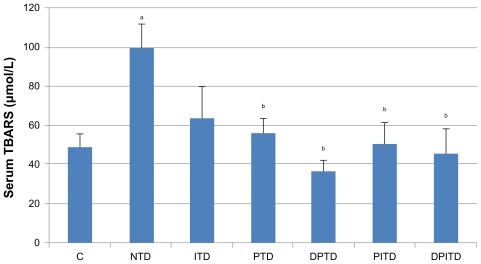
The aim of the study was to explore the possibility that propolis can control diabetes mellitus and prevent diabetic osteopathy in rats. The study compared 60 streptozotocin (STZ)-induced diabetic rats, with ten nondiabetic rats used as a negative control. The experimental design comprised seven groups (n = 10 rats per group): (1) nondiabetic, used as a negative control; (2) nontreated, used as a positive control; (3) treated with insulin alone; (4) treated with a single dose of propolis alone; (5) treated with a double dose of propolis; (6) treated with insulin and a single dose of propolis; and (7) treated with insulin and a double dose of propolis. After 6 weeks of treatment, the rats were sacrificed. Ratios of femur ash to femur weight and of femur weight to body weight (FW/BW) were calculated and calcium (Ca), phosphorus (P), and magnesium (Mg) concentrations in femur ash were estimated and analyzed. Fasting blood glucose (FBG), plasma insulin and glucagon, serum thiobarbituric acid reactive substances (TBARS), plasma parathyroid hormone (PTH), and calcitonin levels were also estimated and analyzed. There was significant reduction in FBG in all diabetic treated rats. Similarly, higher plasma insulin levels were observed in diabetic rats treated with propolis and insulin than in nontreated diabetic rats, although plasma insulin was not comparatively higher in diabetic rats treated with insulin alone. Serum TBARS was significantly lower in the propolis treated rats than the diabetic nontreated rats. No differences in PTH and calcitonin levels were observed among treatment groups. The FW/BW ratio was significantly higher in diabetic treated groups than in control groups. Furthermore, diabetic rats treated with propolis and insulin had significantly higher Ca, P, and Mg concentrations in femoral ash than nontreated diabetic rats and diabetic rats treated with insulin alone. In conclusion, propolis has a remarkable effect on glucose homeostasis and bone mineralization.
这项研究的目的是探索蜂胶是否能控制糖尿病并预防糖尿病大鼠的骨病。研究比较了 60 只链脲佐菌素(STZ)诱导的糖尿病大鼠,10 只非糖尿病大鼠作为阴性对照。实验设计包括 7 个组(每组 10 只大鼠):(1)非糖尿病组,作为阴性对照;(2)未治疗组,作为阳性对照;(3)单独用胰岛素治疗组;(4)单独用蜂胶治疗组;(5)用双倍剂量蜂胶治疗组;(6)用胰岛素和蜂胶治疗组;(7)用胰岛素和双倍剂量蜂胶治疗组。治疗 6 周后,处死大鼠。计算股骨灰分与股骨重量的比值(FW/BW)以及股骨灰分中钙(Ca)、磷(P)和镁(Mg)的浓度,并进行分析。还测定了空腹血糖(FBG)、血浆胰岛素和胰高血糖素、血清丙二醛(TBARS)、血浆甲状旁腺激素(PTH)和降钙素水平,并进行了分析。所有糖尿病治疗大鼠的 FBG 均显著降低。同样,用蜂胶和胰岛素治疗的糖尿病大鼠的血浆胰岛素水平也高于未治疗的糖尿病大鼠,尽管单独用胰岛素治疗的糖尿病大鼠的血浆胰岛素水平并没有更高。用蜂胶治疗的大鼠的血清 TBARS 明显低于未治疗的糖尿病大鼠。各组间 PTH 和降钙素水平无差异。与对照组相比,FW/BW 比值在糖尿病治疗组显著升高。此外,用蜂胶和胰岛素治疗的糖尿病大鼠的股骨灰分中的 Ca、P 和 Mg 浓度明显高于未治疗的糖尿病大鼠和单独用胰岛素治疗的糖尿病大鼠。综上所述,蜂胶对葡萄糖稳态和骨矿化有显著影响。