Parasitology Department, Noguchi Memorial Institute for Medical Research, University of Ghana, Legon-Accra, Ghana.
BMC Infect Dis. 2012 Jan 18;12:8. doi: 10.1186/1471-2334-12-8.
Buruli ulcer (BU), a neglected tropical skin disease caused by Mycobacterium ulcerans, has been reported in over 30 countries worldwide and is highly endemic in rural West and Central Africa. The mode of transmission remains unknown and treatment is the only alternative to disease control. Early and effective treatment to prevent the morbid effects of the disease depends on early diagnosis; however, current diagnosis based on clinical presentation and microscopy has to be confirmed by PCR and other tests in reference laboratories. As such confirmed BU diagnosis is either late, inefficient, time consuming or very expensive, and there is the need for an early diagnosis tool at point of care facilities. In this paper we report on a simple, quick and inexpensive diagnostic test that could be used at point of care facilities, in resource-poor settings.
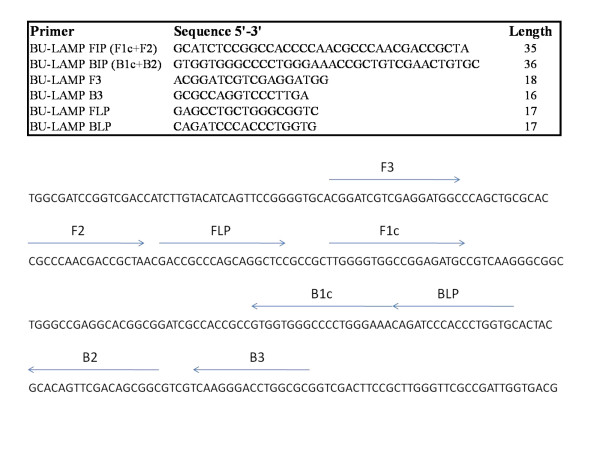
The methodology employed is based on the loop mediated isothermal amplification (LAMP) technique. Four sets of Primers, targeting the mycolactone encoding plasmid genome sequence of M. ulcerans were designed. The BU-LAMP assay was developed and tested on five M. ulcerans strains from patients in Ghana and two American Type Culture Control (ATCC) reference isolates; Ghana #970321 (D19F9) and Benin #990826 (D27D14). We also tested the assay on other closely related, mycolactone-producing mycobacterial strains; M. marinum 1218, M. marinum DL240490, M. liflandii and M. pseudoshotsii, as well as experimentally infected laboratory animal and clinical samples.
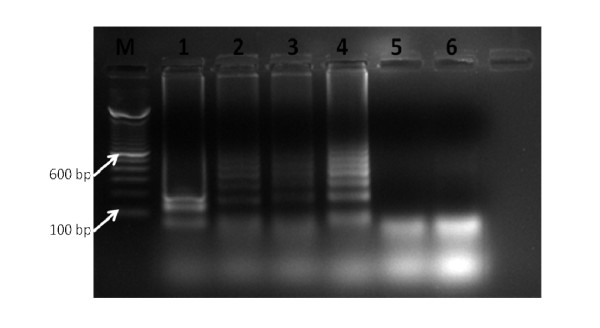
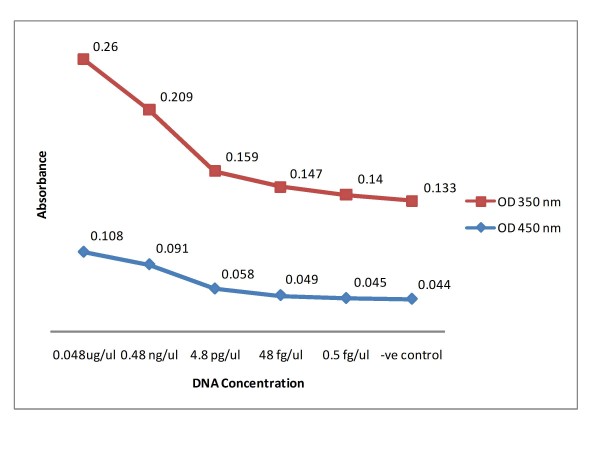
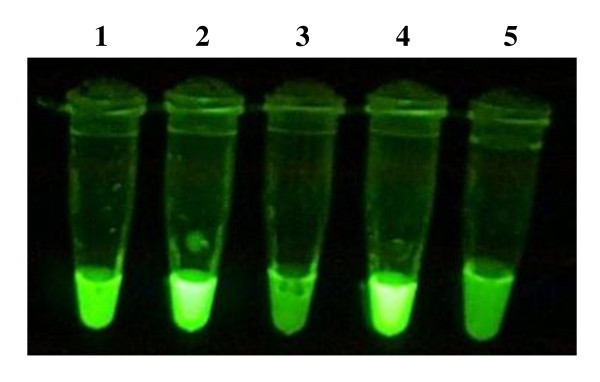
The results revealed a high specificity of the BU-LAMP assay for selectively detecting M. ulcerans. Compared to the conventional IS-2404 PCR, the new assay is cheaper and simpler and ten times more sensitive. Test results can be obtained within 1 hour.
This study indicates that the BU-LAMP assay could be suitable for early disease diagnosis and application in low-resource health facilities.
溃疡分枝杆菌(Mycobacterium ulcerans)引起的皮肤疾病Buruli 溃疡(BU)已在全球 30 多个国家报告,在西非和中非农村地区高度流行。传播方式仍然未知,治疗是控制疾病的唯一选择。早期和有效的治疗以预防疾病的不良影响取决于早期诊断;然而,目前基于临床症状和显微镜检查的诊断必须在参考实验室中通过 PCR 和其他测试进行确认。因此,BU 的确诊要么很晚,要么效率低下、耗时或非常昂贵,并且需要在护理点设施中使用早期诊断工具。在本文中,我们报告了一种简单、快速且廉价的诊断测试,可在资源匮乏的环境中在护理点设施中使用。
所采用的方法基于环介导等温扩增(LAMP)技术。设计了四组针对 M. ulcerans 菌的 mycolactone 编码质粒基因组序列的引物。开发了 BU-LAMP 检测方法,并在加纳的五株 M. ulcerans 菌株和两个美国典型培养物保藏中心(ATCC)参考分离株;加纳 #970321(D19F9)和贝宁 #990826(D27D14)上进行了测试。我们还在其他密切相关的产 mycolactone 分枝杆菌菌株;M. marinum 1218、M. marinum DL240490、M. liflandii 和 M. pseudoshotsii 以及经过实验感染的实验室动物和临床样本上测试了该检测方法。
结果表明,BU-LAMP 检测方法对选择性检测 M. ulcerans 具有很高的特异性。与传统的 IS-2404 PCR 相比,新检测方法更便宜、更简单,灵敏度提高了 10 倍。检测结果可在 1 小时内获得。
这项研究表明,BU-LAMP 检测方法可用于早期疾病诊断,并可在资源匮乏的卫生设施中应用。