Centro di Ricerca E. Menni, Fondazione Poliambulanza Istituto Ospedaliero, Brescia, Italy.
J Cell Mol Med. 2012 Sep;16(9):2208-18. doi: 10.1111/j.1582-4934.2012.01531.x.
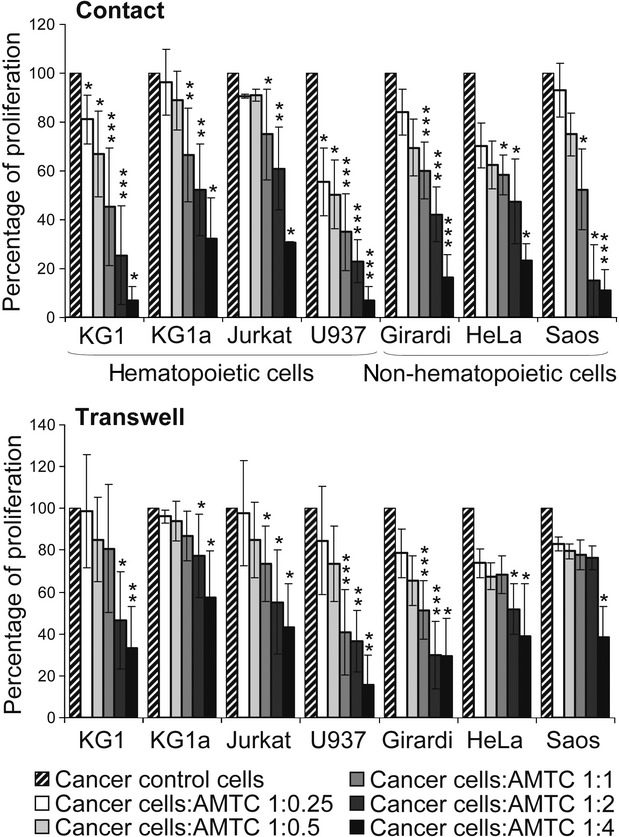
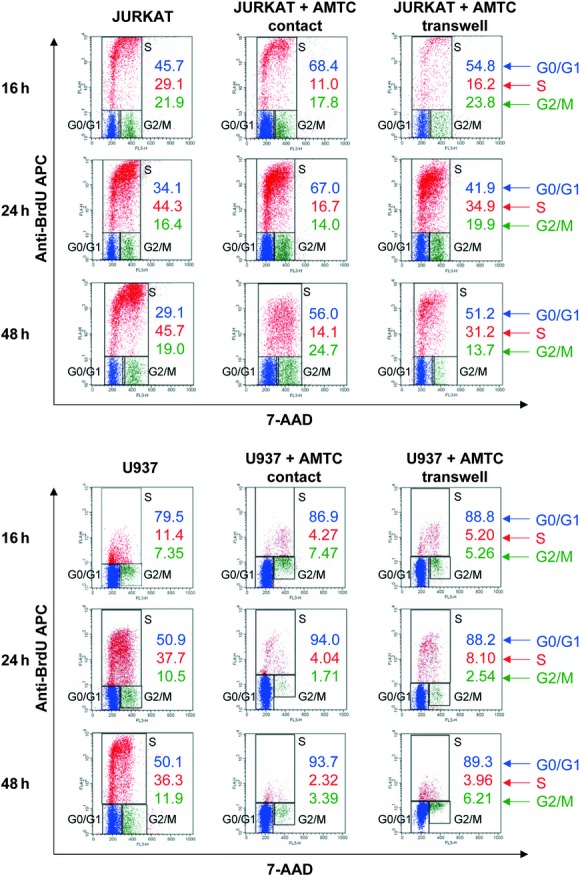
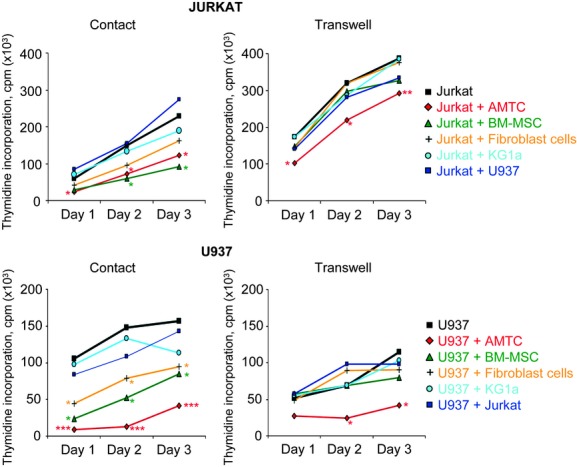
Cells derived from the amniotic foetal membrane of human term placenta have drawn particular attention mainly for their plasticity and immunological properties, which render them interesting for stem-cell research and cell-based therapeutic applications. In particular, we have previously demonstrated that amniotic mesenchymal tissue cells (AMTC) inhibit lymphocyte proliferation in vitro and suppress the generation and maturation of monocyte-derived dendritic cells. Here, we show that AMTC also significantly reduce the proliferation of cancer cell lines of haematopoietic and non-haematopoietic origin, in both cell-cell contact and transwell co-cultures, therefore suggesting the involvement of yet-unknown inhibitory soluble factor(s) in this 'cell growth restraint'. Importantly, we provide evidence that the anti-proliferative effect of AMTC is associated with induction of cell cycle arrest in G0/G1 phase. Gene expression analyses demonstrate that AMTC can down-regulate cancer cells' mRNA expression of genes associated with cell cycle progression, such as cyclins (cyclin D2, cyclin E1, cyclin H) and cyclin-dependent kinase (CDK4, CDK6 and CDK2), whilst they up-regulate cell cycle negative regulator such as p15 and p21, consistent with a block in G0/G1 phase with no progression to S phase. Taken together, these findings warrant further studies to investigate the applicability of these cells for controlling cancer cell proliferation in vivo.
源自人足月胎盘羊膜的细胞因其可塑性和免疫特性而备受关注,这使得它们成为干细胞研究和基于细胞的治疗应用的有趣对象。特别是,我们之前已经证明,羊膜间充质组织细胞(AMTC)在体外抑制淋巴细胞增殖,并抑制单核细胞来源的树突状细胞的生成和成熟。在这里,我们表明 AMTC 还可以显著减少造血和非造血来源的癌细胞系在细胞-细胞接触和 Transwell 共培养中的增殖,因此表明在这种“细胞生长抑制”中涉及未知的抑制性可溶性因子。重要的是,我们提供的证据表明,AMTC 的抗增殖作用与诱导细胞周期停滞在 G0/G1 期有关。基因表达分析表明,AMTC 可以下调与细胞周期进程相关的基因在癌细胞中的 mRNA 表达,例如细胞周期蛋白(cyclin D2、cyclin E1、cyclin H)和细胞周期蛋白依赖性激酶(CDK4、CDK6 和 CDK2),同时它们上调细胞周期负调节剂,如 p15 和 p21,与 G0/G1 期阻滞一致,没有进展到 S 期。总之,这些发现值得进一步研究,以调查这些细胞在体内控制癌细胞增殖的适用性。