Department of Laboratory Medicine, Nijmegen Institute for Infection, Inflammation and Immunity (N4i), Radboud University Nijmegen Medical Centre, Nijmegen, The Netherlands.
PLoS One. 2012;7(1):e29968. doi: 10.1371/journal.pone.0029968. Epub 2012 Jan 17.
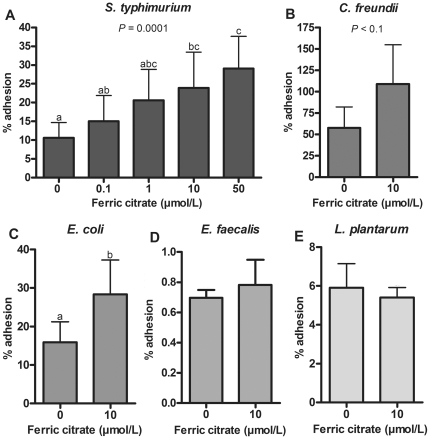
Recent trials have questioned the safety of untargeted oral iron supplementation in developing regions. Excess of luminal iron could select for enteric pathogens at the expense of beneficial commensals in the human gut microflora, thereby increasing the incidence of infectious diseases. The objective of the current study was to determine the effect of high iron availability on virulence traits of prevalent enteric pathogens at the host-microbe interface. A panel of enteric bacteria was cultured under iron-limiting conditions and in the presence of increasing concentrations of ferric citrate to assess the effect on bacterial growth, epithelial adhesion, invasion, translocation and epithelial damage in vitro. Translocation and epithelial integrity experiments were performed using a transwell system in which Caco-2 cells were allowed to differentiate to a tight epithelial monolayer mimicking the intestinal epithelial barrier. Growth of Salmonella typhimurium and other enteric pathogens was increased in response to iron. Adhesion of S. typhimurium to epithelial cells markedly increased when these bacteria were pre-incubated with increasing iron concentration (P = 0.0001), whereas this was not the case for the non-pathogenic Lactobacillus plantarum (P = 0.42). Cellular invasion and epithelial translocation of S. typhimurium followed the trend of increased adhesion. Epithelial damage was increased upon incubation with S. typhimurium or Citrobacter freundii that were pre-incubated under iron-rich conditions. In conclusion, our data fit with the consensus that oral iron supplementation is not without risk as iron could, in addition to inducing pathogenic overgrowth, also increase the virulence of prevalent enteric pathogens.
最近的试验对发展中地区靶向口服铁补充剂的安全性提出了质疑。过多的腔道铁可能会损害人类肠道微生物群中的有益共生体,从而选择肠道病原体,进而增加传染病的发病率。本研究的目的是确定高铁可用性对宿主-微生物界面流行肠道病原体毒力特性的影响。一组肠道细菌在铁限制条件下和柠檬酸铁浓度增加的情况下进行培养,以评估其对细菌生长、上皮黏附、侵袭、易位和体外上皮损伤的影响。使用 Transwell 系统进行易位和上皮完整性实验,其中 Caco-2 细胞被允许分化为紧密的上皮单层,模拟肠道上皮屏障。鼠伤寒沙门氏菌和其他肠道病原体的生长在铁的作用下增加。当这些细菌用递增的铁浓度预孵育时,与上皮细胞的黏附明显增加(P=0.0001),而非致病性植物乳杆菌(P=0.42)则不然。沙门氏菌的细胞侵袭和上皮易位也遵循黏附增加的趋势。用在富铁条件下预孵育的鼠伤寒沙门氏菌或弗氏柠檬酸杆菌孵育会增加上皮损伤。总之,我们的数据符合这样一种共识,即口服铁补充剂并非没有风险,因为铁除了诱导致病性过度生长外,还可能增加流行肠道病原体的毒力。