Prieto Esther Alonso, Caharel Stéphanie, Henson Richard, Rossion Bruno
Institute of Psychology, Institute of Neuroscience, Center for Cognitive and Systems Neuroscience, Université Catholique de Louvain Louvain-la-Neuve, Belgium.
Front Hum Neurosci. 2011 Dec 5;5:138. doi: 10.3389/fnhum.2011.00138. eCollection 2011.
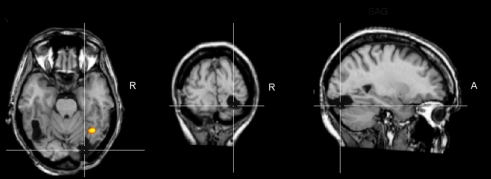
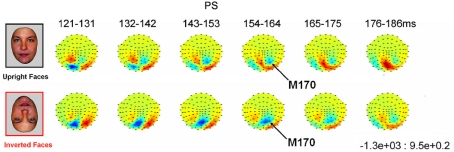
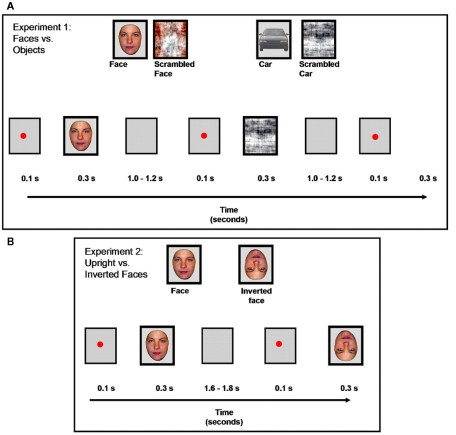
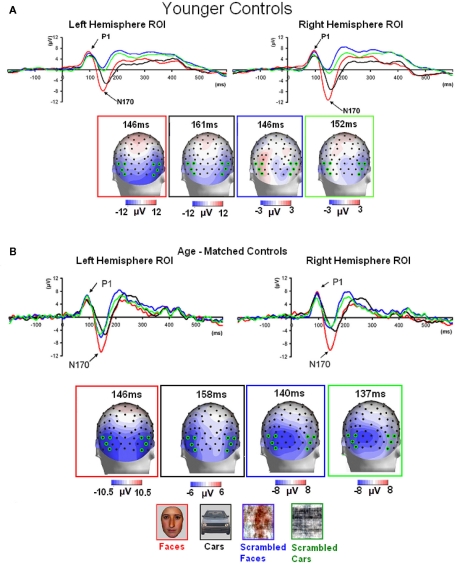
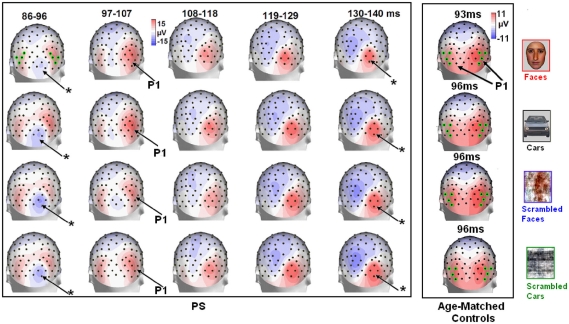
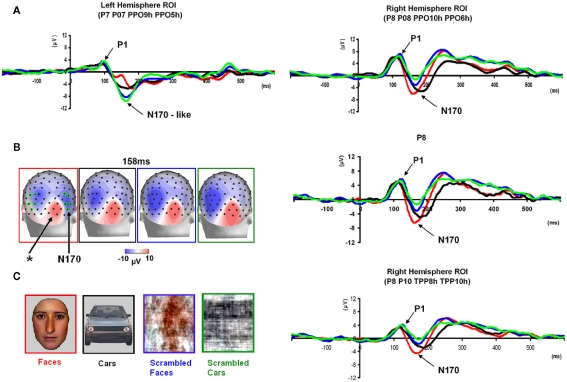
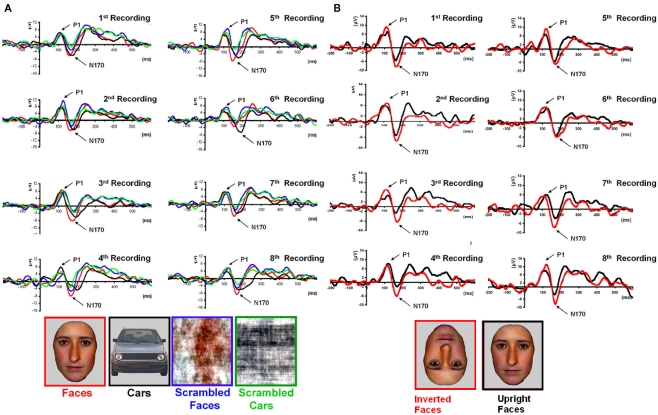
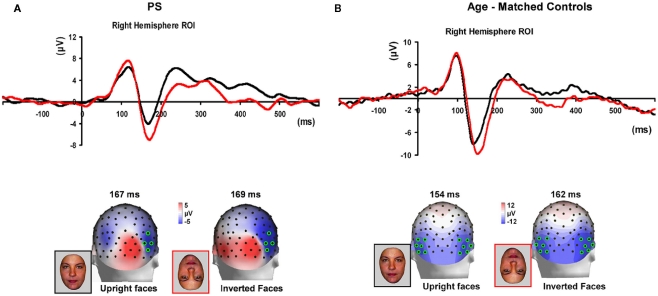
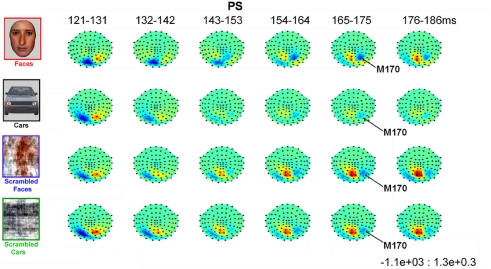
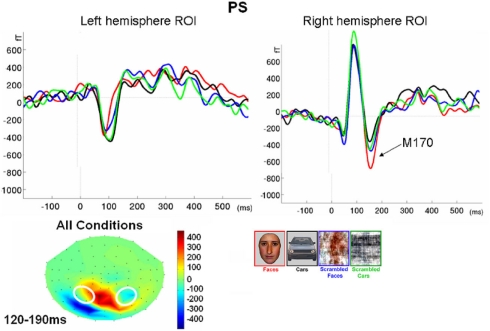
Compared to objects, pictures of faces elicit a larger early electromagnetic response at occipito-temporal sites on the human scalp, with an onset of 130 ms and a peak at about 170 ms. This N170 face effect is larger in the right than the left hemisphere and has been associated with the early categorization of the stimulus as a face. Here we tested whether this effect can be observed in the absence of some of the visual areas showing a preferential response to faces as typically identified in neuroimaging. Event-related potentials were recorded in response to faces, cars, and their phase-scrambled versions in a well-known brain-damaged case of prosopagnosia (PS). Despite the patient's right inferior occipital gyrus lesion encompassing the most posterior cortical area showing preferential response to faces ("occipital face area"), we identified an early face-sensitive component over the right occipito-temporal hemisphere of the patient that was identified as the N170. A second experiment supported this conclusion, showing the typical N170 increase of latency and amplitude in response to inverted faces. In contrast, there was no N170 in the left hemisphere, where PS has a lesion to the middle fusiform gyrus and shows no evidence of face-preferential response in neuroimaging (no left "fusiform face area"). These results were replicated by a magnetoencephalographic investigation of the patient, disclosing a M170 component only in the right hemisphere. These observations indicate that face-preferential activation in the inferior occipital cortex is not necessary to elicit early visual responses associated with face perception (N170/M170) on the human scalp. These results further suggest that when the right inferior occipital cortex is damaged, the integrity of the middle fusiform gyrus and/or the superior temporal sulcus - two areas showing face-preferential responses in the patient's right hemisphere - might be necessary to generate the N170 effect.
与物体相比,人脸图片在人类头皮枕颞部位会引发更大的早期电磁反应,起始时间为130毫秒,峰值出现在约170毫秒左右。这种N170人脸效应在右半球比左半球更大,并且与将刺激物早期归类为人脸有关。在这里,我们测试了在缺乏一些对人脸有优先反应的视觉区域(如神经影像学中通常所确定的)的情况下,是否能观察到这种效应。我们记录了一名著名的面孔失认症(PS)脑损伤患者对人脸、汽车及其相位打乱版本的事件相关电位。尽管患者右侧枕下回病变累及了对人脸显示优先反应的最靠后皮质区域(“枕叶人脸区”),但我们在患者右侧枕颞半球发现了一个早期的人脸敏感成分,被确定为N170。第二个实验支持了这一结论,显示出对倒置人脸反应时典型的N170潜伏期和振幅增加。相比之下,左半球没有N170,该患者左半球梭状回中部有病变,在神经影像学中没有显示出人脸优先反应的证据(没有左侧“梭状回人脸区”)。对该患者的脑磁图研究重复了这些结果,仅在右半球发现了M170成分。这些观察结果表明,枕叶下部皮质中的人脸优先激活对于在人类头皮上引发与人脸感知相关的早期视觉反应(N170/M170)并非必要。这些结果进一步表明,当右侧枕叶下部皮质受损时,梭状回中部和/或颞上沟的完整性——这两个区域在患者右半球显示出人脸优先反应——可能是产生N170效应所必需的。