• 文献检索
  • 文档翻译
  • 深度研究
  • 学术资讯
  • Suppr Zotero 插件Zotero 插件
  • 邀请有礼
  • 套餐&价格
  • 历史记录
应用&插件
Suppr Zotero 插件Zotero 插件浏览器插件Mac 客户端Windows 客户端微信小程序
定价
高级版会员购买积分包购买API积分包
服务
文献检索文档翻译深度研究API 文档MCP 服务
关于我们
关于 Suppr公司介绍联系我们用户协议隐私条款
关注我们

Suppr 超能文献

核心技术专利:CN118964589B侵权必究
粤ICP备2023148730 号-1Suppr @ 2026

文献检索

告别复杂PubMed语法,用中文像聊天一样搜索,搜遍4000万医学文献。AI智能推荐,让科研检索更轻松。

立即免费搜索

文件翻译

保留排版,准确专业,支持PDF/Word/PPT等文件格式,支持 12+语言互译。

免费翻译文档

深度研究

AI帮你快速写综述,25分钟生成高质量综述,智能提取关键信息,辅助科研写作。

立即免费体验

轻中度颈动脉狭窄对接受体外循环冠状动脉旁路移植术患者神经生理状态的影响。

The Influence of Low and Moderate Carotid Stenosis on Neurophysiologic Status of Patients Undergoing on-pump Coronary Artery Bypass Grafting.

作者信息

Trubnikova Olga, Tarasova Irina, Barbarash Olga

机构信息

Department of Multifocal Atherosclerosis, Research Institute for Complex Issues of Cardiovascular Diseases, Siberian Branch of the Russian Academy of Medical Sciences Kemerovo, Russian Federation.

出版信息

Front Neurol. 2012 Jan 18;3:1. doi: 10.3389/fneur.2012.00001. eCollection 2012.

DOI:10.3389/fneur.2012.00001
PMID:22279441
原文链接:https://pmc.ncbi.nlm.nih.gov/articles/PMC3260458/
Abstract

BACKGROUND

Significant (>70%) extracranial stenosis of the internal carotid artery (ICA) is a known risk factor for brain damage in patients with coronary heart disease (CHD) undergoing coronary artery bypass grafting (CABG). There is no clear evidence of the low and moderate ICA stenoses influence on the neurophysiologic status of patients after CABG. This work was aimed at studying the influence ICA stenoses (<50%) on the dynamics of neurophysiologic status in patients undergone CABG.

METHODS

We examined neurophysiologic functions and electroencephalograph in CHD patients (N = 45) aged from 45 to 70 years. All patients were divided into two groups: with ICA stenosis (n = 20) and without one (n = 25).

RESULTS

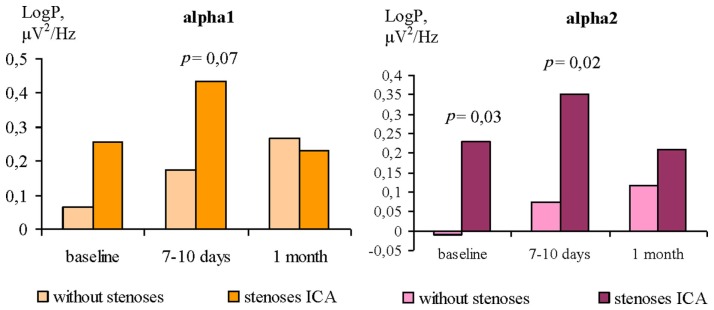
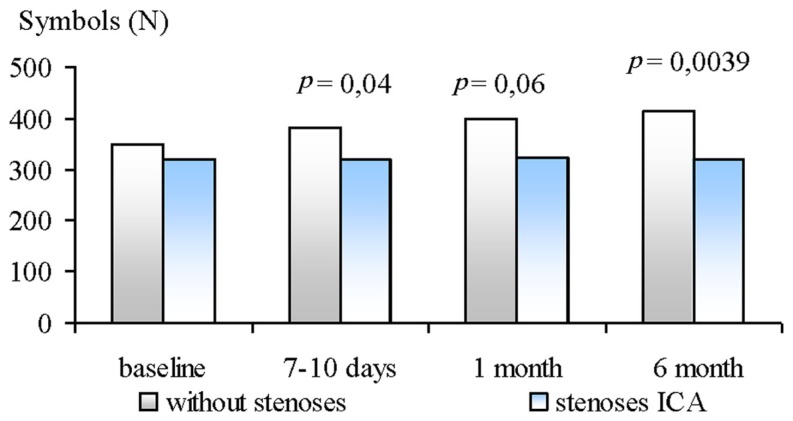
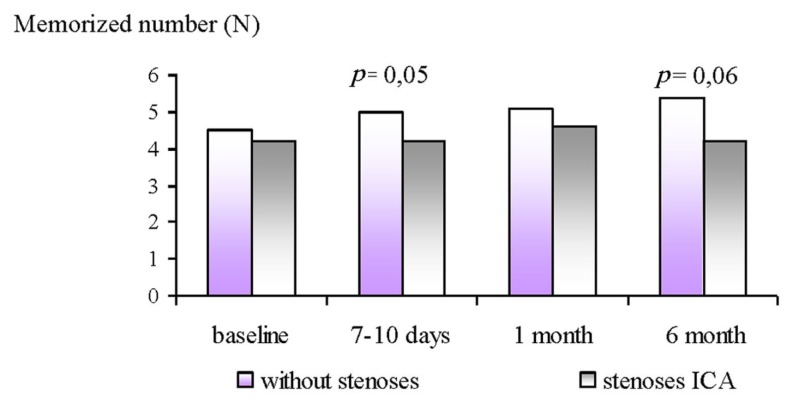
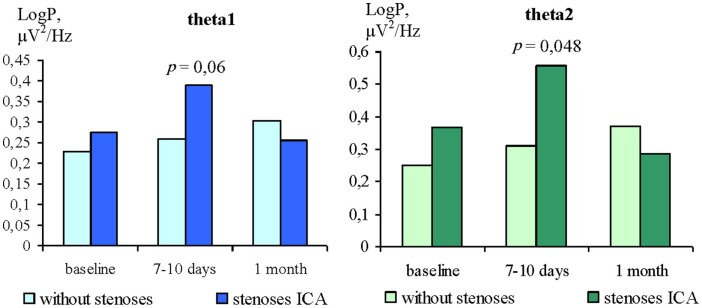
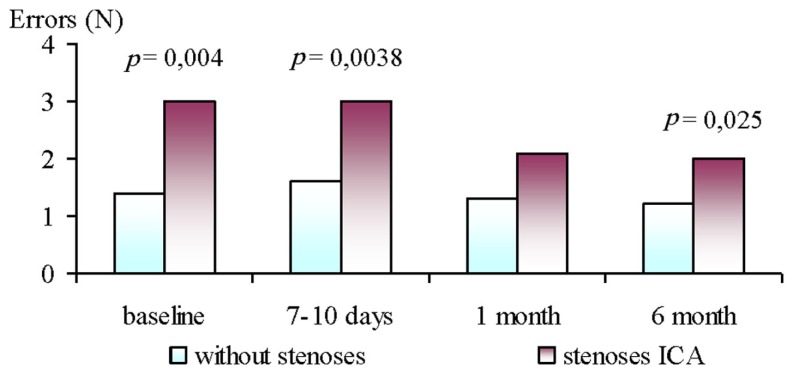
It was established that the group ICA stenosis had a negative dynamics of neurophysiologic status 6 months follow-up after CABG compared with patients without stenosis.

CONCLUSION

Our results suggest that the presence of low and moderate ICA stenosis is one of the factors affecting the neurophysiologic status of CHD patients. It has been assumed that the patients with ≤50% ICA stenoses constitute a high-risk group for cerebral complications after on-pump CABG.

摘要

背景

颈内动脉(ICA)颅外段严重狭窄(>70%)是冠心病(CHD)患者行冠状动脉旁路移植术(CABG)时脑损伤的已知危险因素。目前尚无明确证据表明ICA轻度和中度狭窄对CABG术后患者神经生理状态有影响。本研究旨在探讨ICA狭窄(<50%)对CABG术后患者神经生理状态动态变化的影响。

方法

我们对45至70岁的CHD患者(N = 45)进行了神经生理功能和脑电图检查。所有患者分为两组:有ICA狭窄组(n = 20)和无ICA狭窄组(n = 25)。

结果

与无狭窄患者相比,CABG术后6个月随访发现,ICA狭窄组患者神经生理状态呈负向动态变化。

结论

我们的结果表明,ICA轻度和中度狭窄是影响CHD患者神经生理状态的因素之一。据推测,ICA狭窄≤50%的患者是体外循环下CABG术后发生脑并发症的高危人群。
https://cdn.ncbi.nlm.nih.gov/pmc/blobs/34da/3260458/8275f68b1fc0/fneur-03-00001-g005.jpg
https://cdn.ncbi.nlm.nih.gov/pmc/blobs/34da/3260458/8ed18ff04a6c/fneur-03-00001-g001.jpg
https://cdn.ncbi.nlm.nih.gov/pmc/blobs/34da/3260458/bd7f0e98f761/fneur-03-00001-g002.jpg
https://cdn.ncbi.nlm.nih.gov/pmc/blobs/34da/3260458/64459247b1ca/fneur-03-00001-g003.jpg
https://cdn.ncbi.nlm.nih.gov/pmc/blobs/34da/3260458/ff99799873e2/fneur-03-00001-g004.jpg
https://cdn.ncbi.nlm.nih.gov/pmc/blobs/34da/3260458/8275f68b1fc0/fneur-03-00001-g005.jpg
https://cdn.ncbi.nlm.nih.gov/pmc/blobs/34da/3260458/8ed18ff04a6c/fneur-03-00001-g001.jpg
https://cdn.ncbi.nlm.nih.gov/pmc/blobs/34da/3260458/bd7f0e98f761/fneur-03-00001-g002.jpg
https://cdn.ncbi.nlm.nih.gov/pmc/blobs/34da/3260458/64459247b1ca/fneur-03-00001-g003.jpg
https://cdn.ncbi.nlm.nih.gov/pmc/blobs/34da/3260458/ff99799873e2/fneur-03-00001-g004.jpg
https://cdn.ncbi.nlm.nih.gov/pmc/blobs/34da/3260458/8275f68b1fc0/fneur-03-00001-g005.jpg

相似文献

1
The Influence of Low and Moderate Carotid Stenosis on Neurophysiologic Status of Patients Undergoing on-pump Coronary Artery Bypass Grafting.轻中度颈动脉狭窄对接受体外循环冠状动脉旁路移植术患者神经生理状态的影响。
Front Neurol. 2012 Jan 18;3:1. doi: 10.3389/fneur.2012.00001. eCollection 2012.
2
The impact of an occluded internal carotid artery on the mortality and morbidity of patients undergoing coronary artery bypass grafting.颈内动脉闭塞对接受冠状动脉旁路移植术患者死亡率和发病率的影响。
Am J Surg. 1999 Sep;178(3):201-5. doi: 10.1016/s0002-9610(99)00116-6.
3
Nonselective carotid artery ultrasound screening in patients undergoing coronary artery bypass grafting: Is it necessary?冠状动脉搭桥手术患者的非选择性颈动脉超声筛查:有必要吗?
J Thorac Cardiovasc Surg. 2016 Feb;151(2):402-8. doi: 10.1016/j.jtcvs.2015.09.108. Epub 2015 Oct 3.
4
[A role of carotid stenoses in the structure of early postoperative cognitive dysfunction in patients underwent coronary artery bypass grafting].[颈动脉狭窄在接受冠状动脉搭桥术患者术后早期认知功能障碍结构中的作用]
Zh Nevrol Psikhiatr Im S S Korsakova. 2014;114(11):36-42.
5
Influence of carotid artery stenosis on stroke in patients undergoing off-pump coronary artery bypass grafting.非体外循环冠状动脉搭桥手术患者中颈动脉狭窄对中风的影响。
Eur J Cardiothorac Surg. 2008 Nov;34(5):1005-8. doi: 10.1016/j.ejcts.2008.08.005. Epub 2008 Sep 9.
6
[EEG changes in patients undergoing on-pump coronary artery bypass grafting].[体外循环冠状动脉旁路移植术患者的脑电图变化]
Zh Nevrol Psikhiatr Im S S Korsakova. 2012;112(3 Pt 1):13-7.
7
Endovascular carotid artery stenting and early coronary artery bypass grafting for asymptomatic carotid artery stenosis: long-term outcomes and neurologic events.无症状性颈动脉狭窄的血管内颈动脉支架置入术与早期冠状动脉旁路移植术:长期预后和神经事件
Catheter Cardiovasc Interv. 2009 Feb 1;73(2):139-42. doi: 10.1002/ccd.21824.
8
Is Duplex carotid artery screening prior to CABG justified?冠状动脉旁路移植术(CABG)前进行双侧颈动脉筛查是否合理?
Neurosciences (Riyadh). 2019 Apr;24(2):122-129. doi: 10.17712/nsj.2019.2.20180022.
9
Concomitant carotid endarterectomy and coronary artery bypass grafting versus staged carotid stenting followed by coronary artery bypass grafting.同期颈动脉内膜切除术与冠状动脉搭桥术对比分期颈动脉支架置入术继以冠状动脉搭桥术。
J Cardiovasc Surg (Torino). 2008 Apr;49(2):285-8.
10
[Two successful cases of coronary artery bypass grafting followed by transluminal carotid angioplasty with stenting].冠状动脉搭桥术后行经皮腔内颈动脉血管成形术并置入支架的两例成功病例
Kyobu Geka. 2001 Dec;54(13):1082-6.

引用本文的文献

1
Differential Cognitive Functioning and Benefit From Surgery in Patients Undergoing Coronary Artery Bypass Grafting and Carotid Endarterectomy.冠状动脉搭桥术和颈动脉内膜切除术患者的认知功能差异及手术获益
Front Neurol. 2022 Mar 8;13:824486. doi: 10.3389/fneur.2022.824486. eCollection 2022.
2
Postoperative Cognitive Decline After Cardiac Surgery: A Narrative Review of Current Knowledge in 2019.心脏手术后术后认知功能下降:2019 年当前知识的叙述性综述。
Med Sci Monit. 2019 May 3;25:3262-3270. doi: 10.12659/MSM.914435.

本文引用的文献

1
[Cerebrovascular disorders in patients with coronary bypass surgery].[冠状动脉搭桥手术患者的脑血管疾病]
Zh Nevrol Psikhiatr Im S S Korsakova. 2008;108(3):90-4.
2
Depression, anxiety, and neuropsychological performance in coronary artery bypass graft patients: a follow-up study.冠状动脉搭桥术患者的抑郁、焦虑与神经心理表现:一项随访研究
Psychosomatics. 2008 Jul-Aug;49(4):326-31. doi: 10.1176/appi.psy.49.4.326.
3
Open heart surgery and cognitive decline.
Cleve Clin J Med. 2007 Feb;74 Suppl 1:S52-5. doi: 10.3949/ccjm.74.suppl_1.s52.
4
Defining cognitive change after CABG: decline versus normal variability.定义冠状动脉旁路移植术后的认知变化:衰退与正常变异性
Ann Thorac Surg. 2006 Aug;82(2):388-90. doi: 10.1016/j.athoracsur.2006.02.060.
5
Monitoring the electroencephalogram during bypass procedures.在体外循环手术过程中监测脑电图。
Semin Cardiothorac Vasc Anesth. 2004 Jun;8(2):61-83. doi: 10.1177/108925320400800202.
6
Detection of cognitive decline after coronary surgery: a comparison of computerized and conventional tests.冠状动脉手术后认知功能衰退的检测:计算机化测试与传统测试的比较
Br J Anaesth. 2004 Jun;92(6):814-20. doi: 10.1093/bja/aeh157. Epub 2004 Apr 2.
7
Side of brain infarction and long-term risk of sudden death in patients with symptomatic carotid disease.有症状颈动脉疾病患者的脑梗死部位与猝死的长期风险
Stroke. 2003 Dec;34(12):2871-5. doi: 10.1161/01.STR.0000099964.34430.2D. Epub 2003 Nov 20.
8
Coronary-artery bypass surgery and the brain: persisting concerns.冠状动脉搭桥手术与大脑:持续存在的担忧
Lancet Neurol. 2002 Jun;1(2):119-25. doi: 10.1016/s1474-4422(02)00043-1.
9
Relation between cognitive function and mortality in middle-aged adults: the atherosclerosis risk in communities study.中年成年人认知功能与死亡率之间的关系:社区动脉粥样硬化风险研究
Am J Epidemiol. 2003 Feb 15;157(4):327-34. doi: 10.1093/aje/kwf209.
10
Cognitive impairment and mortality in the community-dwelling elderly.社区老年人的认知障碍与死亡率
Am J Epidemiol. 2000 Apr 1;151(7):676-88. doi: 10.1093/oxfordjournals.aje.a010262.