Institute of Integrative Biology, Experimental Ecology, ETH Zürich Universitätstrasse 16, CHN K 12,2, 8092 Zürich, Switzerland.
BMC Evol Biol. 2012 Jan 26;12:11. doi: 10.1186/1471-2148-12-11.
Host-parasite coevolution can lead to local adaptation of either parasite or host if there is specificity (GxG interactions) and asymmetric evolutionary potential between host and parasite. This has been demonstrated both experimentally and in field studies, but a substantial proportion of studies fail to detect such clear-cut patterns. One explanation for this is that adaptation can be masked by counter-adaptation by the antagonist. Additionally, genetic architecture underlying the interaction is often highly complex thus preventing specific adaptive responses. Here, we have employed a reciprocal cross-infection experiment to unravel the adaptive responses of two components of fitness affecting both parties with different complexities of the underlying genetic architecture (i.e. mortality and spore load). Furthermore, our experimental coevolution of hosts (Tribolium castaneum) and parasites (Nosema whitei) included paired replicates of naive hosts from identical genetic backgrounds to allow separation between host- and parasite-specific responses.
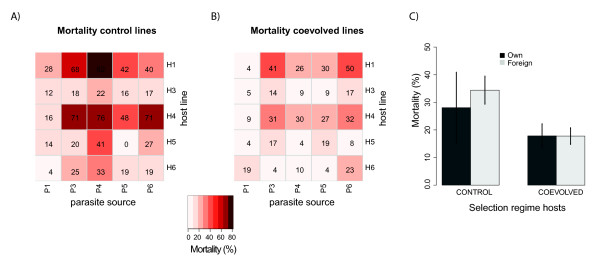
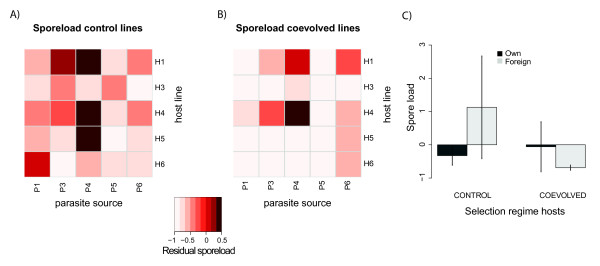
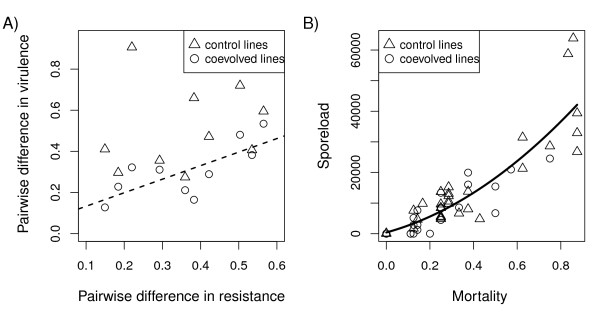
In hosts, coevolution led to higher resistance and altered resistance profiles compared to paired control lines. Host genotype × parasite genotype interactions (GH × GP) were observed for spore load (the trait of lower genetic complexity), but not for mortality. Overall parasite performance correlated with resistance of its matching host coevolution background reflecting a directional and unspecific response to strength of selection during coevolution. Despite high selective pressures exerted by the obligatory killing parasite, and host- and parasite-specific mortality profiles, no general pattern of local adaptation was observed, but one case of parasite maladaptation was consistently observed on both coevolved and control host populations. In addition, the use of replicate control host populations in the assay revealed one case of host maladaptation and one case of parasite adaptation that was masked by host counter-adaptation, suggesting the presence of complex and probably dynamically changing fitness landscapes.
Our results demonstrate that the use of replicate naive populations can be a useful tool to differentiate between host and parasite adaptation in complex and dynamic fitness landscapes. The absence of clear local adaptation patterns during coevolution with a sexual host showing a complex genetic architecture for resistance suggests that directional selection for generality may be more important attributes of host-parasite coevolution than commonly assumed.
如果宿主和寄生虫之间存在特异性(GxG 相互作用)和不对称的进化潜力,宿主-寄生虫的协同进化可能导致寄生虫或宿主的局部适应。这已经在实验和实地研究中得到了证明,但相当一部分研究未能检测到如此明确的模式。一种解释是,适应可能会被拮抗剂的反适应所掩盖。此外,相互作用的遗传结构通常非常复杂,从而阻止了特定的适应性反应。在这里,我们采用了一种互惠的交叉感染实验来揭示两个影响双方的适合度组成部分的适应性反应,这些组成部分的遗传结构具有不同的复杂性(即死亡率和孢子负荷)。此外,我们对宿主(Tribolium castaneum)和寄生虫(Nosema whitei)的实验协同进化包括来自相同遗传背景的配对对照宿主的重复个体,以允许分离宿主和寄生虫特异性反应。
在宿主中,与配对对照系相比,协同进化导致更高的抗性和改变的抗性谱。在孢子负荷(遗传复杂性较低的性状)中观察到宿主基因型 × 寄生虫基因型相互作用(GH × GP),但在死亡率中没有观察到。总体而言,寄生虫的表现与与其匹配的宿主协同进化背景的抗性相关,反映了在协同进化过程中对选择强度的定向和非特异性反应。尽管专性杀伤寄生虫施加了很高的选择压力,以及宿主和寄生虫特异性的死亡率谱,但没有观察到局部适应的一般模式,但在协同进化和对照宿主群体上都观察到了一种寄生虫适应不良的情况。此外,在测定中使用重复的对照宿主群体揭示了一种宿主适应不良和一种寄生虫适应的情况,这被宿主的反适应所掩盖,这表明存在复杂且可能动态变化的适应度景观。
我们的结果表明,使用重复的原始种群可以成为区分复杂和动态适应度景观中宿主和寄生虫适应的有用工具。在与具有复杂遗传抗性结构的有性宿主的协同进化过程中没有明显的局部适应模式表明,方向性选择的一般性可能比通常假设的更重要宿主-寄生虫协同进化的属性。