Division of Adolescent Medicine, Department of Medicine, Children's Hospital Boston, Boston, MA, USA.
Obesity (Silver Spring). 2012 Aug;20(8):1703-9. doi: 10.1038/oby.2012.9. Epub 2012 Jan 27.
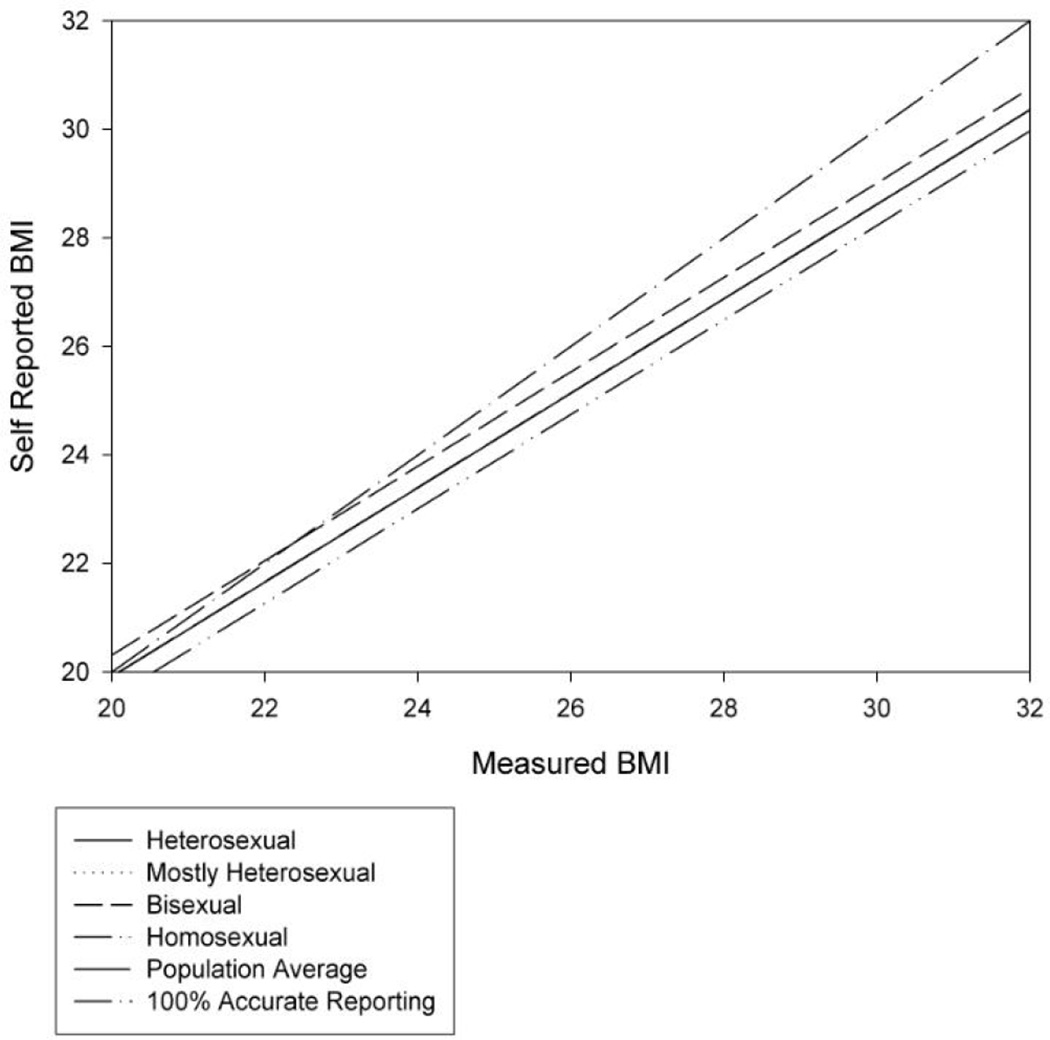
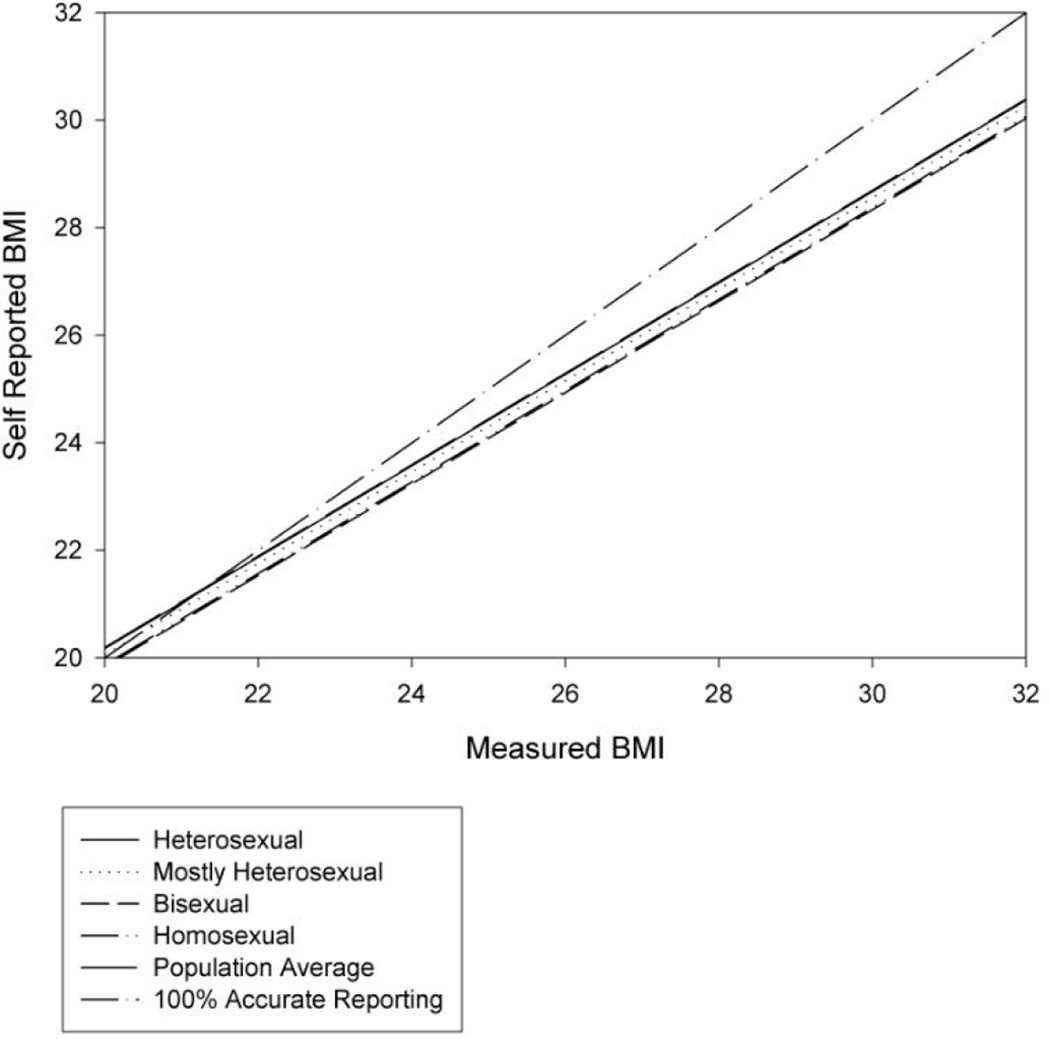
Our objective was to determine if sexual orientation groups differ in accuracy of BMI (kg/m(2)) calculated from self-reported height and weight and if weight status modifies possible differences. Using gender-stratified multiple linear regression to analyze Wave III of the National Longitudinal Study of Adolescent Health (n = 12,197), we examined the association of sexual orientation with BMI calculated from self-reported height and weight (self-reported BMI), controlling for BMI calculated from objectively measured height and weight (objectively measured BMI) as well as demographic, health, and behavioral variables. We tested for effect modification of the relationship between sexual orientation and self-reported BMI by objectively measured BMI. The population underestimated their BMI (females: β = 0.87, P < 0.001; males = 0.86, P < 0.001). Sexual orientation groups differed little in their accuracy of reporting; only gay males had significant underreporting (β = -0.37, P = 0.038) relative to their heterosexual peers. We found no evidence of effect modification of the relationship of sexual orientation and self-reported BMI by objectively measured BMI. With the exception of gay males, sexual orientation groups are consistent in their underreporting of BMI thus providing confidence in most comparisons of weight status based on self-report. Self-reporting of weight and height by gay males may exaggerate the differences in BMI between gay and heterosexual males.
我们的目的是确定性取向群体在自我报告的身高和体重计算的 BMI(kg/m^2)的准确性上是否存在差异,以及体重状况是否会改变可能存在的差异。我们使用性别分层的多元线性回归分析了青少年健康纵向研究(National Longitudinal Study of Adolescent Health,简称 NLSY)的第三波数据(n=12197),我们考察了性取向与自我报告的身高和体重计算的 BMI(自我报告 BMI)之间的关联,控制了从客观测量的身高和体重计算的 BMI(客观测量 BMI)以及人口统计学、健康和行为变量。我们测试了性取向和自我报告 BMI 之间的关系是否受到客观测量 BMI 的影响。该人群低估了他们的 BMI(女性:β=0.87,P<0.001;男性=0.86,P<0.001)。性取向群体在报告的准确性上差异不大;只有男同性恋者与异性恋同龄人相比,报告存在显著的低估(β=-0.37,P=0.038)。我们没有发现性取向和自我报告 BMI 之间的关系受到客观测量 BMI 的影响。除了男同性恋者之外,性取向群体在 BMI 的低估上是一致的,因此大多数基于自我报告的体重状况比较是可信的。男同性恋者自我报告的体重和身高可能夸大了男同性恋者和异性恋男性之间 BMI 的差异。