• 文献检索
  • 文档翻译
  • 深度研究
  • 学术资讯
  • Suppr Zotero 插件Zotero 插件
  • 邀请有礼
  • 套餐&价格
  • 历史记录
应用&插件
Suppr Zotero 插件Zotero 插件浏览器插件Mac 客户端Windows 客户端微信小程序
定价
高级版会员购买积分包购买API积分包
服务
文献检索文档翻译深度研究API 文档MCP 服务
关于我们
关于 Suppr公司介绍联系我们用户协议隐私条款
关注我们

Suppr 超能文献

核心技术专利:CN118964589B侵权必究
粤ICP备2023148730 号-1Suppr @ 2026

文献检索

告别复杂PubMed语法,用中文像聊天一样搜索,搜遍4000万医学文献。AI智能推荐,让科研检索更轻松。

立即免费搜索

文件翻译

保留排版,准确专业,支持PDF/Word/PPT等文件格式,支持 12+语言互译。

免费翻译文档

深度研究

AI帮你快速写综述,25分钟生成高质量综述,智能提取关键信息,辅助科研写作。

立即免费体验

地球化学诱导的分解代谢能量变化解释了东太平洋隆起 9°50'N 地区弥散喷口过去的生态变化。

Geochemically induced shifts in catabolic energy yields explain past ecological changes of diffuse vents in the East Pacific Rise 9°50'N area.

机构信息

Department of Geosciences, University of Bremen, Klagenfurter Straße, 28359 Bremen, Germany.

出版信息

Geochem Trans. 2012 Jan 27;13:2. doi: 10.1186/1467-4866-13-2.

DOI:10.1186/1467-4866-13-2
PMID:22283983
原文链接:https://pmc.ncbi.nlm.nih.gov/articles/PMC3355016/
Abstract

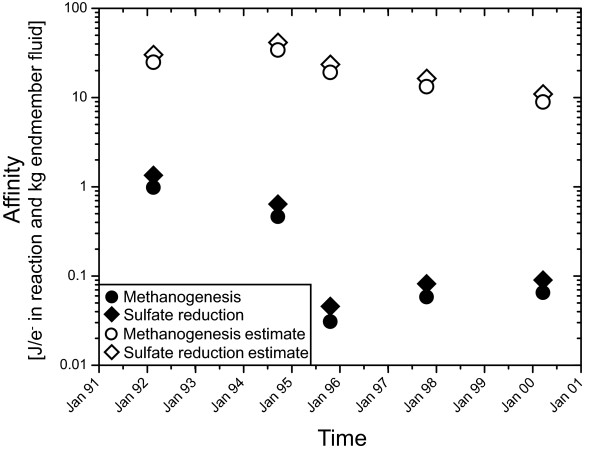
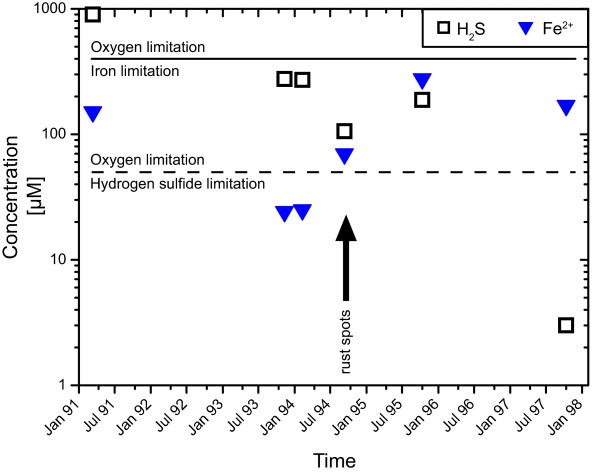
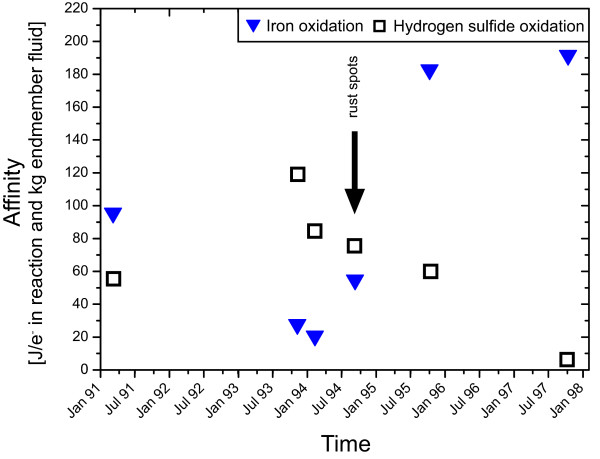
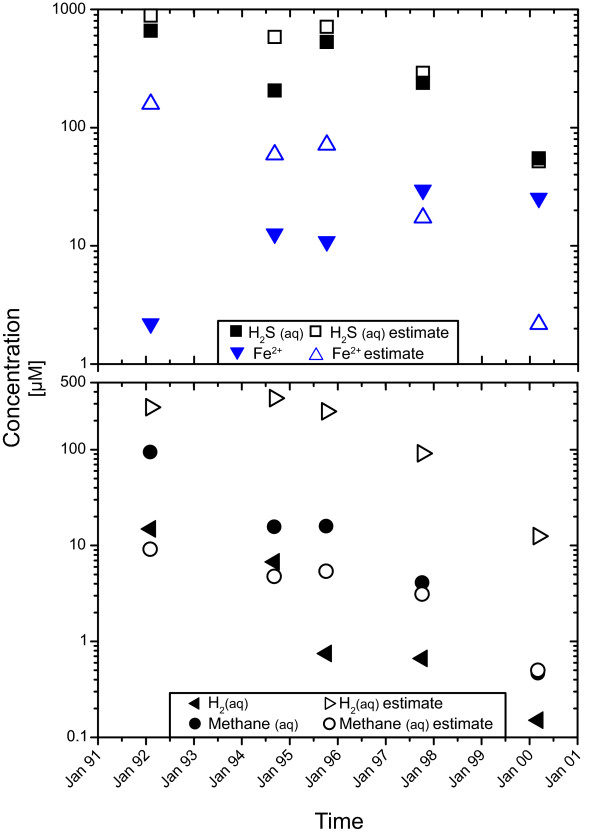
The East Pacific Rise (EPR) at 9°50'N hosts a hydrothermal vent field (Bio9) where the change in fluid chemistry is believed to have caused the demise of a tubeworm colony. We test this hypothesis and expand on it by providing a thermodynamic perspective in calculating free energies for a range of catabolic reactions from published compositional data. The energy calculations show that there was excess H2S in the fluids and that oxygen was the limiting reactant from 1991 to 1997. Energy levels are generally high, although they declined in that time span. In 1997, sulfide availability decreased substantially and H2S was the limiting reactant. Energy availability dropped by a factor of 10 to 20 from what it had been between 1991 and 1995. The perishing of the tubeworm colonies began in 1995 and coincided with the timing of energy decrease for sulfide oxidizers. In the same time interval, energy availability for iron oxidizers increased by a factor of 6 to 8, and, in 1997, there was 25 times more energy per transferred electron in iron oxidation than in sulfide oxidation. This change coincides with a massive spread of red staining (putative colonization by Fe-oxidizing bacteria) between 1995 and 1997.For a different cluster of vents from the EPR 9°50'N area (Tube Worm Pillar), thermodynamic modeling is used to examine changes in subseafloor catabolic metabolism between 1992 and 2000. These reactions are deduced from deviations in diffuse fluid compositions from conservative behavior of redox-sensitive species. We show that hydrogen is significantly reduced relative to values expected from conservative mixing. While H2 concentrations of the hydrothermal endmember fluids were constant between 1992 and 1995, the affinities for hydrogenotrophic reactions in the diffuse fluids decreased by a factor of 15 and then remained constant between 1995 and 2000. Previously, these fluids have been shown to support subseafloor methanogenesis. Our calculation results corroborate these findings and indicate that the 1992-1995 period was one of active growth of hydrogenotrophic communities, while the system was more or less at steady state between 1995 and 2000.

摘要

东太平洋海隆 9°50'N 处拥有一个热液喷口场(Bio9),据信这里的流体化学变化导致了管蠕虫殖民地的消亡。我们通过提供一个热力学视角,根据已发表的成分数据计算一系列分解代谢反应的自由能,来检验这一假说并加以扩展。能量计算表明,流体中存在过量的 H2S,而氧气是 1991 年至 1997 年的限制反应物。尽管在此期间能量水平普遍较高,但它们有所下降。1997 年,硫化物的可用性大幅减少,H2S 成为限制反应物。与 1991 年至 1995 年相比,能量可用性下降了 10 到 20 倍。管蠕虫殖民地的消亡始于 1995 年,与硫化物氧化剂能量减少的时间一致。在同一时间间隔内,铁氧化剂的能量可用性增加了 6 到 8 倍,而在 1997 年,铁氧化过程中每传递一个电子的能量是硫化物氧化过程的 25 倍。这种变化与 1995 年至 1997 年之间大量出现的红色染色(假定为铁氧化细菌的定植)相吻合。对于东太平洋海隆 9°50'N 地区的另一个喷口群(管状蠕虫柱),使用热力学模型来研究 1992 年至 2000 年间海底分解代谢代谢的变化。这些反应是根据扩散流体成分偏离氧化还原敏感物质保守行为推断出来的。我们表明,与保守混合预期相比,氢的含量显著降低。虽然 1992 年至 1995 年期间热液端元流体中的 H2 浓度保持不变,但扩散流体中氢营养型反应的亲和力下降了 15 倍,然后在 1995 年至 2000 年期间保持不变。此前,这些流体已被证明支持海底甲烷生成。我们的计算结果证实了这些发现,并表明 1992-1995 年是氢营养型群落活跃生长的时期,而 1995 年至 2000 年期间,该系统或多或少处于稳定状态。
https://cdn.ncbi.nlm.nih.gov/pmc/blobs/aed4/3355016/60b27399714e/1467-4866-13-2-5.jpg
https://cdn.ncbi.nlm.nih.gov/pmc/blobs/aed4/3355016/ef5b201a471f/1467-4866-13-2-1.jpg
https://cdn.ncbi.nlm.nih.gov/pmc/blobs/aed4/3355016/818e975dffe1/1467-4866-13-2-2.jpg
https://cdn.ncbi.nlm.nih.gov/pmc/blobs/aed4/3355016/556ace092b12/1467-4866-13-2-3.jpg
https://cdn.ncbi.nlm.nih.gov/pmc/blobs/aed4/3355016/1c8e2d7161af/1467-4866-13-2-4.jpg
https://cdn.ncbi.nlm.nih.gov/pmc/blobs/aed4/3355016/60b27399714e/1467-4866-13-2-5.jpg
https://cdn.ncbi.nlm.nih.gov/pmc/blobs/aed4/3355016/ef5b201a471f/1467-4866-13-2-1.jpg
https://cdn.ncbi.nlm.nih.gov/pmc/blobs/aed4/3355016/818e975dffe1/1467-4866-13-2-2.jpg
https://cdn.ncbi.nlm.nih.gov/pmc/blobs/aed4/3355016/556ace092b12/1467-4866-13-2-3.jpg
https://cdn.ncbi.nlm.nih.gov/pmc/blobs/aed4/3355016/1c8e2d7161af/1467-4866-13-2-4.jpg
https://cdn.ncbi.nlm.nih.gov/pmc/blobs/aed4/3355016/60b27399714e/1467-4866-13-2-5.jpg

相似文献

1
Geochemically induced shifts in catabolic energy yields explain past ecological changes of diffuse vents in the East Pacific Rise 9°50'N area.地球化学诱导的分解代谢能量变化解释了东太平洋隆起 9°50'N 地区弥散喷口过去的生态变化。
Geochem Trans. 2012 Jan 27;13:2. doi: 10.1186/1467-4866-13-2.
2
Microbial colonization of metal sulfide minerals at a diffuse-flow deep-sea hydrothermal vent at 9°50'N on the East Pacific Rise.东太平洋海隆 9°50'N 漫射流深海热液喷口处金属硫化物矿物的微生物定殖。
Geobiology. 2020 Sep;18(5):594-605. doi: 10.1111/gbi.12396. Epub 2020 Apr 26.
3
Diversity of meiofauna from the 9°50'N East Pacific rise across a gradient of hydrothermal fluid emissions.来自东太平洋隆起 9°50'N 处的热液喷口梯度中海洋小型生物的多样性。
PLoS One. 2010 Aug 10;5(8):e12321. doi: 10.1371/journal.pone.0012321.
4
Abiotic redox reactions in hydrothermal mixing zones: Decreased energy availability for the subsurface biosphere.水热混合区的非生物氧化还原反应:地下生物圈能量供应减少。
Proc Natl Acad Sci U S A. 2020 Aug 25;117(34):20453-20461. doi: 10.1073/pnas.2003108117. Epub 2020 Aug 12.
5
Discovery of active off-axis hydrothermal vents at 9° 54'N East Pacific Rise.在东太平洋隆起 9°54'N 发现活跃的非轴向热液喷口。
Proc Natl Acad Sci U S A. 2022 Jul 26;119(30):e2205602119. doi: 10.1073/pnas.2205602119. Epub 2022 Jul 21.
6
Time-series analysis of two hydrothermal plumes at 9°50'N East Pacific Rise reveals distinct, heterogeneous bacterial populations.对东太平洋海隆 9°50'N 两处热液羽流的时间序列分析揭示了截然不同且具有异质性的细菌种群。
Geobiology. 2012 Mar;10(2):178-92. doi: 10.1111/j.1472-4669.2011.00315.x. Epub 2012 Jan 4.
7
Iron Transformation Pathways and Redox Micro-Environments in Seafloor Sulfide-Mineral Deposits: Spatially Resolved Fe XAS and δ(57/54)Fe Observations.海底硫化物矿床中的铁转化途径与氧化还原微环境:空间分辨Fe XAS和δ(57/54)Fe观测
Front Microbiol. 2016 May 10;7:648. doi: 10.3389/fmicb.2016.00648. eCollection 2016.
8
A new species of deep-sea Tegastidae (Crustacea: Copepoda: Harpacticoida) from 9°50'N on the East Pacific Rise, with remarks on its ecology.东太平洋海隆北纬9°50′处深海叶颚猛水蚤科(甲壳纲:桡足亚纲:猛水蚤目)一新物种及其生态学述评
Zootaxa. 2008 Sep 3;1866:323-336.
9
Geochemical constraints on chemolithoautotrophic metabolism by microorganisms in seafloor hydrothermal systems.海底热液系统中微生物化能自养代谢的地球化学限制因素
Geochim Cosmochim Acta. 1997 Oct;61(20):4375-91. doi: 10.1016/s0016-7037(97)00241-x.
10
Bioenergetic characterization of a shallow-sea hydrothermal vent system: Milos Island, Greece.对米洛斯岛(希腊)浅海热液喷口系统的生物能量学特征进行研究。
PLoS One. 2020 Jun 5;15(6):e0234175. doi: 10.1371/journal.pone.0234175. eCollection 2020.

引用本文的文献

1
The Energetic Potential for Undiscovered Manganese Metabolisms in Nature.自然界中未被发现的锰代谢的能量潜力。
Front Microbiol. 2021 Jun 9;12:636145. doi: 10.3389/fmicb.2021.636145. eCollection 2021.
2
Abiotic redox reactions in hydrothermal mixing zones: Decreased energy availability for the subsurface biosphere.水热混合区的非生物氧化还原反应:地下生物圈能量供应减少。
Proc Natl Acad Sci U S A. 2020 Aug 25;117(34):20453-20461. doi: 10.1073/pnas.2003108117. Epub 2020 Aug 12.
3
Bioenergetic characterization of a shallow-sea hydrothermal vent system: Milos Island, Greece.

本文引用的文献

1
Hydrogen is an energy source for hydrothermal vent symbioses.氢是热液喷口共生体的能源。
Nature. 2011 Aug 10;476(7359):176-80. doi: 10.1038/nature10325.
2
An experimental and theoretical approach to determining linkages between geochemical variability and microbial biodiversity in seafloor hydrothermal chimneys.一种实验和理论方法,用于确定海底热液喷口地球化学变异性与微生物生物多样性之间的联系。
Geobiology. 2010 Dec;8(5):457-70. doi: 10.1111/j.1472-4669.2010.00255.x. Epub 2010 Aug 18.
3
Bacterial diversity in a subseafloor habitat following a deep-sea volcanic eruption.
对米洛斯岛(希腊)浅海热液喷口系统的生物能量学特征进行研究。
PLoS One. 2020 Jun 5;15(6):e0234175. doi: 10.1371/journal.pone.0234175. eCollection 2020.
4
Hydrogen Does Not Appear To Be a Major Electron Donor for Symbiosis with the Deep-Sea Hydrothermal Vent Tubeworm Riftia pachyptila.氢气似乎并非与深海热液喷口管虫厚壳贻贝共生的主要电子供体。
Appl Environ Microbiol. 2019 Dec 13;86(1). doi: 10.1128/AEM.01522-19.
5
Hydrogen-limited growth of hyperthermophilic methanogens at deep-sea hydrothermal vents.深海热液喷口嗜热产甲烷菌的氢限制生长。
Proc Natl Acad Sci U S A. 2012 Aug 21;109(34):13674-9. doi: 10.1073/pnas.1206632109. Epub 2012 Aug 6.
6
Microbial diversity within basement fluids of the sediment-buried Juan de Fuca Ridge flank.沉积物掩埋的胡安·德富卡岭侧翼基底液中的微生物多样性。
ISME J. 2013 Jan;7(1):161-72. doi: 10.1038/ismej.2012.73. Epub 2012 Jul 12.
深海火山喷发后海底栖息地的细菌多样性。
FEMS Microbiol Ecol. 2003 Apr 1;43(3):393-409. doi: 10.1111/j.1574-6941.2003.tb01080.x.
4
Short-term microbial and physico-chemical variability in low-temperature hydrothermal fluids near 5 degrees S on the Mid-Atlantic Ridge.大西洋中脊南纬5度附近低温热液流体的短期微生物和物理化学变异性
Environ Microbiol. 2009 Oct;11(10):2526-41. doi: 10.1111/j.1462-2920.2009.01978.x. Epub 2009 Jun 24.
5
Calculation of the relative metastabilities of proteins using the CHNOSZ software package.使用 CHNOSZ 软件包计算蛋白质的相对亚稳性。
Geochem Trans. 2008 Oct 3;9:10. doi: 10.1186/1467-4866-9-10.
6
Geochemical constraints on sources of metabolic energy for chemolithoautotrophy in ultramafic-hosted deep-sea hydrothermal systems.超镁铁质岩宿主深海热液系统中化能自养代谢能量来源的地球化学限制
Astrobiology. 2007 Dec;7(6):933-50. doi: 10.1089/ast.2006.0119.
7
A ubiquitous thermoacidophilic archaeon from deep-sea hydrothermal vents.一种来自深海热液喷口的无处不在的嗜热嗜酸古菌。
Nature. 2006 Jul 27;442(7101):444-7. doi: 10.1038/nature04921.
8
Bacterial and archaeal phylotypes associated with distinct mineralogical layers of a white smoker spire from a deep-sea hydrothermal vent site (9 degrees N, East Pacific Rise).与一个深海热液喷口(北纬9度,东太平洋海隆)的白色烟囱尖顶不同矿物层相关的细菌和古菌系统发育型。
Environ Microbiol. 2006 May;8(5):909-20. doi: 10.1111/j.1462-2920.2005.00978.x.
9
Biogeochemical evidence that thermophilic archaea mediate the anaerobic oxidation of methane.嗜热古菌介导甲烷厌氧氧化的生物地球化学证据。
Appl Environ Microbiol. 2003 Mar;69(3):1680-6. doi: 10.1128/AEM.69.3.1680-1686.2003.
10
Geochemical constraints on chemolithoautotrophic metabolism by microorganisms in seafloor hydrothermal systems.海底热液系统中微生物化能自养代谢的地球化学限制因素
Geochim Cosmochim Acta. 1997 Oct;61(20):4375-91. doi: 10.1016/s0016-7037(97)00241-x.