Sanou Guillaume S, Tiendrebeogo Régis W, Ouédraogo André L, Diarra Amidou, Ouédraogo Alphonse, Yaro Jean-Baptiste, Ouédraogo Espérance, Verra Federica, Behr Charlotte, Troye-Blomberg Marita, Modiano David, Dolo Amagana, Torcia Maria G, Traoré Yves, Sirima Sodiomon B, Nébié Issa
Centre National de Recherche et de Formation sur le Paludisme, Ouagadougou, Burkina Faso.
BMC Res Notes. 2012 Jan 27;5:76. doi: 10.1186/1756-0500-5-76.
Fulani ethnic group individuals are less susceptible than sympatric Mossi ethnic group, in term of malaria infection severity, and differ in antibody production against malaria antigens. The differences in susceptibility to malaria between Fulani and Mossi ethnic groups are thought to be regulated by different genetic backgrounds and offer the opportunity to compare haematological parameters, Tregs and γδT cell profiles in seasonal and stable malaria transmission settings in Burkina Faso. The study was conducted at two different time points i.e. during the high and low malaria transmission period.
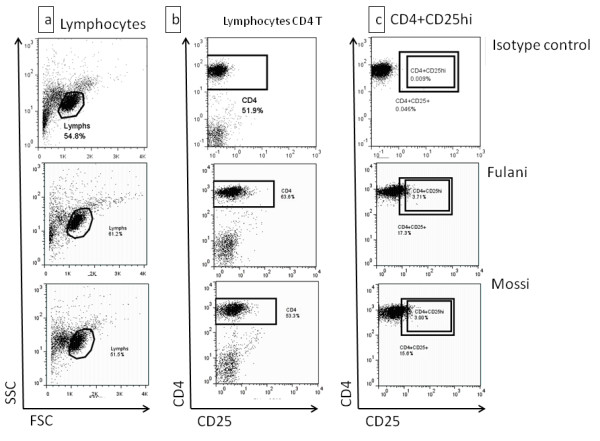
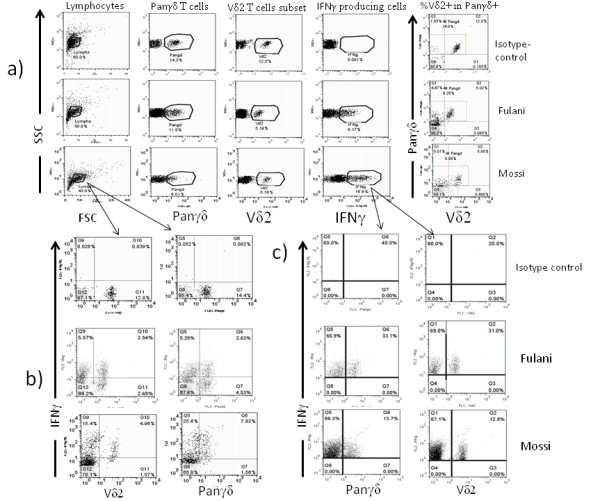
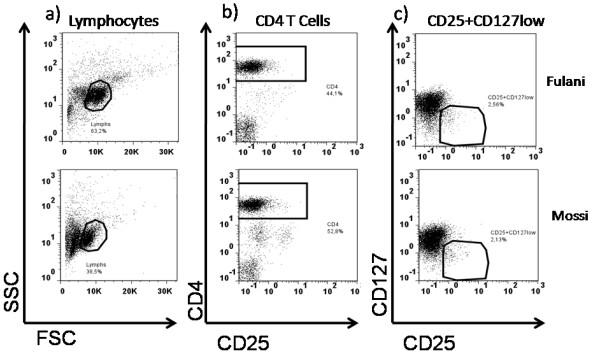
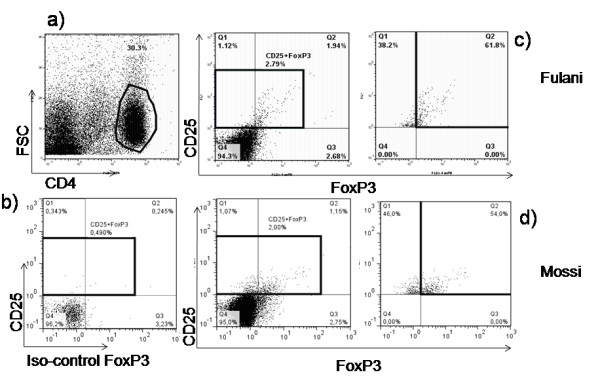
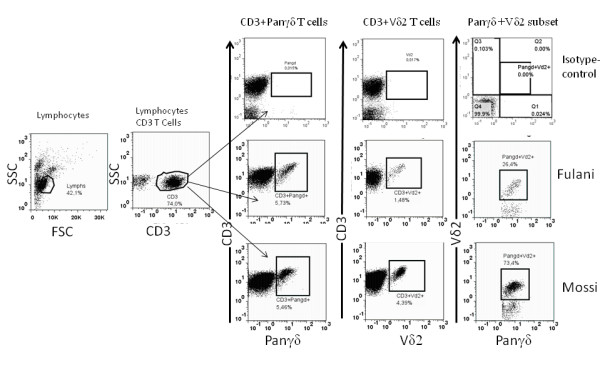
Two cross-sectional surveys were undertaken in adults above 20 years belonging either to the Fulani or the Mossi ethnic groups 1) at the peak of the malaria transmission season and 2) during the middle of the low malaria transmission season. Full blood counts, proportions of Tregs and γδ T cells were measured at both time-points.As previously shown the Fulani and Mossi ethnic groups showed a consistent difference in P. falciparum infection rates and parasite load. Differential white blood cell counts showed that the absolute lymphocyte counts were higher in the Mossi than in the Fulani ethnic group at both time points. While the proportion of CD4+CD25high was higher in the Fulani ethnic group at the peak of malaria transmission season (p = 0.03), no clear pattern emerged for T regulatory cells expressing FoxP3+ and CD127low. However CD3+γδ+ subpopulations were found to be higher in the Fulani compared to the Mossi ethnic group, and this difference was statistically significant at both time-points (p = 0.004 at low transmission season and p = 0.04 at peak of transmission).
Our findings on regulatory T cell phenotypes suggest an interesting role for immune regulatory mechanisms in response to malaria. The study also suggests that TCRγδ + cells might contribute to the protection against malaria in the Fulani ethnic group involving their reported parasite inhibitory activities.
在疟疾感染严重程度方面,富拉尼族个体比同区域的莫西族个体更不易感,且在针对疟疾抗原的抗体产生方面存在差异。富拉尼族和莫西族对疟疾易感性的差异被认为受不同遗传背景的调控,这为在布基纳法索季节性和稳定疟疾传播环境中比较血液学参数、调节性T细胞(Tregs)和γδT细胞谱提供了机会。该研究在两个不同时间点进行,即疟疾传播高峰期和低谷期。
对20岁以上的富拉尼族或莫西族成年人进行了两项横断面调查:1)在疟疾传播季节高峰期;2)在疟疾传播低峰期中期。在这两个时间点均测量了全血细胞计数、Tregs和γδT细胞的比例。如先前所示,富拉尼族和莫西族在恶性疟原虫感染率和寄生虫载量方面存在一致差异。白细胞分类计数显示,在两个时间点,莫西族的绝对淋巴细胞计数均高于富拉尼族。虽然在疟疾传播高峰期富拉尼族中CD4 + CD25高表达的比例更高(p = 0.03),但对于表达FoxP3 +和CD127低的调节性T细胞未出现明确模式。然而,发现富拉尼族中CD3 +γδ+亚群高于莫西族,且这种差异在两个时间点均具有统计学意义(低传播季节时p = 0.004,传播高峰期时p = 0.04)。
我们关于调节性T细胞表型的研究结果表明免疫调节机制在应对疟疾方面发挥了有趣的作用。该研究还表明,TCRγδ +细胞可能通过其报道的寄生虫抑制活性,在富拉尼族对疟疾的保护中发挥作用。