Department of Breast Surgery, The First Affiliated Hospital of Xiamen University, Xiamen, China.
BMC Cancer. 2012 Jan 27;12:47. doi: 10.1186/1471-2407-12-47.
Extracellular matrix protein 1 (ECM1) and vascular endothelial growth factor-C (VEGF-C) are secretory glycoproteins that are associated with lymphangiogenesis; these proteins could, therefore, play important roles in the lymphatic dissemination of tumors. However, very little is known about their potential roles in lymphangiogenesis. The aim of this study was to investigate whether correlations exist between ECM1 and VEGF-C in human breast cancer, lymphangiogenesis, and the clinicopathological characteristics of the disease.
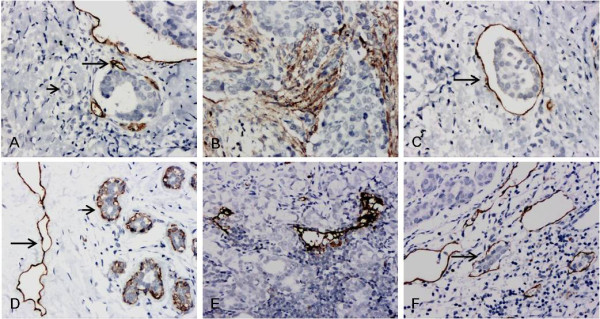
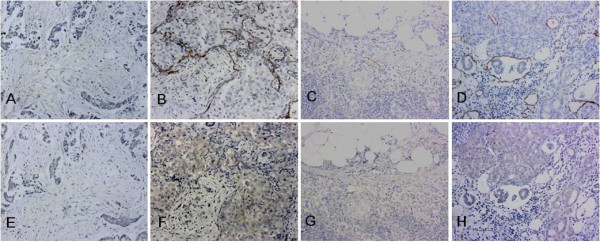
ECM1 and VEGF-C mRNA and protein expression levels in 41 patients were investigated using real-time reverse transcriptase polymerase chain reaction (RT-PCR), or immunohistochemical (IHC) staining of breast cancer tissue, matched noncancerous breast epithelial tissues, and suspicious metastatic axillary lymph nodes. D2-40 labelled lymph vessels and lymphatic microvessel density (LMVD) were counted. Correlations between ECM1 or VEGF-C protein expression levels, LMVD, and clinicopathological parameters were statistically tested.
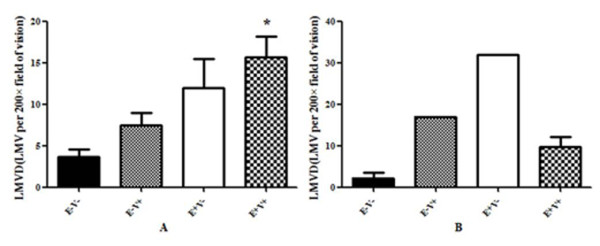
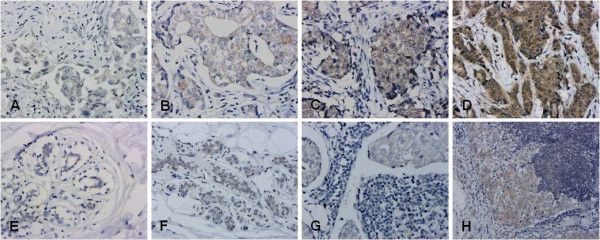
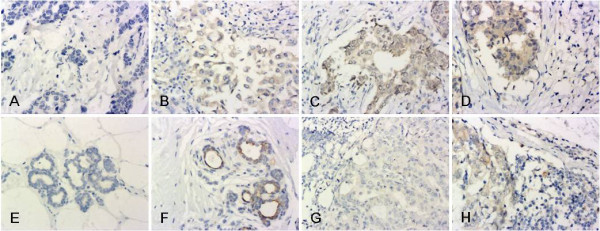
The rate of ECM1 positive staining in breast cancer tissues was higher (31/41, 75.6%) than that in the corresponding epithelial tissues (4/41, 9.8%, P < 0.001) and lymph nodes (13/41, 31.7%, P < 0.001). Similarly, the VEGF-C expression rate in cancer specimens was higher (33/41, 80.5%) than in epithelial tissues (19/41, 46.3%, P < 0.01) or lymph nodes (15/41, 36.6%, P < 0.01). Higher ECM1 and VEGF-C mRNA expression levels were also detected in the tumor tissues, compared to the non-cancerous tissue types or lymph nodes (P < 0.05). ECM1 protein expression was positively correlated with the estrogen receptor status (P < 0.05) and LMVD (P < 0.05). LMVD in the ECM1- and VEGF-C-positive tumor specimens was higher than that in the tissue types with negative staining (P < 0.05).
Both ECM1 and VEGF-C were overexpressed in breast cancer tissue samples. ECM1 expression was positively correlated with estrogen responsiveness and the metastatic properties of breast cancer. We conclude, therefore, that ECM1 and VEGF-C may have a synergistic effect on lymphangiogenesis to facilitate lymphatic metastasis of breast cancer.
细胞外基质蛋白 1(ECM1)和血管内皮生长因子-C(VEGF-C)是与淋巴管生成相关的分泌糖蛋白;因此,这些蛋白可能在肿瘤的淋巴扩散中发挥重要作用。然而,关于它们在淋巴管生成中的潜在作用知之甚少。本研究旨在探讨 ECM1 和 VEGF-C 在人乳腺癌、淋巴管生成以及疾病的临床病理特征之间是否存在相关性。
采用实时逆转录聚合酶链反应(RT-PCR)或免疫组织化学(IHC)染色检测 41 例乳腺癌组织、配对的非癌性乳腺上皮组织和可疑转移性腋窝淋巴结中 ECM1 和 VEGF-CmRNA 和蛋白的表达水平。计数 D2-40 标记的淋巴管和淋巴管微血管密度(LMVD)。统计检验 ECM1 或 VEGF-C 蛋白表达水平、LMVD 与临床病理参数之间的相关性。
乳腺癌组织中 ECM1 阳性染色率(31/41,75.6%)高于相应上皮组织(4/41,9.8%,P<0.001)和淋巴结(13/41,31.7%,P<0.001)。同样,癌组织中 VEGF-C 的表达率(33/41,80.5%)高于上皮组织(19/41,46.3%,P<0.01)或淋巴结(15/41,36.6%,P<0.01)。与非癌组织类型或淋巴结相比,肿瘤组织中 ECM1 和 VEGF-C 的 mRNA 表达水平也更高(P<0.05)。ECM1 蛋白表达与雌激素受体状态(P<0.05)和 LMVD(P<0.05)呈正相关。ECM1 和 VEGF-C 阳性肿瘤标本中的 LMVD 高于染色阴性的组织类型(P<0.05)。
ECM1 和 VEGF-C 在乳腺癌组织样本中均过度表达。ECM1 表达与雌激素反应性和乳腺癌的转移特性呈正相关。因此,我们得出结论,ECM1 和 VEGF-C 可能对淋巴管生成具有协同作用,促进乳腺癌的淋巴转移。