Department of Psychological and Brain Sciences, Indiana University, 1101 East 10th Street, Bloomington, IN 47405, USA.
Schizophr Res. 2012 Apr;136(1-3):143-9. doi: 10.1016/j.schres.2012.01.003. Epub 2012 Jan 28.
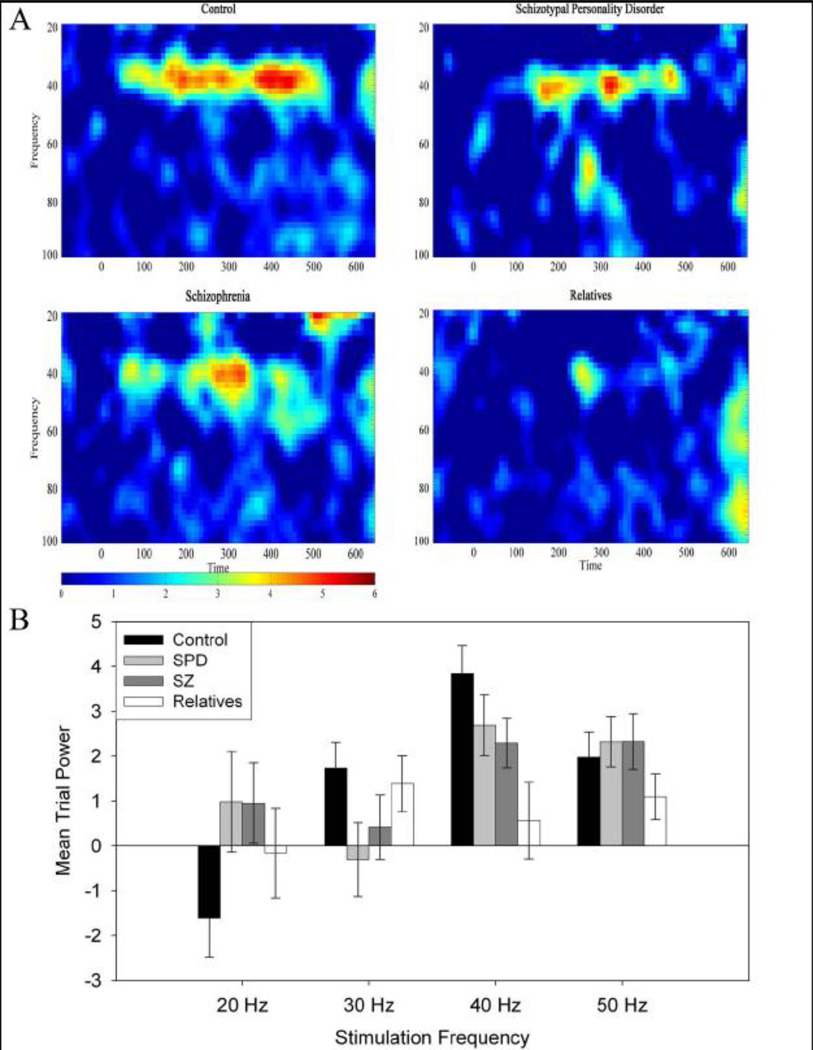
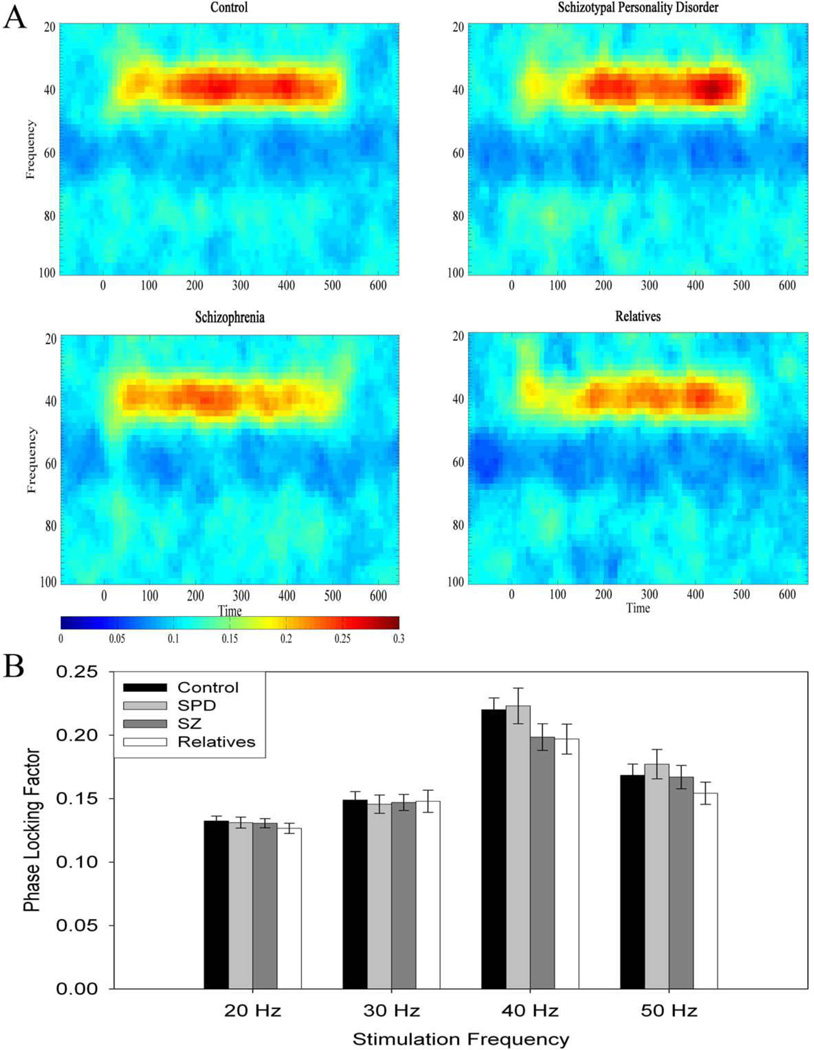
The power and phase synchronization of the auditory steady state response (ASSR) at 40 Hz stimulation is usually reduced in schizophrenia (SZ). The sensitivity of the 40 Hz ASSR to schizophrenia spectrum phenotypes, such as schizotypal personality disorder (SPD), or to familial risk has been less well characterized. We compared the ASSR of patients with SZ, persons with schizotypal personality disorder, first degree relatives of patients with SZ, and healthy control participants. ASSRs were obtained to 20, 30, 40 and 50 Hz click trains, and assessed using measures of power (mean trial power or MTP) and phase consistency (phase locking factor or PLF). The MTP to 40 Hz stimulation was reduced in relatives, and there was a trend for MTP reduction in SZ. The 40 Hz ASSR was not reduced in SPD participants. PLF did not differ among groups. These data suggest the 40 Hz ASSR is sensitive to familial risk factors associated with schizophrenia.
40Hz 刺激时听觉稳态反应(ASSR)的功率和相位同步通常在精神分裂症(SZ)中降低。40Hz ASSR 对精神分裂症谱系表型(如精神分裂型人格障碍, SPD)或家族风险的敏感性特征描述得较少。我们比较了 SZ 患者、精神分裂型人格障碍患者、SZ 患者一级亲属和健康对照组的 ASSR。使用平均试验功率或 MTP 和相位一致性的相位锁定因子或 PLF 评估 ASSR。在亲属中,20、30、40 和 50Hz 点击序列的 40Hz 刺激的 MTP 降低,而 SZ 中 MTP 降低呈趋势。SPD 参与者的 40Hz ASSR 没有降低。PLF 在各组之间没有差异。这些数据表明,40Hz ASSR 对与精神分裂症相关的家族危险因素敏感。