Department of Physiology and Neurobiology, Ben-Gurion University of the Negev, Beer-Sheva, Israel.
PLoS Comput Biol. 2012 Jan;8(1):e1002334. doi: 10.1371/journal.pcbi.1002334. Epub 2012 Jan 26.
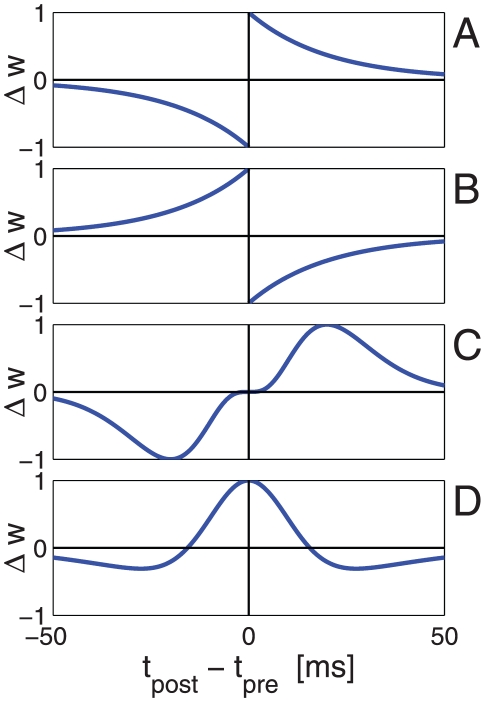
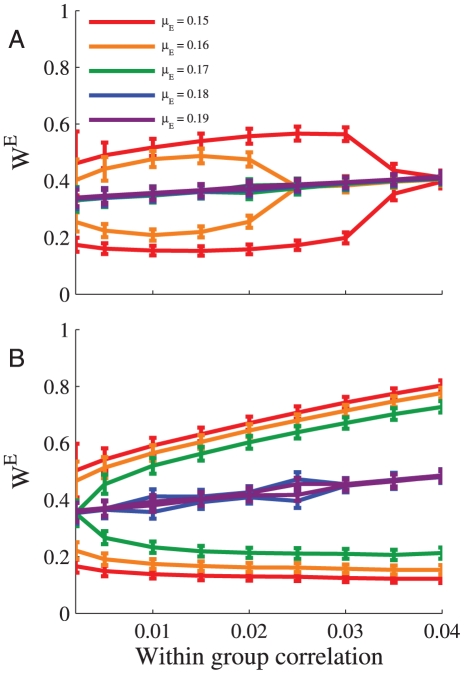
It has been suggested that excitatory and inhibitory inputs to cortical cells are balanced, and that this balance is important for the highly irregular firing observed in the cortex. There are two hypotheses as to the origin of this balance. One assumes that it results from a stable solution of the recurrent neuronal dynamics. This model can account for a balance of steady state excitation and inhibition without fine tuning of parameters, but not for transient inputs. The second hypothesis suggests that the feed forward excitatory and inhibitory inputs to a postsynaptic cell are already balanced. This latter hypothesis thus does account for the balance of transient inputs. However, it remains unclear what mechanism underlies the fine tuning required for balancing feed forward excitatory and inhibitory inputs. Here we investigated whether inhibitory synaptic plasticity is responsible for the balance of transient feed forward excitation and inhibition. We address this issue in the framework of a model characterizing the stochastic dynamics of temporally anti-symmetric Hebbian spike timing dependent plasticity of feed forward excitatory and inhibitory synaptic inputs to a single post-synaptic cell. Our analysis shows that inhibitory Hebbian plasticity generates 'negative feedback' that balances excitation and inhibition, which contrasts with the 'positive feedback' of excitatory Hebbian synaptic plasticity. As a result, this balance may increase the sensitivity of the learning dynamics to the correlation structure of the excitatory inputs.
有人提出,皮质细胞的兴奋和抑制输入是平衡的,这种平衡对于皮质中观察到的高度不规则放电很重要。对于这种平衡的起源有两种假设。一种假设认为,它是神经元的动态反馈的稳定解的结果。这个模型可以解释稳态兴奋和抑制之间的平衡,而不需要微调参数,但不能解释瞬态输入。第二种假设认为,突触后细胞的前馈兴奋性和抑制性输入已经平衡。因此,后一种假设确实解释了瞬态输入的平衡。然而,目前尚不清楚是什么机制导致了平衡前馈兴奋性和抑制性输入所需的微调。在这里,我们研究了抑制性突触可塑性是否负责平衡瞬态前馈兴奋和抑制。我们在一个模型的框架内研究了这个问题,该模型描述了前馈兴奋性和抑制性突触输入到单个突触后细胞的时间反称海伯氏尖峰时间依赖可塑性的随机动力学。我们的分析表明,抑制性海伯氏可塑性产生了“负反馈”,平衡了兴奋和抑制,这与兴奋性海伯氏突触可塑性的“正反馈”形成对比。因此,这种平衡可能会增加学习动力学对兴奋性输入的相关结构的敏感性。