Health Protection Agency, London, United Kingdom.
PLoS One. 2012;7(1):e30279. doi: 10.1371/journal.pone.0030279. Epub 2012 Jan 23.
The World Health Organization and European Centre for Disease Prevention and Control have highlighted the importance of establishing systems to monitor severe influenza. Following the H1N1 (2009) influenza pandemic, a sentinel network of 23 Trusts, the UK Severe Influenza Surveillance System (USISS), was established to monitor hospitalisations due to confirmed seasonal influenza in England. This article presents the results of the first season of operation of USISS in 2010/11.
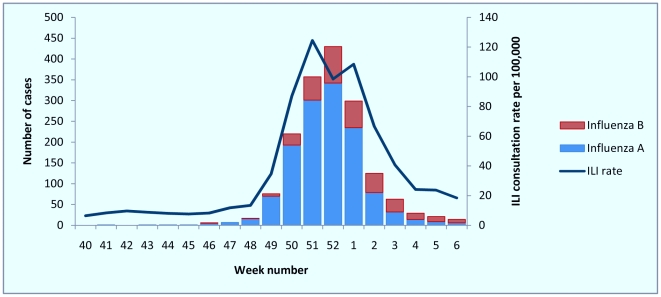
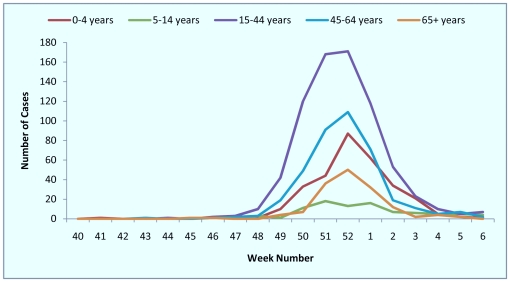
METHODOLOGY/PRINCIPAL FINDINGS: A case was defined as a person hospitalised with confirmed influenza of any type. Weekly aggregate numbers of hospitalised influenza cases, broken down by flu type and level of care, were submitted by participating Trusts. Cases in 2010/11 were compared to cases during the 2009 pandemic in hospitals with available surveillance data for both time periods (n = 19). An unexpected resurgence in seasonal A/H1N1 (2009) influenza activity in England was observed in December 2010 with reports of severe disease. Reported cases over the period of 4 October 2010 to 13 February 2011 were mostly due to influenza A/H1N1 (2009). One thousand and seventy-one cases of influenza A/H1N1 (2009) occurred over this period compared to 409 at the same Trusts over the 2009/10 pandemic period (1 April 2009 to 6 January 2010). Median age of influenza A/H1N1 (2009) cases in 2010/11 was 35 years, compared with 20 years during the pandemic (p = <0.0001).
CONCLUSIONS/SIGNIFICANCE: The Health Protection Agency successfully established a sentinel surveillance system for severe influenza in 2010/11, detecting a rise in influenza cases mirroring other surveillance indicators. The data indicate an upward shift in the age-distribution of influenza A/H1N1 (2009) during the 2010/11 influenza season as compared to the 2009/10 pandemic. Systems to enable the ongoing surveillance of severe influenza will be a key component in understanding and responding to the evolving epidemiology of influenza in the post-pandemic era.
世界卫生组织和欧洲疾病预防控制中心强调了建立监测严重流感系统的重要性。在 2009 年 H1N1(甲型 H1N1)流感大流行之后,英国建立了一个由 23 家信托机构组成的哨点网络,即英国严重流感监测系统(USISS),以监测英格兰因确诊季节性流感而住院的人数。本文介绍了该系统在 2010/11 年首个运营季节的结果。
方法/主要发现:病例定义为因确诊流感而住院的人。参与信托机构每周按流感类型和护理级别汇总住院流感病例数。2010/11 年的病例与两个时期均有监测数据的医院 2009 年大流行期间的病例进行了比较(n=19)。2010 年 12 月,英国季节性 A/H1N1(2009)流感活动出人意料地再次活跃,有严重疾病的报告。2010 年 10 月 4 日至 2011 年 2 月 13 日期间报告的病例主要由 A/H1N1(2009)流感引起。在此期间,发生了 1071 例 A/H1N1(2009)流感病例,而同一信托机构在 2009/10 大流行期间(2009 年 4 月 1 日至 2010 年 1 月 6 日)发生了 409 例。2010/11 年 A/H1N1(2009)病例的中位年龄为 35 岁,而大流行期间为 20 岁(p<0.0001)。
结论/意义:英国卫生保护局在 2010/11 年成功建立了严重流感哨点监测系统,检测到的流感病例上升与其他监测指标一致。数据表明,与 2009/10 大流行期间相比,2010/11 流感季节 A/H1N1(2009)的年龄分布有所上升。能够持续监测严重流感的系统将是了解和应对大流行后流感流行病学演变的关键组成部分。