Department of Physiology and Biophysics, University of Miami School of Medicine, Miami, Florida, United States of America.
PLoS One. 2012;7(1):e30662. doi: 10.1371/journal.pone.0030662. Epub 2012 Jan 26.
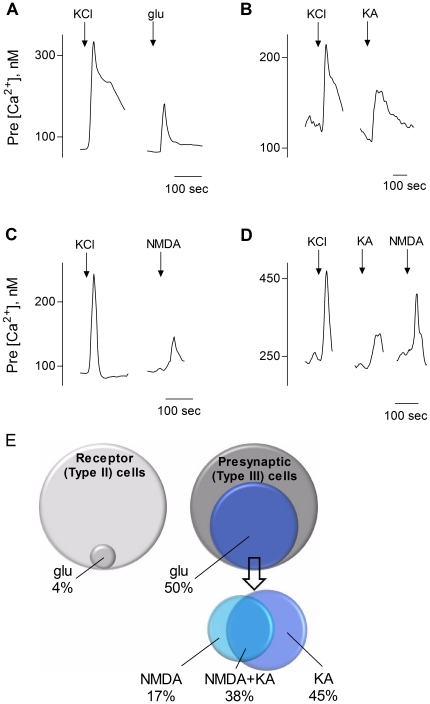
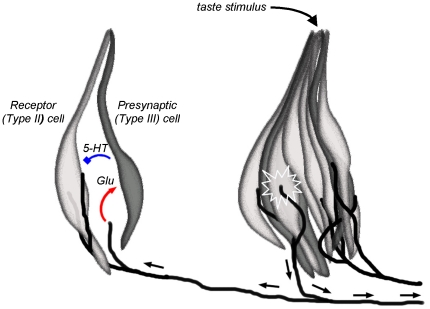
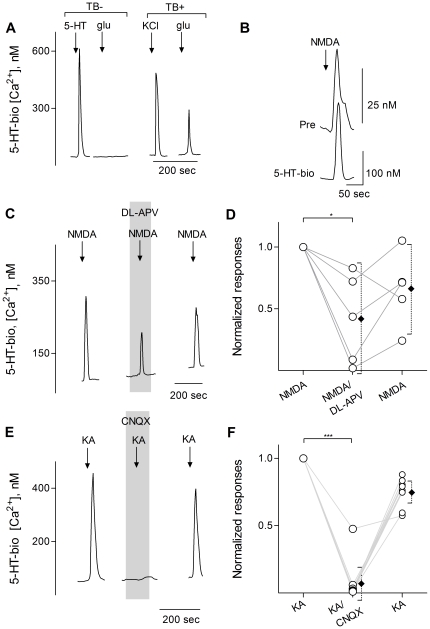
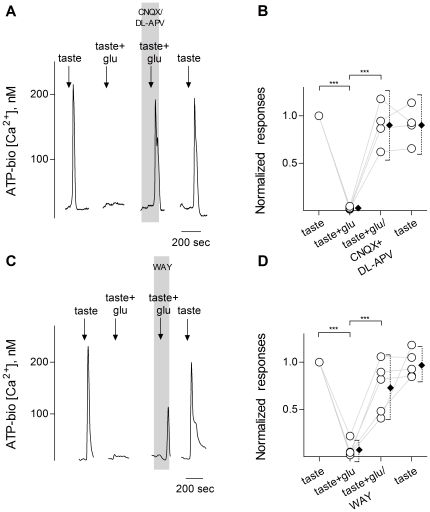
Recent studies suggest that l-glutamate may be an efferent transmitter released from axons innervating taste buds. In this report, we determined the types of ionotropic synaptic glutamate receptors present on taste cells and that underlie this postulated efferent transmission. We also studied what effect glutamate exerts on taste bud function. We isolated mouse taste buds and taste cells, conducted functional imaging using Fura 2, and used cellular biosensors to monitor taste-evoked transmitter release. The findings show that a large fraction of Presynaptic (Type III) taste bud cells (∼50%) respond to 100 µM glutamate, NMDA, or kainic acid (KA) with an increase in intracellular Ca(2+). In contrast, Receptor (Type II) taste cells rarely (4%) responded to 100 µM glutamate. At this concentration and with these compounds, these agonists activate glutamatergic synaptic receptors, not glutamate taste (umami) receptors. Moreover, applying glutamate, NMDA, or KA caused taste buds to secrete 5-HT, a Presynaptic taste cell transmitter, but not ATP, a Receptor cell transmitter. Indeed, glutamate-evoked 5-HT release inhibited taste-evoked ATP secretion. The findings are consistent with a role for glutamate in taste buds as an inhibitory efferent transmitter that acts via ionotropic synaptic glutamate receptors.
最近的研究表明,L-谷氨酸可能是从支配味蕾的轴突释放的传出递质。在本报告中,我们确定了存在于味觉细胞上的离子型突触谷氨酸受体的类型,并阐明了这种假定的传出传递。我们还研究了谷氨酸对味蕾功能的影响。我们分离了小鼠的味蕾和味觉细胞,使用 Fura 2 进行功能成像,并使用细胞生物传感器监测味觉诱发的递质释放。研究结果表明,很大一部分 Presynaptic(III 型)味蕾细胞(约 50%)对 100µM 谷氨酸、NMDA 或 kainic acid(KA)的反应是细胞内 Ca(2+)增加。相比之下,Receptor(II 型)味觉细胞很少(4%)对 100µM 谷氨酸有反应。在这个浓度和这些化合物下,这些激动剂激活谷氨酸能突触受体,而不是谷氨酸味觉(鲜味)受体。此外,应用谷氨酸、NMDA 或 KA 会导致味蕾分泌 5-HT,一种 Presynaptic 味觉细胞递质,但不是 ATP,一种 Receptor 细胞递质。事实上,谷氨酸诱导的 5-HT 释放抑制了味觉诱导的 ATP 分泌。这些发现与谷氨酸作为一种抑制性传出递质在味蕾中的作用一致,其通过离子型突触谷氨酸受体发挥作用。