Department of Zoology, Islamia College Peshawar (A Public Sector University), University Campus, Jamrod Road, Peshawar 25120, Khyber Pakhtunkhwa, Pakistan.
J Transl Med. 2012 Jan 31;10:20. doi: 10.1186/1479-5876-10-20.
Transfusion transmitted infections create significant burden on health care system. Donor selection is of paramount importance because infected individuals serve as an asymptomatic reservoir and a potential source of transmission.
A retrospective study was carried out in healthy blood donors in the Lady Reading Hospital Peshawar, Pakistan over a period of three and a half years i.e., from January 2008 to June 2011, to determine the prevalence of HBV, HCV, HIV and syphilis in order to provide information for relevant polices.
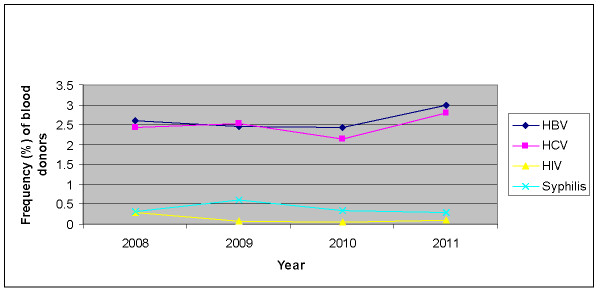
Out of 1,27,828 sample of blood donors, recorded mean prevalence for HBs Ag, anti-HCV, anti-HIV and syphilis was 2.68%, 2.46%, 0.06% and 0.43%, respectively, with an increasing trend in frequencies of transfusion transmitted infections (TTIs).
This study reflects that blood transfusion is one of the leading risk factor of spread of the TTIs, which showed the need and importance of the mandatory screening of these infectious markers in blood donations.
输血传播感染给医疗保健系统带来了巨大负担。供者选择至关重要,因为感染个体是无症状的储源,也是潜在的传播源。
本研究是在巴基斯坦白沙瓦莱迪女士医院的健康献血者中进行的一项回顾性研究,时间跨度为 3 年半,即从 2008 年 1 月至 2011 年 6 月,目的是确定乙型肝炎病毒(HBV)、丙型肝炎病毒(HCV)、艾滋病病毒(HIV)和梅毒在献血者中的流行率,为相关政策提供信息。
在 127828 例献血者样本中,HBsAg、抗-HCV、抗-HIV 和梅毒的记录平均流行率分别为 2.68%、2.46%、0.06%和 0.43%,输血传播感染(TTIs)的频率呈上升趋势。
本研究反映了输血是 TTIs 传播的主要危险因素之一,这表明在献血中强制性筛查这些感染性标志物的必要性和重要性。