M'baya Bridon, Jumbe Vincent, Samuel Vincent, M'bwana Robert, Mangani Charles
Malawi Blood Transfusion Service.
College of Medicine, Department of Health Systems and Policy.
Malawi Med J. 2019 Jun;31(2):118-125. doi: 10.4314/mmj.v31i2.3.
Collecting blood from voluntary non-remunerated blood donors from low risk populations is a key strategy for blood safety. Identifying such populations involves analysis of population and blood donor data to identify risk factors for transfusion transmissible infections (TTIs). There are no recent seroprevalence statistics for blood donors in Malawi. This study fills this gap by describing characteristics of blood donors, trend of annual prevalence of HIV, HBV, HCV and syphilis and factors associated with each TTI.
Retrospective analysis of blood donors' records in the MBTS database from 2011 to 2015 was undertaken. Summary statistics were performed to describe characteristics of the blood donors. Univariable and multivariable logistic regression analyses were performed to determine association between prevalence of infections and socio-demographic factors. Time trend analysis was done to assess changes in prevalence. P-value <0.05 was considered statistically significant.
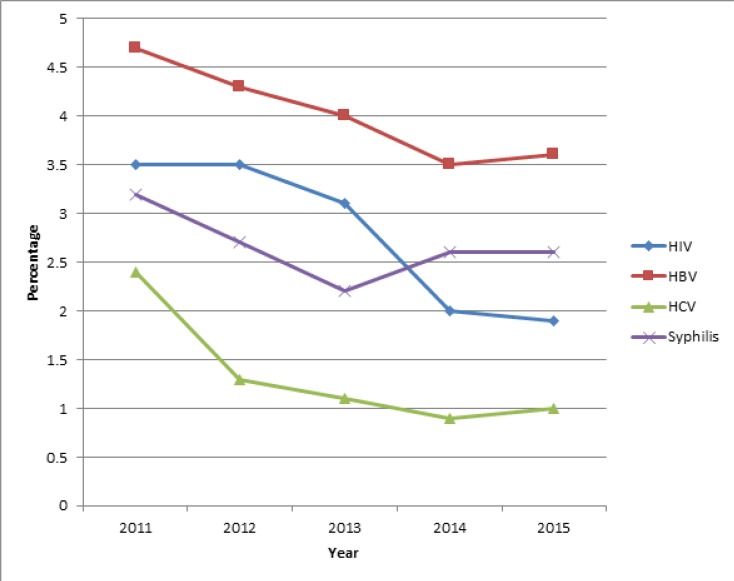
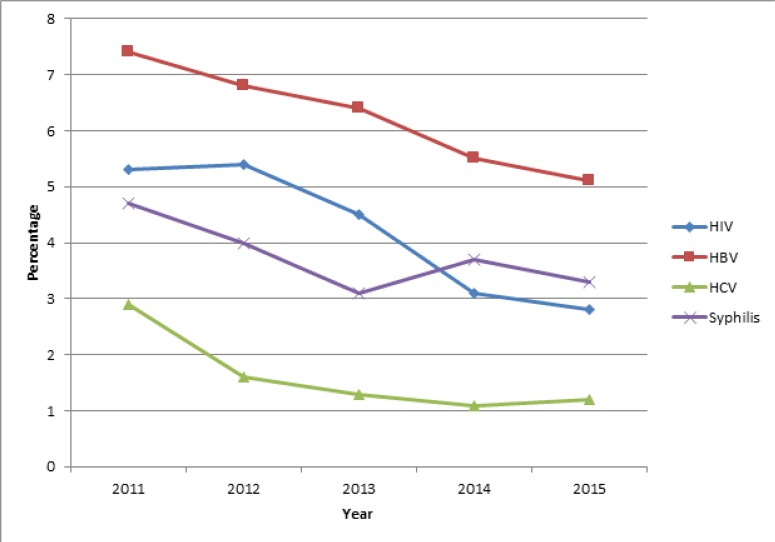
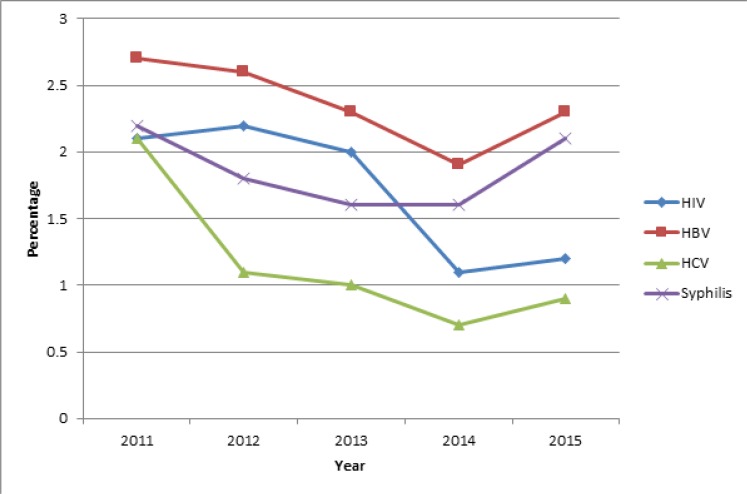
The number of blood donors screened over the 5 year period was 125,893. The mean number of donors donating blood per year was 39, 289; median age was 19 years; 82% were male, 87% single and 72% students and56% were repeat blood donors. Overall prevalence of each TTI decreased. The 2015 prevalence was: 3.6% for HBV; 1.9% for HIV; 2.6% for Syphilis and 1.0% for HCV while the 2011 prevalence was 4.7% for HBV; 3.5% for HIV 3.2% for syphilis and 2.4% for HCV.Repeat blood donors had significantly lower prevalence of TTIs than first time donors. Females were associated with lower risk for HBV, HCV and syphilis. Age ≥25 years and being out of school were associated with HIV. Age ≥25 years was associated with reduced risk for HCV and being self-employed and married were each associated with syphilis.
The typical blood donor is a young single male student. Repeat blood donation improves safety of the blood supply.
从低风险人群中采集自愿无偿献血者的血液是保障血液安全的关键策略。识别此类人群需要分析人口和献血者数据,以确定输血传播感染(TTIs)的风险因素。马拉维目前没有关于献血者的血清流行率统计数据。本研究通过描述献血者的特征、艾滋病毒、乙肝病毒、丙肝病毒和梅毒的年度流行趋势以及与每种TTI相关的因素,填补了这一空白。
对2011年至2015年MBTS数据库中献血者的记录进行回顾性分析。进行汇总统计以描述献血者的特征。进行单变量和多变量逻辑回归分析,以确定感染流行率与社会人口学因素之间的关联。进行时间趋势分析以评估流行率的变化。P值<0.05被认为具有统计学意义。
5年期间筛查的献血者人数为125,893人。每年献血者的平均人数为39,289人;中位年龄为19岁;82%为男性,87%为单身,72%为学生,56%为重复献血者。每种TTI的总体流行率均有所下降。2015年的流行率为:乙肝病毒3.6%;艾滋病毒1.9%;梅毒2.6%;丙肝病毒1.0%,而2011年乙肝病毒的流行率为4.7%;艾滋病毒3.5%,梅毒3.2%,丙肝病毒2.4%。重复献血者的TTIs流行率明显低于首次献血者。女性感染乙肝病毒、丙肝病毒和梅毒的风险较低。年龄≥25岁且辍学与艾滋病毒感染有关。年龄≥25岁与丙肝病毒感染风险降低有关,个体经营和已婚分别与梅毒感染有关。
典型的献血者是年轻的单身男学生。重复献血可提高血液供应的安全性。