Tsiapali Ekaterini, Schmidt Marcia M, Dizon Don, Steinhoff Margaret, Gass Jennifer
Program in Women's Oncology, Women and Infants Hospital, 101 Dudley Street, Providence, RI 02905, USA.
Int J Breast Cancer. 2011;2011:873987. doi: 10.4061/2011/873987. Epub 2011 Sep 8.
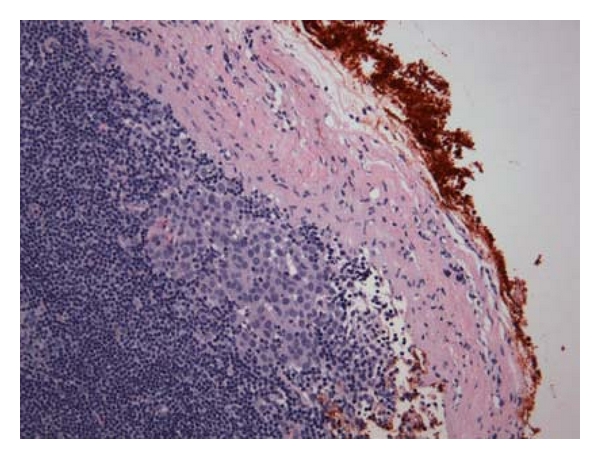
Background. Sentinel node biopsy (SNB) represents the standard of care in breast cancer axillary evaluation. Our study aims to characterize the patterns of malignant cell distribution within the sentinel nodes (SN). Methods. In a retrospective IRB-approved study, we examined the anatomic location of the nodal area with the highest radioactive signal or most intense blue staining (hot spot) and its distance from the metastatic foci. Results. 58 patients underwent SNB between January 2006 and February 2007. 12 patients with 19 positive SN were suitable for analysis. 4 (21%) metastases were located in the nodal hilum and 15 (79%) in the cortex. 6 (31%) metastases were found adjacent to the hotspot, and 9 (47%) within 4 mm of the hotspot. Conclusions. In our pilot series, SN metastases were within 4 mm of the hotspot in 78% of the cases. Pathologic analysis focused in that area may contribute to the more accurate identification of nodal metastases.
背景。前哨淋巴结活检(SNB)是乳腺癌腋窝评估的标准治疗方法。我们的研究旨在描述前哨淋巴结(SN)内恶性细胞的分布模式。方法。在一项经机构审查委员会(IRB)批准的回顾性研究中,我们检查了放射性信号最强或蓝色染色最浓(热点)的淋巴结区域的解剖位置及其与转移灶的距离。结果。2006年1月至2007年2月期间,58例患者接受了SNB。12例有19个阳性SN的患者适合进行分析。4例(21%)转移位于淋巴结门,15例(79%)位于皮质。6例(31%)转移灶位于热点附近,9例(47%)在热点4毫米范围内。结论。在我们的初步系列研究中,78%的病例中SN转移灶位于热点4毫米范围内。专注于该区域的病理分析可能有助于更准确地识别淋巴结转移。