Hamburg Center for Health Economics, University of Hamburg, Esplanade 36, 20354 Hamburg, Germany.
Health Care Manag Sci. 2012 Dec;15(4):310-26. doi: 10.1007/s10729-012-9193-z.
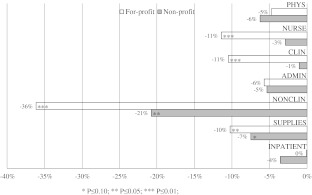
We investigated the effects of privatization on hospital efficiency in Germany. To do so, we obtained boot-strapped data envelopment analysis (DEA) efficiency scores in the first stage of our analysis and subsequently employed a difference-in-difference matching approach within a panel regression framework. Our findings show that conversions from public to private for-profit status were associated with an increase in efficiency of between 2.9 and 4.9%. We defined four alternative post-privatization periods and found that the increase in efficiency after a conversion to private for-profit status appeared to be permanent. We also observed an increase in efficiency for the first three years after hospitals were converted to private non-profit status, but our estimations suggest that this effect was rather transitory. Our findings also show that the efficiency gains after a conversion to private for-profit status were achieved through substantial decreases in staffing ratios in all analyzed staff categories with the exception of physicians and administrative staff. It was also striking that the efficiency gains of hospitals converted to for-profit status were significantly lower in the diagnosis-related groups (DRG) era than in the pre-DRG era. Altogether, our results suggest that converting hospitals to private for-profit status may be an effective way to ensure the scarce resources in the hospital sector are used more efficiently.
我们研究了私有化对德国医院效率的影响。为此,我们在分析的第一阶段获得了 bootstrap 数据的 DEA 效率得分,然后在面板回归框架内采用了差异匹配方法。我们的研究结果表明,从公有制转为私有制盈利性机构会使效率提高 2.9%到 4.9%。我们定义了四个不同的私有化后时期,并发现向私有制盈利性机构转变后效率的提高似乎是永久性的。我们还观察到,在医院转为私有制非营利性机构后的头三年效率也有所提高,但我们的估计表明,这种影响是暂时的。我们的研究结果还表明,向私有制盈利性机构转变后的效率提高是通过所有分析人员类别(除了医生和行政人员)的人员比例大幅下降实现的。引人注目的是,在 DRG 时代,转为盈利性机构的医院的效率提高明显低于 DRG 之前的时代。总的来说,我们的研究结果表明,将医院转为私有制盈利性机构可能是确保医院部门稀缺资源更有效地利用的有效途径。