National Institute of Health and Medical Research, U1047, Faculty of Medicine, Montpellier 1 University, Montpelier, France.
Diabetes Care. 2012 Mar;35(3):617-23. doi: 10.2337/dc11-1352. Epub 2012 Feb 1.
To extend our previous work on evaluating the use of oligonucleotide arrays to discriminate colonization from infection owing to Staphylococcus aureus in diabetic foot ulcers (DFUs).
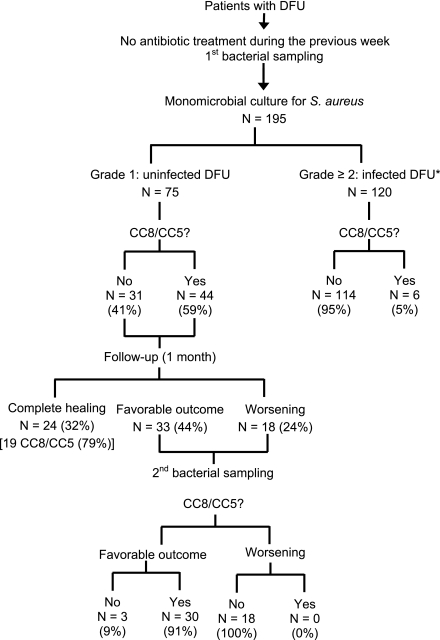
Patients admitted to 14 French diabetic foot departments for a DFU were screened for entry into the study. At admission, ulcers were classified based on clinical examination according to the Infectious Diseases Society of America system. Only patients with monomicrobial culture for S. aureus were included. In persons with an uninfected ulcer, a second wound bacterial specimen was obtained 1 month later. Using oligonucleotide arrays, S. aureus resistance and virulence genes were determined, and each isolate was affiliated to a clonal complex (CC).
S. aureus was initially isolated from 75 uninfected and 120 infected ulcers; 35 were methicillin resistant. A total of 44 (59%) strains from uninfected DFUs belonged to CC5/CC8 clones vs. 6 (5%) from infected DFUs (P < 0.001). During follow-up, 57 (76%) of uninfected DFUs healed or had a favorable outcome; the strain in 49 (86%) of them belonged to CC5/CC8. Conversely, 18 (24%) had a poor outcome but not a single strain belonged to CC5/CC8 clone. Moreover, lukDE was significantly associated with a favorable outcome of the wound.
As suggested by our previous study, the use of DNA arrays appears to be a promising technique that might help distinguishing uninfected from infected wounds, predicting ulcer outcome and then contributing to a more adequate use of antibiotics.
扩展我们之前关于使用寡核苷酸阵列来区分糖尿病足溃疡(DFU)中金黄色葡萄球菌定植和感染的工作。
我们筛选了 14 家法国糖尿病足科的住院患者,以纳入该研究。入院时,根据美国传染病学会的系统,根据临床检查对溃疡进行分类。仅纳入金黄色葡萄球菌单培养阳性的患者。对于未感染的溃疡患者,在 1 个月后获得第二个伤口细菌标本。使用寡核苷酸阵列,确定金黄色葡萄球菌的耐药性和毒力基因,并将每个分离株归属于克隆复合物(CC)。
我们最初从 75 例未感染和 120 例感染的溃疡中分离出金黄色葡萄球菌;35 株为耐甲氧西林金黄色葡萄球菌。与感染性 DFU 中 6 株(5%)相比,来自未感染 DFU 的 44 株(59%)属于 CC5/CC8 克隆(P<0.001)。在随访期间,57 例(76%)未感染的 DFU 愈合或有良好的结局;其中 49 例(86%)的菌株属于 CC5/CC8。相反,18 例(24%)的结果较差,但没有一株属于 CC5/CC8 克隆。此外,lukDE 与伤口的良好结局显著相关。
正如我们之前的研究表明,DNA 阵列的使用似乎是一种很有前途的技术,它可以帮助区分未感染和感染的伤口,预测溃疡的结局,从而有助于更合理地使用抗生素。