Department of Analytical Chemistry and Food Chemistry, University of Vienna, Waehringer Strasse 38, A-1090 Vienna, Austria; E-Mails:
Sensors (Basel). 2009;9(12):9805-15. doi: 10.3390/s91209805. Epub 2009 Dec 3.
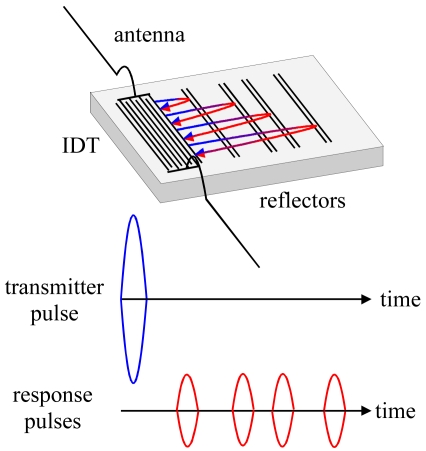
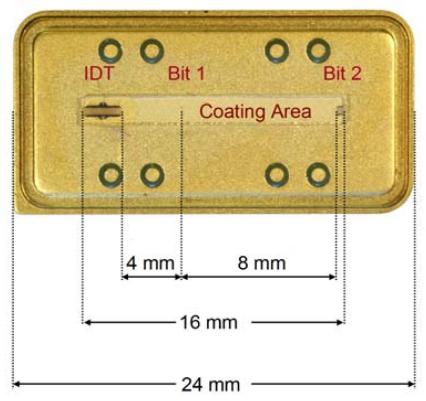
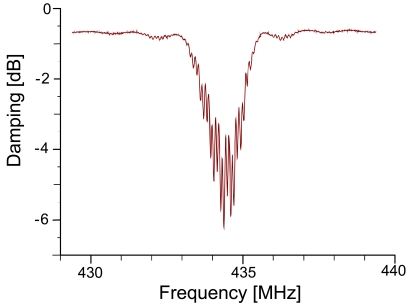
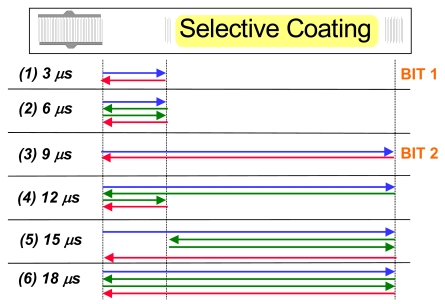
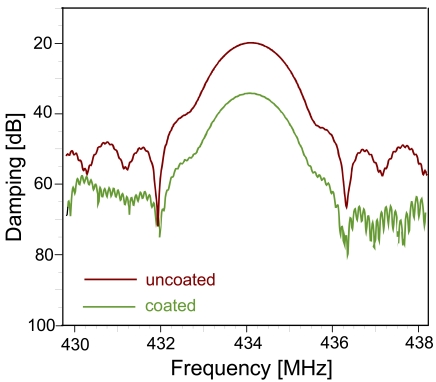
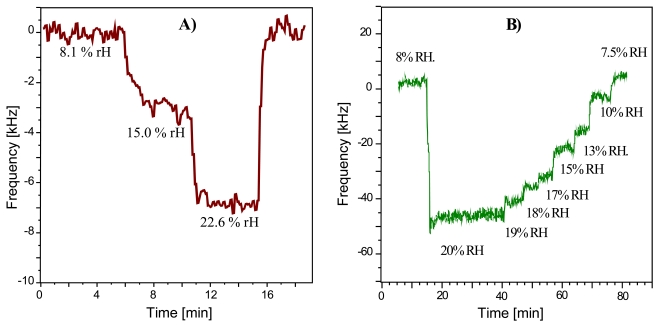
One-port surface acoustic wave (SAW) devices with defined reflector patterns give characteristic signal patterns in the time domain making them identifiable and leading to so-called RFID-Tags. Each sensor responds with a burst of signals, their timed positions giving the identification code, while the amplitudes can be related to the analyte concentration. This paper presents the first combination of such a transducer with chemically sensitive layer materials. These include crosslinked polyvinyl alcohol for determining relative humidity and tert-butylcalix[4]arene for detecting solvent vapors coated on the free space between the reflectors. In going from the time domain to the frequency domain by Fourier transformation, changes in frequency and phase lead to sensor responses. Hence, it is possible to measure the concentration of tetrachloroethene in air down to 50 ppm, as well as 1% changes in relative humidity.
单端口表面声波(SAW)器件具有定义的反射器图案,在时域中产生特征信号图案,使它们具有可识别性,并导致所谓的 RFID 标签。每个传感器都会发出一阵信号响应,它们的定时位置给出识别码,而幅度可以与分析物浓度相关联。本文首次将这种换能器与化学敏感层材料结合在一起。这些材料包括用于确定相对湿度的交联聚乙烯醇和用于检测涂覆在反射器之间自由空间的溶剂蒸气的叔丁基杯[4]芳烃。通过傅里叶变换从时域转换到频域时,频率和相位的变化会导致传感器响应。因此,有可能测量空气中四氯乙烯的浓度低至 50ppm,以及相对湿度的 1%变化。