Stahl Ullrich, Voigt Achim, Dirschka Marian, Barié Nicole, Richter Christiane, Waldbaur Ansgar, Gruhl Friederike J, Rapp Bastian E, Rapp Michael, Länge Kerstin
Institute of Microstructure Technology, Karlsruhe Institute of Technology, Hermann-von-Helmholtz-Platz 1, 76344 Eggenstein-Leopoldshafen, Germany.
Faculty of Chemical Engineering, Central University of Ecuador, Calle Ritter s/n y Bolivia, 170521 Quito, Ecuador.
Sensors (Basel). 2017 Nov 3;17(11):2529. doi: 10.3390/s17112529.
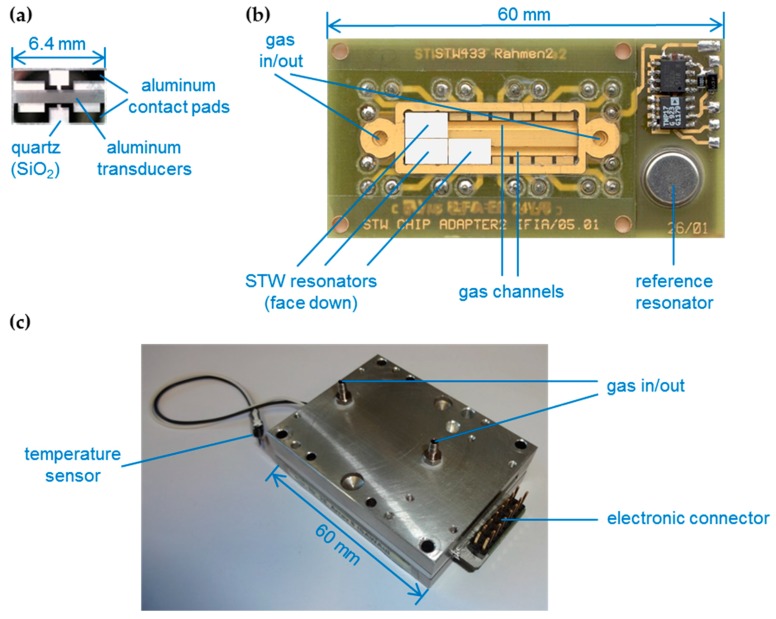
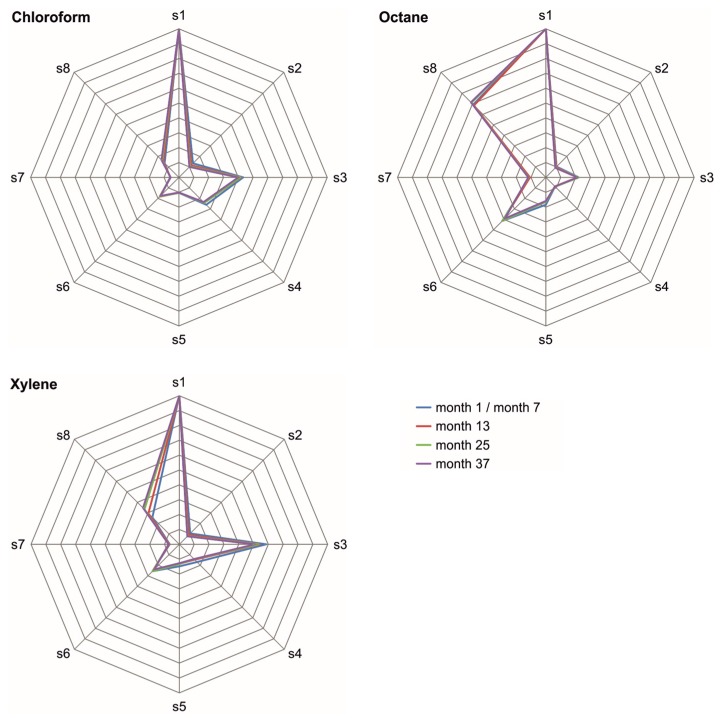
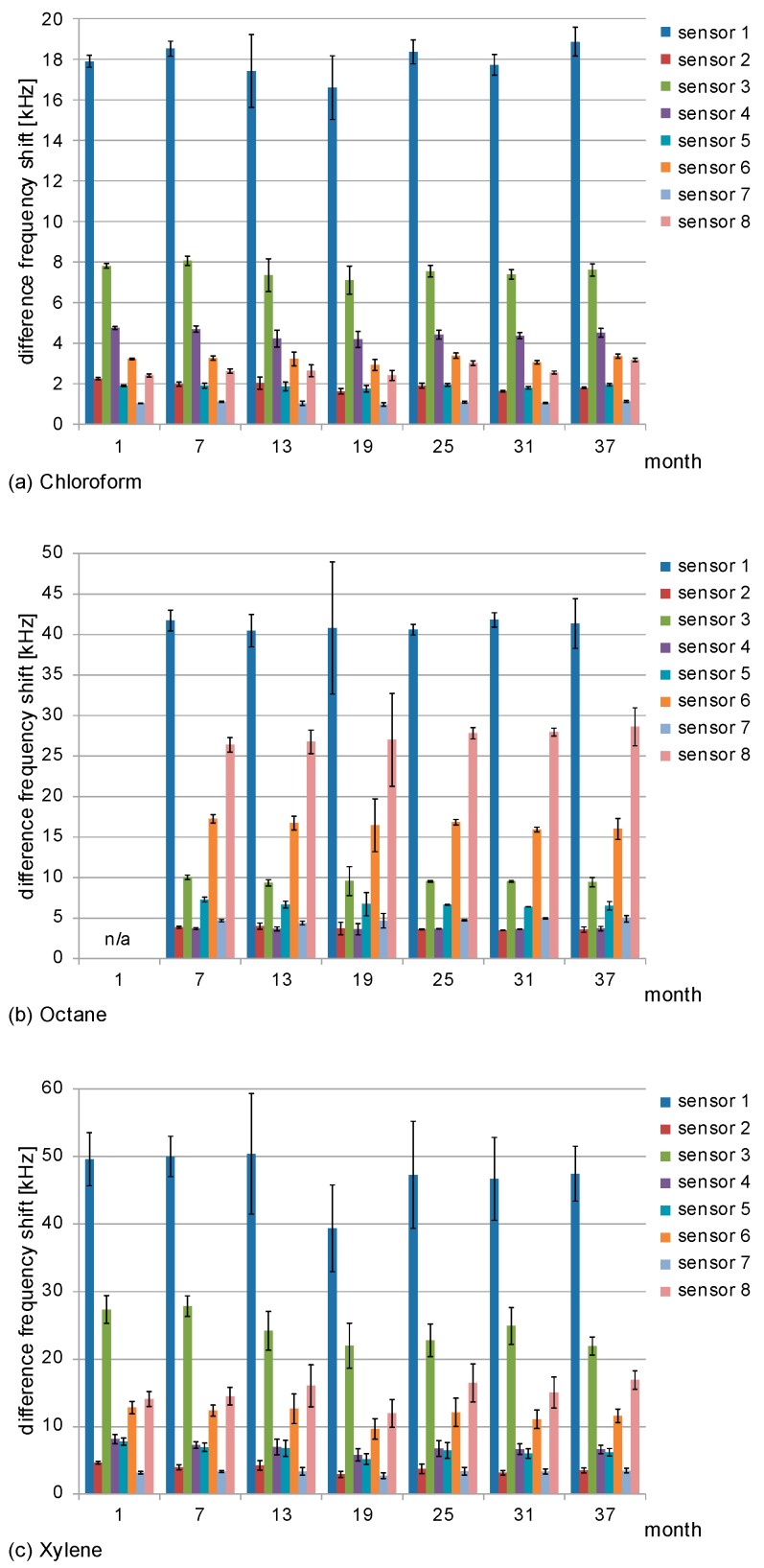
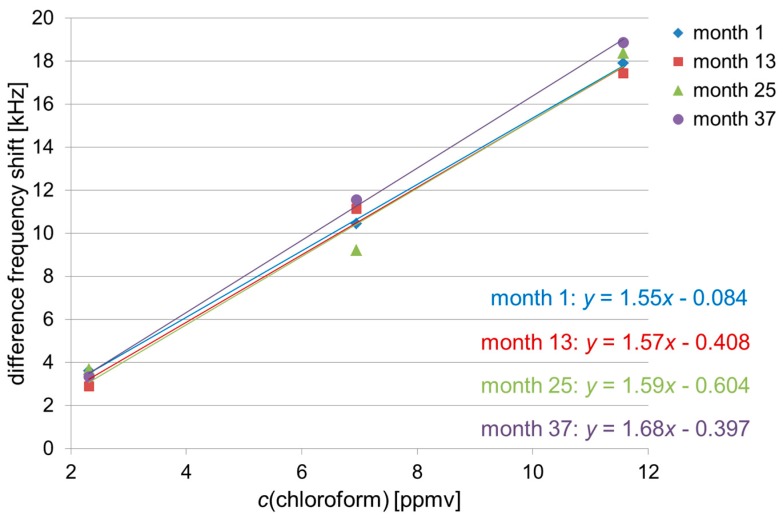
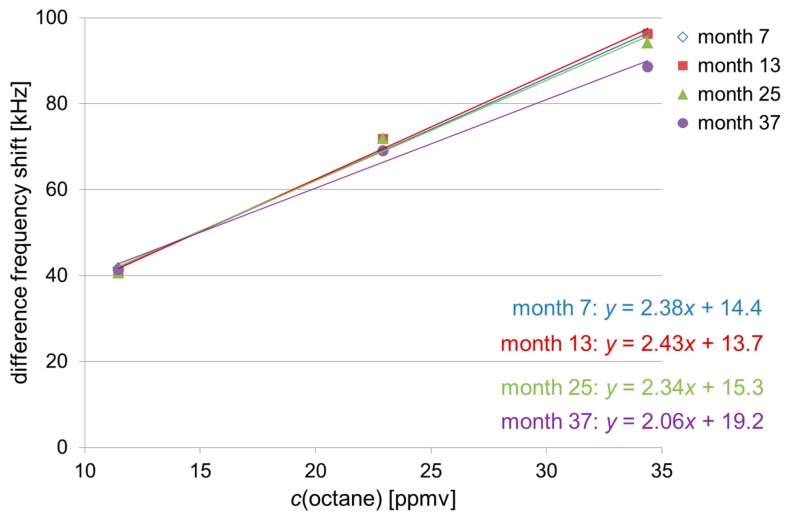
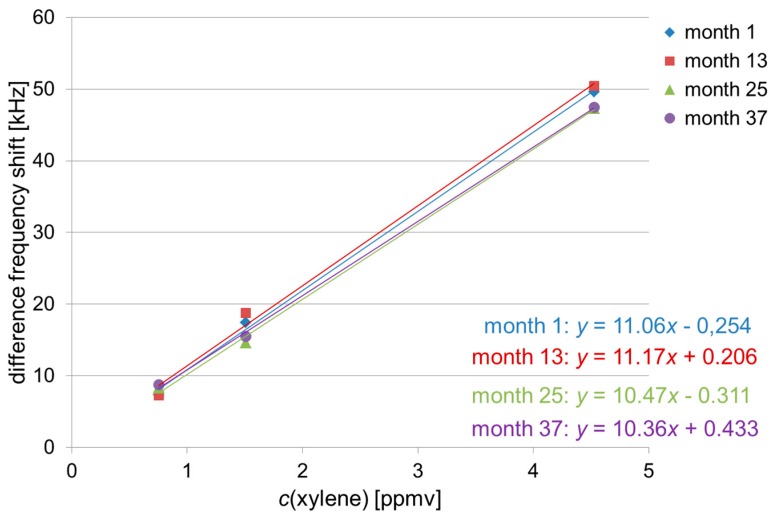
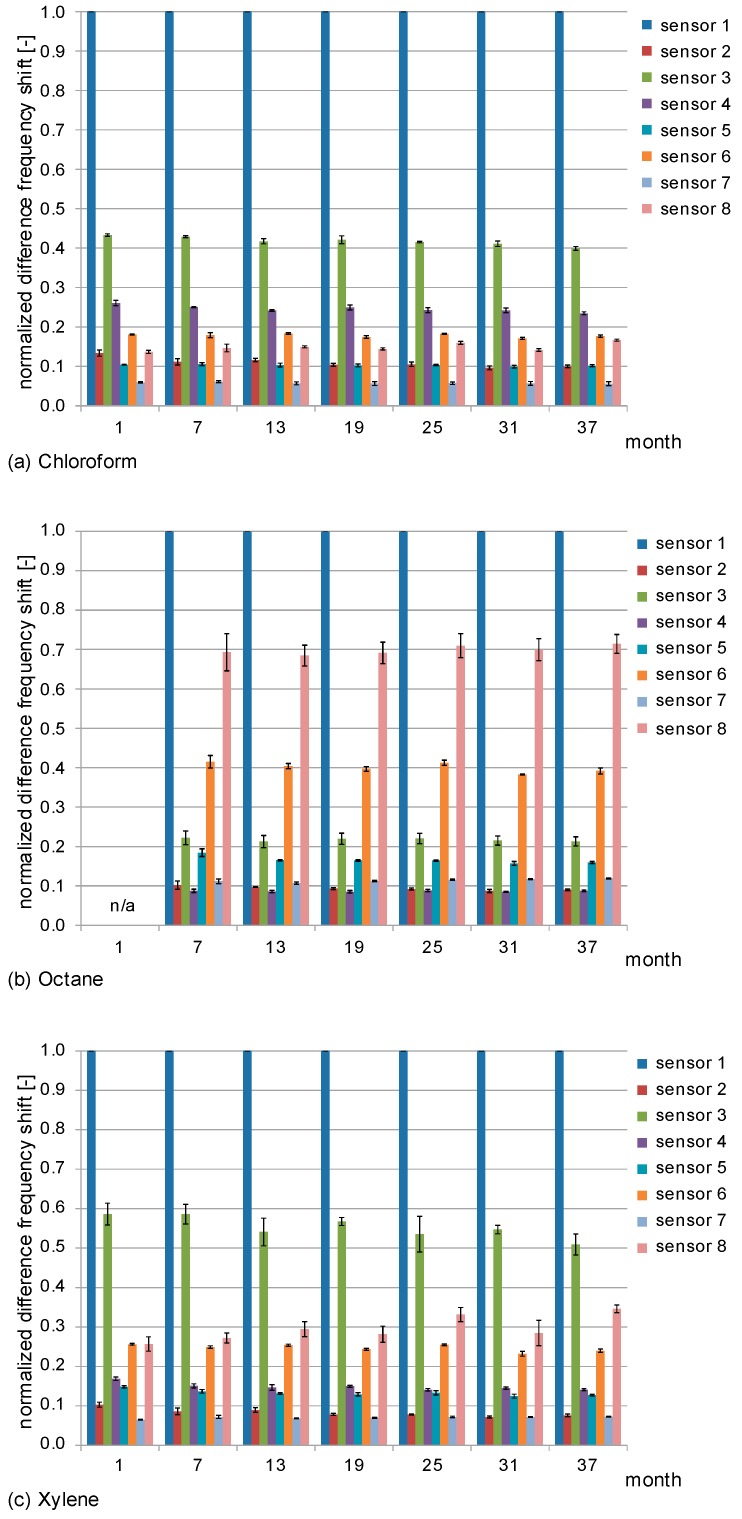
Arrays with polymer-coated acoustic sensors, such as surface acoustic wave (SAW) and surface transverse wave (STW) sensors, have successfully been applied for a variety of gas sensing applications. However, the stability of the sensors' polymer coatings over a longer period of use has hardly been investigated. We used an array of eight STW resonator sensors coated with different polymers. This sensor array was used at semi-annual intervals for a three-year period to detect organic solvent vapors of three different chemical classes: a halogenated hydrocarbon (chloroform), an aliphatic hydrocarbon (octane), and an aromatic hydrocarbon (xylene). The sensor signals were evaluated with regard to absolute signal shifts and normalized signal shifts leading to signal patterns characteristic of the respective solvent vapors. No significant time-related changes of sensor signals or signal patterns were observed, i.e., the polymer coatings kept their performance during the course of the study. Therefore, the polymer-coated STW sensors proved to be robust devices which can be used for detecting organic solvent vapors both qualitatively and quantitatively for several years.
带有聚合物涂层声学传感器的阵列,如表面声波(SAW)传感器和表面横向波(STW)传感器,已成功应用于各种气体传感应用。然而,传感器聚合物涂层在较长使用期内的稳定性几乎未被研究过。我们使用了一个由八个涂覆不同聚合物的STW谐振器传感器组成的阵列。该传感器阵列在三年时间里每隔半年使用一次,以检测三种不同化学类别的有机溶剂蒸汽:一种卤代烃(氯仿)、一种脂肪烃(辛烷)和一种芳烃(二甲苯)。针对绝对信号偏移和归一化信号偏移对传感器信号进行了评估,从而得出了各自溶剂蒸汽特有的信号模式。未观察到传感器信号或信号模式有与时间相关的显著变化,即聚合物涂层在研究过程中保持了其性能。因此,聚合物涂层的STW传感器被证明是坚固耐用的设备,可用于定性和定量检测有机溶剂蒸汽数年。