Alfaradhi Maria Z, Ozanne Susan E
Metabolic Research Laboratories, Institute of Metabolic Science, Addenbrooke's Hospital, University of Cambridge Cambridge, UK.
Front Genet. 2011 Jun 3;2:27. doi: 10.3389/fgene.2011.00027. eCollection 2011.
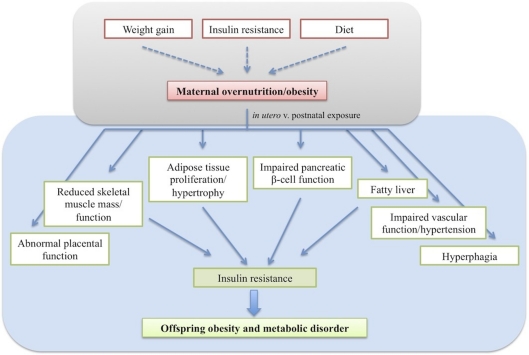
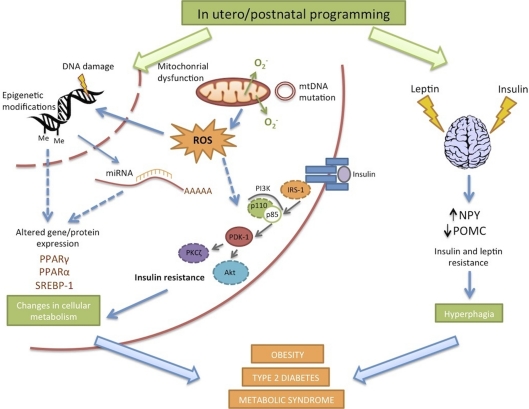
Metabolic disorders have seen an increased prevalence in recent years in developed as well as developing countries. While it is clear lifestyle choices and habits have contributed to this epidemic, mounting evidence suggests the nutritional milieu during critical stages of development in early life can "program" individuals to develop the metabolic syndrome later in life. Extensive epidemiological data presents an association between maternal obesity and nutrition during pregnancy and offspring obesity, and a number of animal models have been established in order to uncover the underlying mechanisms contributing to the programming of physiological systems. It is hard to distinguish the causal factors due to the complex nature of the maternal-fetal relationship; however, in order to develop adequate prevention strategies it is vital to identify which maternal factor(s) - be it the diet, diet-induced obesity or weight gain - and at which time during early development instigate the programmed phenotype. Curtailing the onset of obesity at this early stage in life presents a promising avenue through which to stem the growing epidemic of obesity.
近年来,代谢紊乱在发达国家和发展中国家的患病率均有所上升。虽然生活方式的选择和习惯显然是导致这一流行趋势的原因,但越来越多的证据表明,生命早期发育关键阶段的营养环境会“编程”个体,使其在以后的生活中患上代谢综合征。大量的流行病学数据表明,孕期母亲肥胖与营养状况和后代肥胖之间存在关联,并且已经建立了许多动物模型,以揭示导致生理系统编程的潜在机制。由于母婴关系的复杂性,很难区分因果因素;然而,为了制定适当的预防策略,确定哪些母体因素(无论是饮食、饮食引起的肥胖还是体重增加)以及在早期发育的哪个阶段引发程序化表型至关重要。在生命的这个早期阶段控制肥胖的发生,是遏制肥胖流行趋势的一个有希望的途径。