Kosaka Nobuyoshi, Ochiya Takahiro
Division of Molecular and Cellular Medicine, National Cancer Center Research Institute Tokyo, Japan.
Front Genet. 2012 Jan 3;2:97. doi: 10.3389/fgene.2011.00097. eCollection 2011.
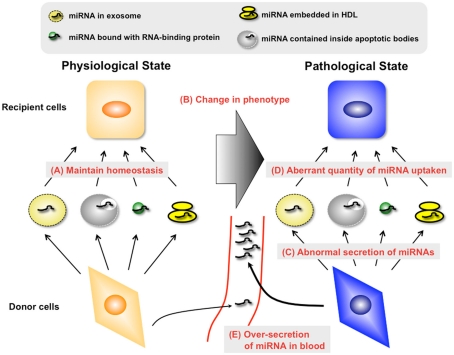
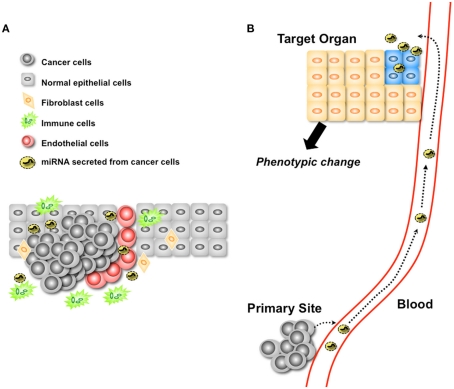
microRNAs (miRNAs) have been identified as a fine-tuner in a wide array of biological processes, including development, organogenesis, metabolism, and homeostasis. Deregulation of miRNAs causes diseases, especially cancer. This occurs through a variety of mechanisms, such as genetic alterations, epigenetic regulation, or altered expression of transcription factors, which target miRNAs. Recently, it was discovered that extracellular miRNAs circulate in the blood of both healthy and diseased patients. Since RNase is abundant in the bloodstream, most of the secretory miRNAs are contained in apoptotic bodies, microvesicles, and exosomes or bound to the RNA-binding proteins. However, the secretory mechanism and biological function, as well as the significance of extracellular miRNAs, remain largely unclear. In this article, we summarize the latest and most significant discoveries in recent peer-reviewed research on secretory miRNA involvement in many aspects of physiological and pathological conditions, with a special focus on cancer. In addition, we discuss a new aspect of cancer research that is revealed by the emergence of "secretory miRNA."
微小RNA(miRNA)已被确定为多种生物过程的精细调节因子,这些过程包括发育、器官形成、代谢和体内平衡。miRNA失调会引发疾病,尤其是癌症。这是通过多种机制发生的,例如基因改变、表观遗传调控或靶向miRNA的转录因子表达改变。最近发现,细胞外miRNA在健康和患病患者的血液中循环。由于血液中富含核糖核酸酶(RNase),大多数分泌型miRNA包含在凋亡小体、微泡和外泌体中,或与RNA结合蛋白结合。然而,分泌机制、生物学功能以及细胞外miRNA的意义在很大程度上仍不清楚。在本文中,我们总结了最近同行评审研究中关于分泌型miRNA参与生理和病理状况诸多方面的最新且最重要的发现,特别关注癌症。此外,我们还讨论了“分泌型miRNA”的出现所揭示的癌症研究的一个新方面。