Hunter Melissa Piper, Ismail Noura, Zhang Xiaoli, Aguda Baltazar D, Lee Eun Joo, Yu Lianbo, Xiao Tao, Schafer Jeffrey, Lee Mei-Ling Ting, Schmittgen Thomas D, Nana-Sinkam S Patrick, Jarjoura David, Marsh Clay B
Division of Pulmonary, Allergy, Critical Care, Sleep Medicine, College of Medicine, The Ohio State University, Columbus, OH, USA.
PLoS One. 2008;3(11):e3694. doi: 10.1371/journal.pone.0003694. Epub 2008 Nov 11.
MicroRNAs (miRNA) are small non-coding RNAs that regulate translation of mRNA and protein. Loss or enhanced expression of miRNAs is associated with several diseases, including cancer. However, the identification of circulating miRNA in healthy donors is not well characterized. Microvesicles, also known as exosomes or microparticles, circulate in the peripheral blood and can stimulate cellular signaling. In this study, we hypothesized that under normal healthy conditions, microvesicles contain miRNAs, contributing to biological homeostasis.
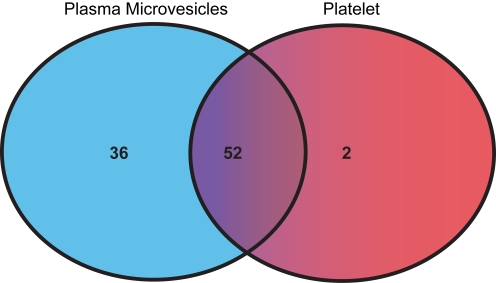
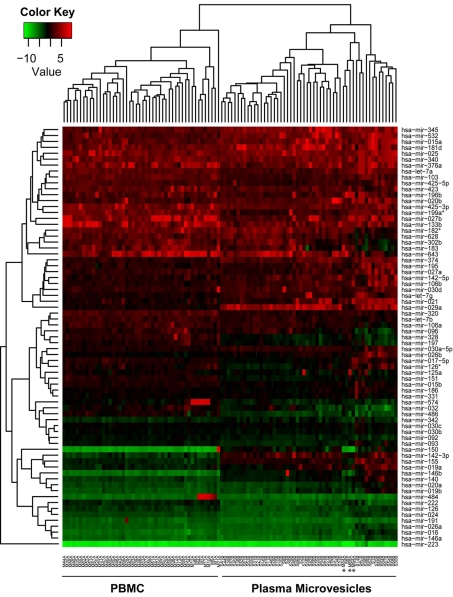
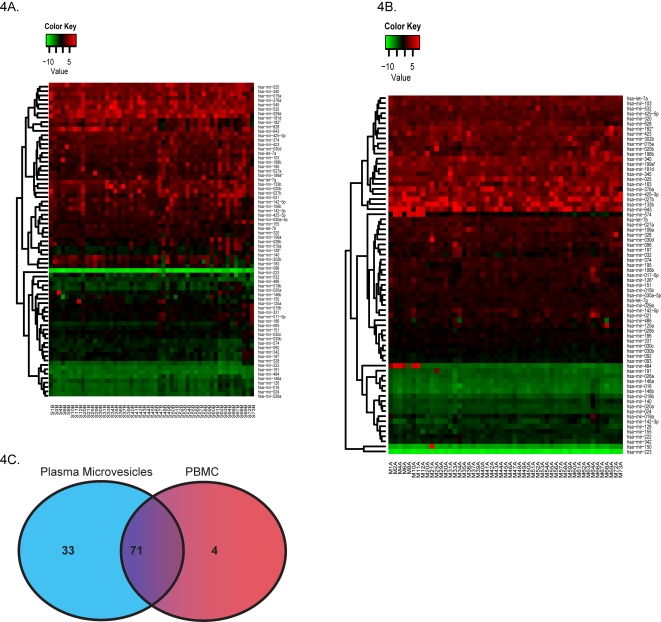
METHODOLOGY/PRINCIPAL FINDINGS: Microvesicles were isolated from the plasma of normal healthy individuals. RNA was isolated from both the microvesicles and matched mononuclear cells and profiled for 420 known mature miRNAs by real-time PCR. Hierarchical clustering of the data sets indicated significant differences in miRNA expression between peripheral blood mononuclear cells (PBMC) and plasma microvesicles. We observed 71 miRNAs co-expressed between microvesicles and PBMC. Notably, we found 33 and 4 significantly differentially expressed miRNAs in the plasma microvesicles and mononuclear cells, respectively. Prediction of the gene targets and associated biological pathways regulated by the detected miRNAs was performed. The majority of the miRNAs expressed in the microvesicles from the blood were predicted to regulate cellular differentiation of blood cells and metabolic pathways. Interestingly, a select few miRNAs were also predicted to be important modulators of immune function.
This study is the first to identify and define miRNA expression in circulating plasma microvesicles of normal subjects. The data generated from this study provides a basis for future studies to determine the predictive role of peripheral blood miRNA signatures in human disease and will enable the definition of the biological processes regulated by these miRNA.
微小RNA(miRNA)是一类小的非编码RNA,可调节mRNA和蛋白质的翻译。miRNA的表达缺失或增强与包括癌症在内的多种疾病相关。然而,健康供体中循环miRNA的鉴定尚未得到充分表征。微泡,也称为外泌体或微粒,在外周血中循环并可刺激细胞信号传导。在本研究中,我们假设在正常健康条件下,微泡含有miRNA,有助于生物稳态。
方法/主要发现:从正常健康个体的血浆中分离微泡。从微泡和匹配的单核细胞中分离RNA,并通过实时PCR对420种已知的成熟miRNA进行分析。数据集的层次聚类表明外周血单核细胞(PBMC)和血浆微泡之间miRNA表达存在显著差异。我们观察到微泡和PBMC之间共表达71种miRNA。值得注意的是,我们分别在血浆微泡和单核细胞中发现了33种和4种显著差异表达的miRNA。对检测到的miRNA调控的基因靶点和相关生物学途径进行了预测。血液中微泡表达的大多数miRNA预计可调节血细胞的细胞分化和代谢途径。有趣的是,少数几种miRNA也预计是免疫功能的重要调节因子。
本研究首次鉴定并定义了正常受试者循环血浆微泡中的miRNA表达。本研究产生的数据为未来研究确定外周血miRNA特征在人类疾病中的预测作用提供了基础,并将有助于定义这些miRNA调控的生物学过程。