Laboratorio de Arbovirus, Instituto de Virología Dr. J. M. Vanella, Facultad de Ciencias Médicas, Universidad Nacional de Córdoba, Córdoba, Argentina.
PLoS Negl Trop Dis. 2012 Jan;6(1):e1489. doi: 10.1371/journal.pntd.0001489. Epub 2012 Jan 31.
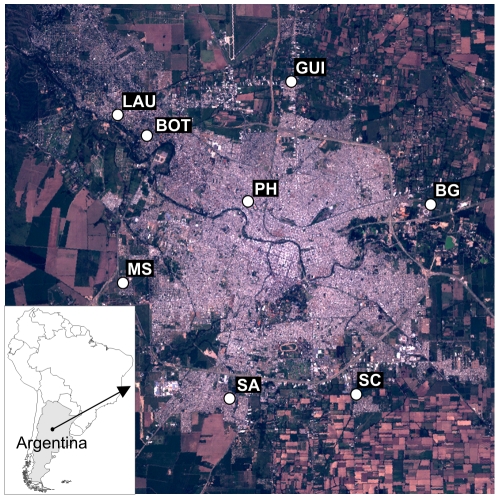
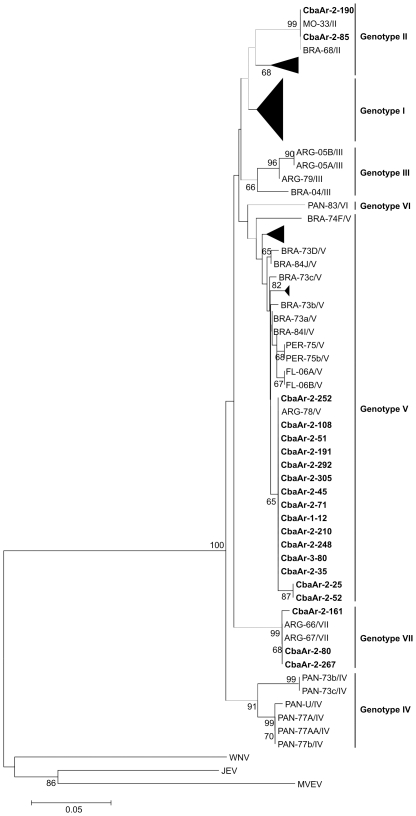
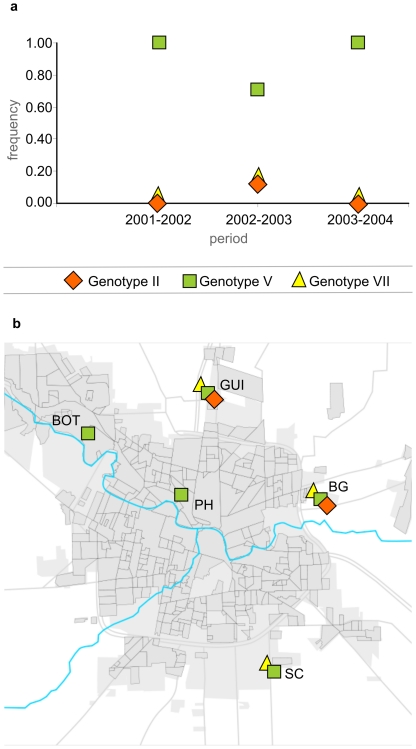
St. Louis encephalitis virus is a complex zoonoses. In 2005, 47 laboratory-confirmed and probable clinical cases of SLEV infection were reported in Córdoba, Argentina. Although the causes of 2005 outbreak remain unknown, they might be related not only to virological factors, but also to ecological and environmental conditions. We hypothesized that one of the factors for SLE reemergence in Córdoba, Argentina, was the introduction of a new SLEV genotype (SLEV genotype III), with no previous activity in the area. In order to evaluate this hypothesis we carried out a molecular characterization of SLEV detections from mosquitoes collected between 2001 and 2004 in Córdoba city. A total of 315 mosquito pools (11,002 individuals) including 12 mosquitoes species were analyzed. Overall, 20 pools (8 mosquitoes species) were positive for SLEV. During this study, genotypes II, V and VII were detected. No mosquito pool infected with genotype III was detected before the 2005 outbreak. Genotype V was found every year and in the 8 sampled sites. Genotypes II and VII showed limited temporal and spatial activities. We cannot dismiss the association of genotype II and V as etiological agents during the outbreak. However, the silent circulation of other SLEV strains in Córdoba city before the 2005 outbreak suggests that the introduction of genotype III was an important factor associated to this event. Not mutually exclusive, other factors such as changes in avian hosts and mosquitoes vectors communities, driven by climatic and environmental modifications, should also be taken into consideration in further studies.
圣路易斯型脑炎病毒是一种复杂的人畜共患病。2005 年,阿根廷科尔多瓦报告了 47 例实验室确诊和可能的临床圣路易斯型脑炎病毒感染病例。尽管 2005 年暴发的原因尚不清楚,但它们可能不仅与病毒因素有关,还与生态和环境条件有关。我们假设阿根廷科尔多瓦圣路易斯型脑炎病毒再次出现的一个因素是引入了一种新的圣路易斯型脑炎病毒基因型(圣路易斯型脑炎病毒基因型 III),该地区以前没有这种病毒。为了验证这一假设,我们对 2001 年至 2004 年期间在科尔多瓦市采集的蚊子中检测到的圣路易斯型脑炎病毒进行了分子特征分析。共分析了 315 个蚊子群(11002 只),包括 12 种蚊子。共有 20 个蚊子群(8 种蚊子)检测到圣路易斯型脑炎病毒呈阳性。在这项研究中,检测到了基因型 II、V 和 VII。在 2005 年暴发之前,没有检测到感染基因型 III 的蚊子群。基因型 V 每年都有发现,并且在 8 个采样地点都有发现。基因型 II 和 VII 的活动时间和空间有限。我们不能排除基因型 II 和 V 在暴发期间作为病原体的关联。然而,在 2005 年暴发之前,科尔多瓦市其他圣路易斯型脑炎病毒株的沉默循环表明,基因型 III 的引入是与该事件相关的一个重要因素。需要考虑的其他因素,如气候和环境变化驱动的鸟类宿主和蚊子媒介群落的变化,与这些因素并不相互排斥,也应在进一步的研究中加以考虑。