Eastern Cereal and Oilseed Research Centre, Biodiversity (Mycology and Botany), 960 Carling Ave., Ottawa, Ontario, K1A 0C6, Canada.
Stud Mycol. 2011 Nov 15;70(1):139-58. doi: 10.3114/sim.2011.70.03.
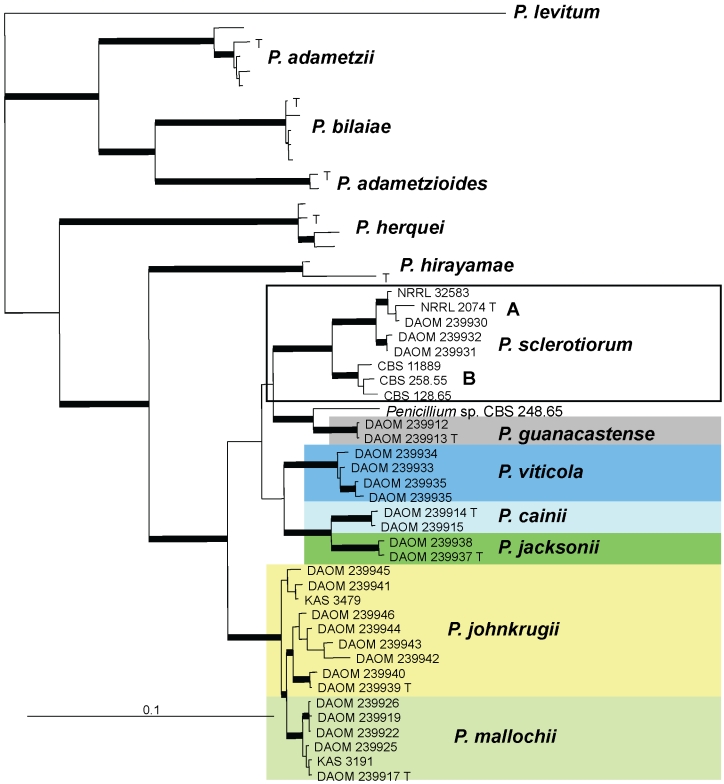
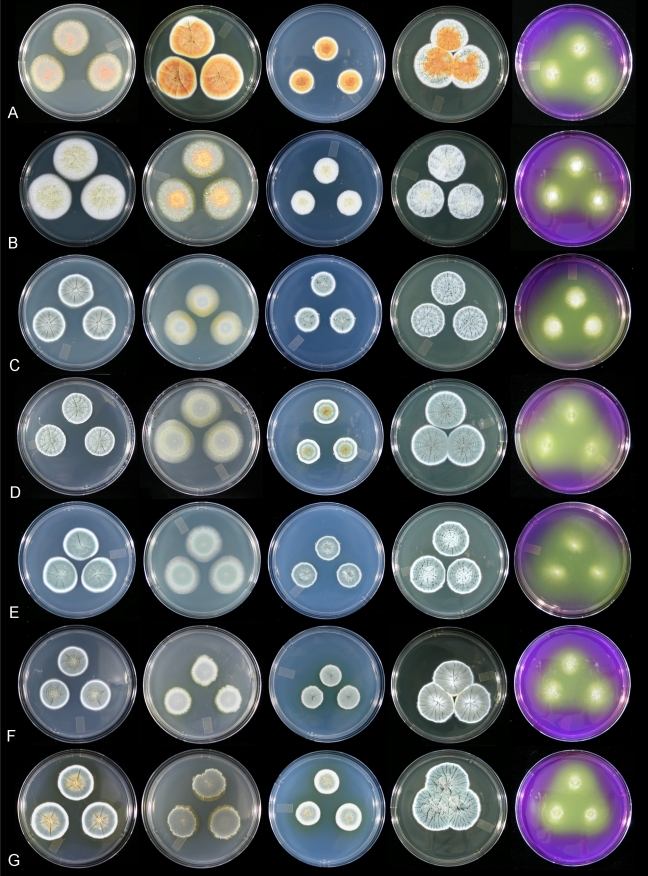
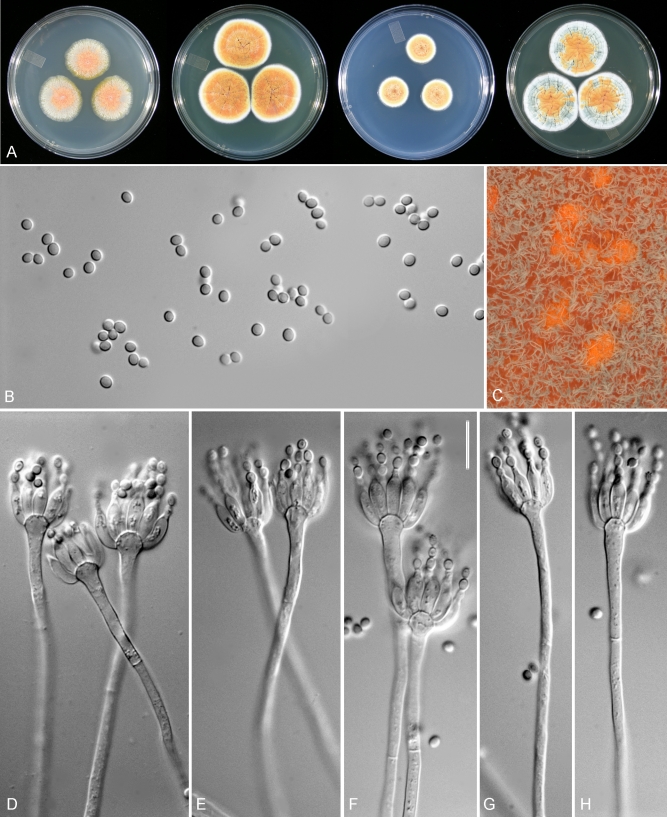
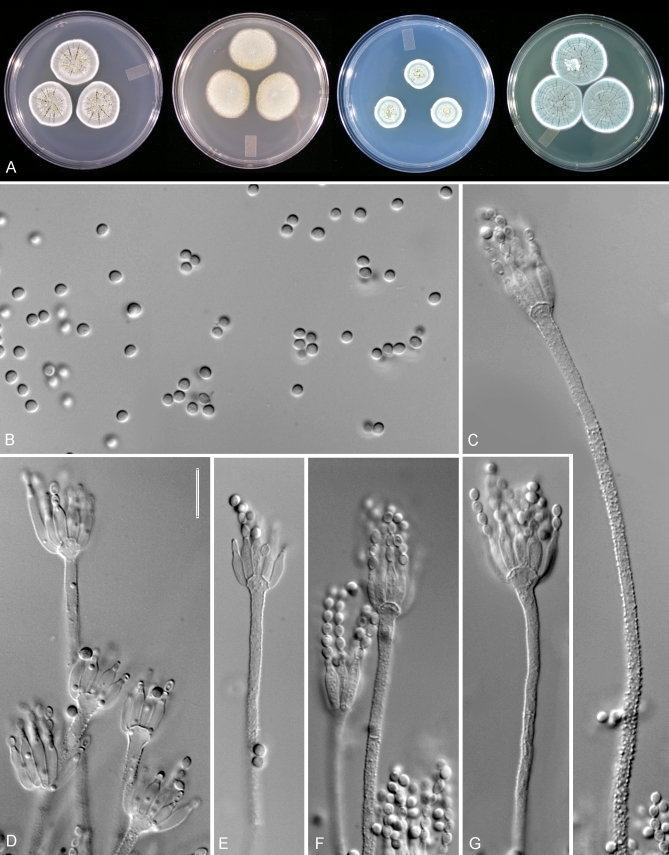
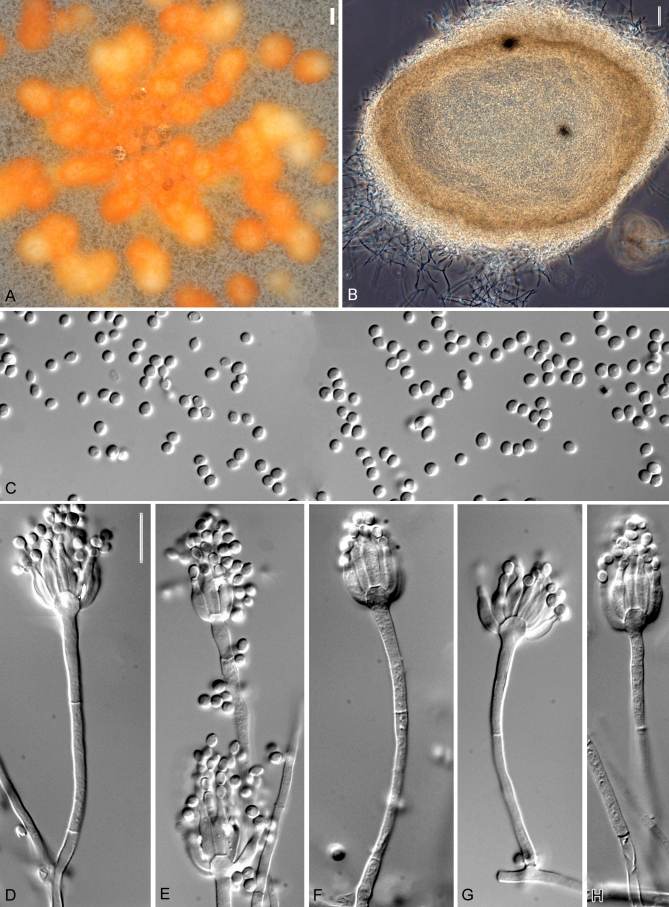
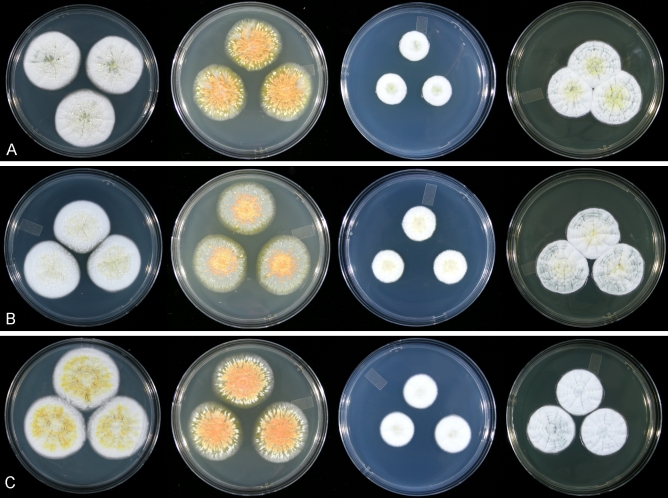
The morphological concept of Penicillium sclerotiorum (subgenus Aspergilloides) includes strains with monoverticillate, vesiculate conidiophores, and vivid orange to red colony colours, with colourful sclerotia sometimes produced. Multigene phylogenetic analyses with the nuclear ribosomal internal transcribed spacer (ITS) region, cytochrome c oxidase subunit 1 (cox1), β-tubulin (benA), translation elongation factor 1-α (tef1-α), and calmodulin (cmd), reveal that the P. sclerotiorum morphospecies is a complex of seven phylogenetically distinct species, three of which were recently described, namely P. guanacastense, P. mallochii, and P. viticola. Three previously unidentified species are described here as P. cainii, P. jacksonii, and P. johnkrugii. The phylogenetic species are morphologically similar, but differ in combinations of colony characters, sclerotium production, conidiophore stipe roughening and branching, and conidial shape. Ecological characters and differences in geographical distribution further characterise some of the species, but increased sampling is necessary to confirm these differences. The fungal DNA barcode, the ITS, and the animal DNA barcode, cox1, have lower species resolving ability in our phylogenetic analyses, but still allow identification of all the species. Tef1-α and cmd were superior in providing fully resolved, statistically well-supported phylogenetic trees for this species complex, whereas benA resolved all species but had some issues with paraphyly. Penicilliumadametzioides and P. multicolor, considered synonyms of P. sclerotiorum by some previous authors, do not belong to the P. sclerotiorum complex.
New species:Penicillium cainii K.G. Rivera, Malloch & Seifert, P. jacksonii K.G. Rivera, Houbraken & Seifert, P. johnkrugii K.G. Rivera, Houbraken & Seifert.
Penicillium sclerotiorum(拟青霉亚属)的形态概念包括单轮生、囊泡状分生孢子梗和鲜明橙色至红色菌落颜色的菌株,有时会产生有颜色的菌核。通过核核糖体内部转录间隔区(ITS)区域、细胞色素 c 氧化酶亚基 1(cox1)、β-微管蛋白(benA)、翻译延伸因子 1-α(tef1-α)和钙调蛋白(cmd)的多基因系统发育分析表明,P. sclerotiorum 形态种是七个在系统发育上明显不同的种的复合体,其中三个最近被描述,即 P. guanacastense、P. mallochii 和 P. viticola。这里描述了三个以前未鉴定的种,即 P. cainii、P. jacksonii 和 P. johnkrugii。这些系统发育种在形态上相似,但在菌落特征、菌核产生、分生孢子梗粗糙和分枝以及分生孢子形状的组合上存在差异。生态特征和地理分布的差异进一步描述了一些种,但需要增加采样来确认这些差异。真菌 DNA 条码 ITS 和动物 DNA 条码 cox1 在我们的系统发育分析中具有较低的物种分辨率能力,但仍能识别所有的种。tef1-α 和 cmd 在为这个种复合体提供完全分辨率、统计上支持良好的系统发育树方面表现优越,而 benA 则能分辨出所有的种,但存在一些并系问题。Penicillium adametzioides 和 P. multicolor,一些先前的作者认为它们是 P. sclerotiorum 的同义词,不属于 P. sclerotiorum 复合体。
Penicillium cainii K.G. Rivera, Malloch & Seifert、P. jacksonii K.G. Rivera, Houbraken & Seifert、P. johnkrugii K.G. Rivera, Houbraken & Seifert。