• 文献检索
  • 文档翻译
  • 深度研究
  • 学术资讯
  • Suppr Zotero 插件Zotero 插件
  • 邀请有礼
  • 套餐&价格
  • 历史记录
应用&插件
Suppr Zotero 插件Zotero 插件浏览器插件Mac 客户端Windows 客户端微信小程序
定价
高级版会员购买积分包购买API积分包
服务
文献检索文档翻译深度研究API 文档MCP 服务
关于我们
关于 Suppr公司介绍联系我们用户协议隐私条款
关注我们

Suppr 超能文献

核心技术专利:CN118964589B侵权必究
粤ICP备2023148730 号-1Suppr @ 2026

文献检索

告别复杂PubMed语法,用中文像聊天一样搜索,搜遍4000万医学文献。AI智能推荐,让科研检索更轻松。

立即免费搜索

文件翻译

保留排版,准确专业,支持PDF/Word/PPT等文件格式,支持 12+语言互译。

免费翻译文档

深度研究

AI帮你快速写综述,25分钟生成高质量综述,智能提取关键信息,辅助科研写作。

立即免费体验

青霉的系统发育和拟青霉科分为三个科。

Phylogeny of Penicillium and the segregation of Trichocomaceae into three families.

机构信息

CBS-KNAW Fungal Biodiversity Centre, Uppsalalaan 8, 3584 CT Utrecht, The Netherlands.

出版信息

Stud Mycol. 2011 Nov 15;70(1):1-51. doi: 10.3114/sim.2011.70.01.

DOI:10.3114/sim.2011.70.01
PMID:22308045
原文链接:https://pmc.ncbi.nlm.nih.gov/articles/PMC3233907/
Abstract

UNLABELLED

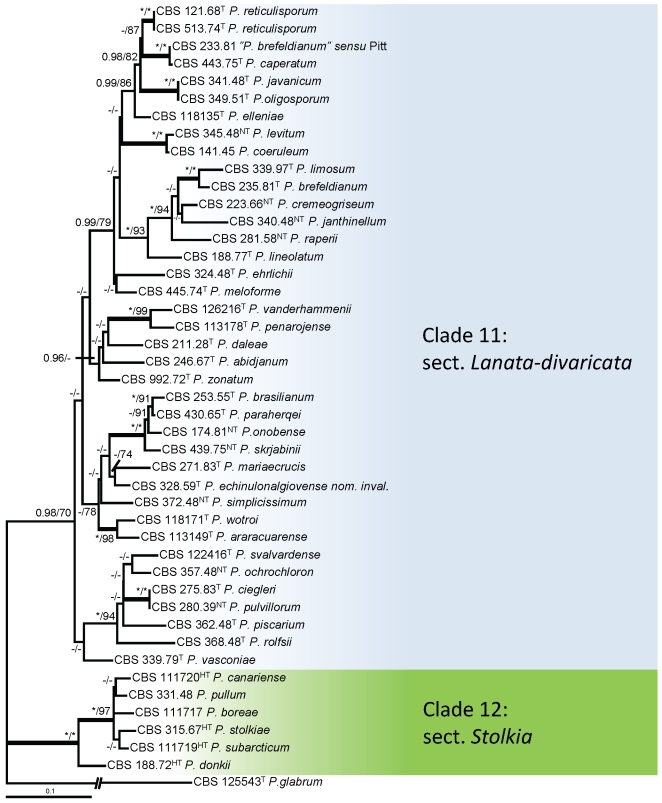
Species of Trichocomaceae occur commonly and are important to both industry and medicine. They are associated with food spoilage and mycotoxin production and can occur in the indoor environment, causing health hazards by the formation of β-glucans, mycotoxins and surface proteins. Some species are opportunistic pathogens, while others are exploited in biotechnology for the production of enzymes, antibiotics and other products. Penicillium belongs phylogenetically to Trichocomaceae and more than 250 species are currently accepted in this genus. In this study, we investigated the relationship of Penicillium to other genera of Trichocomaceae and studied in detail the phylogeny of the genus itself. In order to study these relationships, partial RPB1, RPB2 (RNA polymerase II genes), Tsr1 (putative ribosome biogenesis protein) and Cct8 (putative chaperonin complex component TCP-1) gene sequences were obtained. The Trichocomaceae are divided in three separate families: Aspergillaceae, Thermoascaceae and Trichocomaceae. The Aspergillaceae are characterised by the formation flask-shaped or cylindrical phialides, asci produced inside cleistothecia or surrounded by Hülle cells and mainly ascospores with a furrow or slit, while the Trichocomaceae are defined by the formation of lanceolate phialides, asci borne within a tuft or layer of loose hyphae and ascospores lacking a slit. Thermoascus and Paecilomyces, both members of Thermoascaceae, also form ascospores lacking a furrow or slit, but are differentiated from Trichocomaceae by the production of asci from croziers and their thermotolerant or thermophilic nature. Phylogenetic analysis shows that Penicillium is polyphyletic. The genus is re-defined and a monophyletic genus for both anamorphs and teleomorphs is created (Penicillium sensu stricto). The genera Thysanophora, Eupenicillium, Chromocleista, Hemicarpenteles and Torulomyces belong in Penicilliums. str. and new combinations for the species belonging to these genera are proposed. Analysis of Penicillium below genus rank revealed the presence of 25 clades. A new classification system including both anamorph and teleomorph species is proposed and these 25 clades are treated here as sections. An overview of species belonging to each section is presented.

TAXONOMIC NOVELTIES

New sections, all in Penicillium: sect. Sclerotiora Houbraken & Samson, sect. Charlesia Houbraken & Samson, sect. Thysanophora Houbraken & Samson,sect. Ochrosalmonea Houbraken & Samson, sect. Cinnamopurpurea Houbraken & Samson, Fracta Houbraken & Samson, sect. Stolkia Houbraken & Samson, sect. Gracilenta Houbraken & Samson, sect. Citrina Houbraken & Samson, sect. Turbata Houbraken & Samson, sect. Paradoxa Houbraken & Samson, sect. Canescentia Houbraken & Samson. New combinations:Penicillium asymmetricum (Subramanian & Sudha) Houbraken & Samson, P. bovifimosum (Tuthill & Frisvad) Houbraken & Samson, P. glaucoalbidum (Desmazières) Houbraken & Samson, P. laeve (K. Ando & Manoch) Houbraken & Samson, P. longisporum (Kendrick) Houbraken & Samson, P. malachiteum (Yaguchi & Udagawa) Houbraken & Samson, P. ovatum (K. Ando & Nawawi) Houbraken & Samson, P. parviverrucosum (K. Ando & Pitt) Houbraken & Samson, P. saturniforme (Wang & Zhuang) Houbraken & Samson, P. taiwanense (Matsushima) Houbraken & Samson. New names:Penicillium coniferophilum Houbraken & Samson, P. hennebertii Houbraken & Samson, P. melanostipe Houbraken & Samson, P. porphyreum Houbraken & Samson.

摘要

未命名

Trichocomaceae 物种普遍存在,对工业和医学都很重要。它们与食物变质和霉菌毒素生产有关,并且可以在室内环境中出现,通过形成β-葡聚糖、霉菌毒素和表面蛋白来危害健康。一些物种是机会性病原体,而另一些则被用于生物技术中,以生产酶、抗生素和其他产品。青霉属在系统发育上属于 Trichocomaceae,目前在这个属中有超过 250 个被接受的种。在这项研究中,我们研究了青霉属与 Trichocomaceae 其他属的关系,并详细研究了该属本身的系统发育。为了研究这些关系,我们获得了部分 RPB1、RPB2(RNA 聚合酶 II 基因)、Tsr1(假定核糖体生物发生蛋白)和 Cct8(假定伴侣蛋白复合物成分 TCP-1)基因序列。Trichocomaceae 分为三个独立的科:曲霉科、Thermoascaceae 和 Trichocomaceae。曲霉科的特征是形成瓶形或圆柱形的瓶梗,内生在闭囊壳内或被 Hülle 细胞包围的子囊,以及主要具有裂缝或裂缝的子囊孢子,而 Trichocomaceae 的特征是形成披针形的瓶梗,子囊生于疏松菌丝的束或层内,以及无裂缝的子囊孢子。Thermoascus 和 Paecilomyces,两者都属于 Thermoascaceae,也形成无裂缝或裂缝的子囊孢子,但与 Trichocomaceae 的区别在于子囊从十字形关节形成,以及它们的耐热或嗜热特性。系统发育分析表明,青霉属是多系的。该属被重新定义,并创建了一个用于无性型和有性型的单系属(严格意义上的青霉属)。属 Thysanophora、Eupenicillium、Chromocleista、Hemicarpenteles 和 Torulomyces 属于 Penicillium. str.,并提出了这些属的种的新组合。在属以下水平分析青霉属时,发现了 25 个分支。提出了一个包括无性型和有性型种的新分类系统,这里将这 25 个分支视为节。本文介绍了每个节的物种概述。

分类学上的新发现

Penicillium 的新节,均在 Penicillium 属内:节。Sclerotiora Houbraken & Samson、节。Charlesia Houbraken & Samson、节。Thysanophora Houbraken & Samson、节。Ochrosalmonea Houbraken & Samson、节。Cinnamopurpurea Houbraken & Samson、Fracta Houbraken & Samson、节。Stolkia Houbraken & Samson、节。Gracilenta Houbraken & Samson、节。Citrina Houbraken & Samson、节。Turbata Houbraken & Samson、节。Paradoxa Houbraken & Samson、节。Canescentia Houbraken & Samson。新组合:Penicillium asymmetricum (Subramanian & Sudha) Houbraken & Samson、P. bovifimosum (Tuthill & Frisvad) Houbraken & Samson、P. glaucoalbidum (Desmazières) Houbraken & Samson、P. laeve (K. Ando & Manoch) Houbraken & Samson、P. longisporum (Kendrick) Houbraken & Samson、P. malachiteum (Yaguchi & Udagawa) Houbraken & Samson、P. ovatum (K. Ando & Nawawi) Houbraken & Samson、P. parviverrucosum (K. Ando & Pitt) Houbraken & Samson、P. saturniforme (Wang & Zhuang) Houbraken & Samson、P. taiwanense (Matsushima) Houbraken & Samson。新名称:Penicillium coniferophilum Houbraken & Samson、P. hennebertii Houbraken & Samson、P. melanostipe Houbraken & Samson、P. porphyreum Houbraken & Samson。

https://cdn.ncbi.nlm.nih.gov/pmc/blobs/b9e9/3233907/31bdddb9a547/1fig9.jpg
https://cdn.ncbi.nlm.nih.gov/pmc/blobs/b9e9/3233907/379fc68c3f84/1fig1a.jpg
https://cdn.ncbi.nlm.nih.gov/pmc/blobs/b9e9/3233907/39052028db26/1fig7.jpg
https://cdn.ncbi.nlm.nih.gov/pmc/blobs/b9e9/3233907/58c055a8f885/1fig8.jpg
https://cdn.ncbi.nlm.nih.gov/pmc/blobs/b9e9/3233907/36931d64fda9/1fig10.jpg
https://cdn.ncbi.nlm.nih.gov/pmc/blobs/b9e9/3233907/f49fec7e35d1/1fig11.jpg
https://cdn.ncbi.nlm.nih.gov/pmc/blobs/b9e9/3233907/8885fb11433b/1fig12.jpg
https://cdn.ncbi.nlm.nih.gov/pmc/blobs/b9e9/3233907/27058a1403d1/1fig13a.jpg
https://cdn.ncbi.nlm.nih.gov/pmc/blobs/b9e9/3233907/f5d1d555617a/1fig2.jpg
https://cdn.ncbi.nlm.nih.gov/pmc/blobs/b9e9/3233907/3365118036b6/1fig3.jpg
https://cdn.ncbi.nlm.nih.gov/pmc/blobs/b9e9/3233907/9da3e206963e/1fig4.jpg
https://cdn.ncbi.nlm.nih.gov/pmc/blobs/b9e9/3233907/5623b0e7f5dc/1fig5.jpg
https://cdn.ncbi.nlm.nih.gov/pmc/blobs/b9e9/3233907/a94547c2bae0/1fig6.jpg
https://cdn.ncbi.nlm.nih.gov/pmc/blobs/b9e9/3233907/31bdddb9a547/1fig9.jpg
https://cdn.ncbi.nlm.nih.gov/pmc/blobs/b9e9/3233907/379fc68c3f84/1fig1a.jpg
https://cdn.ncbi.nlm.nih.gov/pmc/blobs/b9e9/3233907/39052028db26/1fig7.jpg
https://cdn.ncbi.nlm.nih.gov/pmc/blobs/b9e9/3233907/58c055a8f885/1fig8.jpg
https://cdn.ncbi.nlm.nih.gov/pmc/blobs/b9e9/3233907/36931d64fda9/1fig10.jpg
https://cdn.ncbi.nlm.nih.gov/pmc/blobs/b9e9/3233907/f49fec7e35d1/1fig11.jpg
https://cdn.ncbi.nlm.nih.gov/pmc/blobs/b9e9/3233907/8885fb11433b/1fig12.jpg
https://cdn.ncbi.nlm.nih.gov/pmc/blobs/b9e9/3233907/27058a1403d1/1fig13a.jpg
https://cdn.ncbi.nlm.nih.gov/pmc/blobs/b9e9/3233907/f5d1d555617a/1fig2.jpg
https://cdn.ncbi.nlm.nih.gov/pmc/blobs/b9e9/3233907/3365118036b6/1fig3.jpg
https://cdn.ncbi.nlm.nih.gov/pmc/blobs/b9e9/3233907/9da3e206963e/1fig4.jpg
https://cdn.ncbi.nlm.nih.gov/pmc/blobs/b9e9/3233907/5623b0e7f5dc/1fig5.jpg
https://cdn.ncbi.nlm.nih.gov/pmc/blobs/b9e9/3233907/a94547c2bae0/1fig6.jpg
https://cdn.ncbi.nlm.nih.gov/pmc/blobs/b9e9/3233907/31bdddb9a547/1fig9.jpg

相似文献

1
Phylogeny of Penicillium and the segregation of Trichocomaceae into three families.青霉的系统发育和拟青霉科分为三个科。
Stud Mycol. 2011 Nov 15;70(1):1-51. doi: 10.3114/sim.2011.70.01.
2
Classification of , , and related genera (): An overview of families, genera, subgenera, sections, series and species.[具体属名]、[具体属名]、[具体属名]及相关属的分类([具体分类级别]):科、属、亚属、组、系及物种概述
Stud Mycol. 2020 Jun 27;95:5-169. doi: 10.1016/j.simyco.2020.05.002. eCollection 2020 Mar.
3
Phylogeny and nomenclature of the genus Talaromyces and taxa accommodated in Penicillium subgenus Biverticillium.塔玛尔青霉属的系统发育和命名及归入青霉属毕赤酵母亚属中的分类单元。
Stud Mycol. 2011 Nov 15;70(1):159-83. doi: 10.3114/sim.2011.70.04.
4
Taxonomy of Penicillium section Citrina.青霉属Citrina 组的分类。
Stud Mycol. 2011 Nov 15;70(1):53-138. doi: 10.3114/sim.2011.70.02.
5
A review of recently introduced , , and other species.对最近引入的[具体物种未明确列出]以及其他[物种类型未明确列出]物种的综述。
Stud Mycol. 2024 Mar;107:1-66. doi: 10.3114/sim.2024.107.01. Epub 2024 Jan 10.
6
Taxonomy, phylogeny and identification of with emphasis on thermophilic species.分类学、系统发育学以及(相关物种的)鉴定,重点关注嗜热物种。
Stud Mycol. 2022 Jul;101:121-243. doi: 10.3114/sim.2022.101.03. Epub 2022 Apr 1.
7
is monophyletic: Evidence from multiple gene phylogenies and extrolites profiles.是单系的:来自多个基因系统发育和次生代谢产物谱的证据。
Stud Mycol. 2016 Sep;85:199-213. doi: 10.1016/j.simyco.2016.11.006. Epub 2016 Nov 29.
8
Redefining and related genera in the .在……中重新定义及相关属。 (原文不完整,翻译可能不太准确,需结合完整内容进一步完善)
Stud Mycol. 2019 Jun;93:65-153. doi: 10.1016/j.simyco.2018.07.001. Epub 2018 Aug 7.
9
Phylogenetic re-evaluation of with the introduction of a new family .随着一个新科的引入对……进行系统发育重新评估。 (注:原文中“Phylogenetic re-evaluation of ”后面似乎缺少具体内容)
Stud Mycol. 2019 Aug 21;93:155-252. doi: 10.1016/j.simyco.2019.08.002. eCollection 2019 Jun.
10
A taxonomic review of Penicillium species producing conidiophores with solitary phialides, classified in section Torulomyces.对分类于串珠霉组、产生具单个瓶梗分生孢子梗的青霉属物种的分类学综述。
Persoonia. 2016 Jun;36:134-55. doi: 10.3767/003158516X690952. Epub 2016 Feb 8.

引用本文的文献

1
Occurrence of and Species, Accumulation of Fungal Secondary Metabolites, and qPCR Detection of Potential Aflatoxigenic Species in Chickpea ( L.) Seeds from Different Farming Systems.不同种植系统下鹰嘴豆(鹰嘴豆属)种子中真菌种类的出现、真菌次生代谢产物的积累以及潜在产黄曲霉毒素真菌种类的定量聚合酶链反应检测
Foods. 2025 Jul 25;14(15):2610. doi: 10.3390/foods14152610.
2
sp. nov., A Novel Soil Fungus from Korea.新种,一种来自韩国的新型土壤真菌。
Mycobiology. 2025 Aug 7;53(5):629-636. doi: 10.1080/12298093.2025.2535782. eCollection 2025.
3
Exploring the diversity and pathogenicity of species isolated from clinical in Southern China.

本文引用的文献

1
Penicillium menonorum, a new species related to P. pimiteouiense.Penicillium menonorum,一种与 P. pimiteouiense 相关的新物种。
IMA Fungus. 2011 Dec;2(2):121-5. doi: 10.5598/imafungus.2011.02.02.02. Epub 2011 Sep 29.
2
The amsterdam declaration on fungal nomenclature.《关于真菌命名的阿姆斯特丹宣言》。
IMA Fungus. 2011 Jun;2(1):105-12. doi: 10.5598/imafungus.2011.02.01.14. Epub 2011 Jun 7.
3
Fleming's penicillin producing strain is not Penicillium chrysogenum but P. rubens.弗莱明的青霉素产生菌株不是产黄青霉,而是红青霉。
探索中国南方临床分离菌株的多样性及致病性。
Front Microbiol. 2025 Jun 26;16:1610481. doi: 10.3389/fmicb.2025.1610481. eCollection 2025.
4
Exploring fungal pathogens to control the plant invasive Rubus niveus on Galapagos Island San Cristobal.探索真菌病原体以控制加拉帕戈斯群岛圣克里斯托瓦尔岛上的入侵植物悬钩子。
Sci Rep. 2025 Jul 1;15(1):20358. doi: 10.1038/s41598-025-08949-5.
5
Two new species of and a new genus in from the forest dump-sites in Chiang Mai, Thailand.来自泰国清迈森林垃圾场的 两个新物种及 中的一个新属。 (注:原文中部分内容缺失,导致翻译可能不太完整准确)
MycoKeys. 2025 Apr 29;116:275-301. doi: 10.3897/mycokeys.116.150635. eCollection 2025.
6
Two new species of (Eurotiales, Aspergillaceae) from China based on morphological and molecular analyses.基于形态学和分子分析的来自中国的曲霉属(散囊菌目,曲霉科)两个新物种
MycoKeys. 2025 Apr 25;116:255-274. doi: 10.3897/mycokeys.116.149376. eCollection 2025.
7
Phylogenetic and ecological drivers of the avian lung mycobiome and its potentially pathogenic component.鸟类肺部真菌微生物组及其潜在致病成分的系统发育和生态驱动因素。
Commun Biol. 2025 Apr 19;8(1):634. doi: 10.1038/s42003-025-08041-8.
8
Inside out: New root endophytic and species isolated from orchids () in Brazil.由内而外:从巴西兰花()中分离出的新的根内生菌和物种。
Fungal Syst Evol. 2025 Jun;15:179-200. doi: 10.3114/fuse.2025.15.08. Epub 2025 Jan 29.
9
Unearthing limestone fungal diversity: Description of seven novel species from Portugal.发掘石灰岩真菌的多样性:来自葡萄牙的七个新物种的描述。
Fungal Syst Evol. 2025 Jun;15:47-77. doi: 10.3114/fuse.2025.15.02. Epub 2024 Oct 2.
10
, , and () in Brazilian caves, with the description of four new species.巴西洞穴中的[具体物种名称未给出]、[具体物种名称未给出]和[具体物种名称未给出]([物种所属类别未给出]),并描述了四个新物种。
Fungal Syst Evol. 2024 Dec;14:89-107. doi: 10.3114/fuse.2024.14.06. Epub 2024 Mar 15.
IMA Fungus. 2011 Jun;2(1):87-95. doi: 10.5598/imafungus.2011.02.01.12. Epub 2011 Jun 7.
4
Aspergillus sect. Aeni sect. nov., a new section of the genus for A.karnatakaensis sp. nov. and some allied fungi.曲霉属新节丛赤壳组,包括新种卡纳塔克曲霉和相关真菌。
IMA Fungus. 2010 Dec;1(2):197-205. doi: 10.5598/imafungus.2010.01.02.13. Epub 2010 Nov 26.
5
Sex in Penicillium series Roqueforti.青霉属罗克福尔亚种的性行为。
IMA Fungus. 2010 Dec;1(2):171-80. doi: 10.5598/imafungus.2010.01.02.10. Epub 2010 Nov 23.
6
Phylogeny and nomenclature of the genus Talaromyces and taxa accommodated in Penicillium subgenus Biverticillium.塔玛尔青霉属的系统发育和命名及归入青霉属毕赤酵母亚属中的分类单元。
Stud Mycol. 2011 Nov 15;70(1):159-83. doi: 10.3114/sim.2011.70.04.
7
A taxonomic and phylogenetic revision of the Penicillium sclerotiorum complex.青霉属 sclerotiorum 复合体的分类学和系统发育修订。
Stud Mycol. 2011 Nov 15;70(1):139-58. doi: 10.3114/sim.2011.70.03.
8
Taxonomy of Penicillium section Citrina.青霉属Citrina 组的分类。
Stud Mycol. 2011 Nov 15;70(1):53-138. doi: 10.3114/sim.2011.70.02.
9
Phylogeny and intraspecific variation of the extreme xerophile, Xeromyces bisporus.极端嗜旱真菌双孢拟内孢霉的系统发育和种内变异。
Fungal Biol. 2011 Nov;115(11):1100-11. doi: 10.1016/j.funbio.2011.06.012. Epub 2011 Jul 22.
10
Rasamsonia, a new genus comprising thermotolerant and thermophilic Talaromyces and Geosmithia species.拉沙蒙西亚属,包含耐热和嗜热的拟青霉属和地丝霉属种的一个新属。
Antonie Van Leeuwenhoek. 2012 Feb;101(2):403-21. doi: 10.1007/s10482-011-9647-1. Epub 2011 Oct 2.