Department of General Surgery, Graduate School of Medicine, Chiba University, 1-8-1, Inohana, Chuo-ku, Chiba 260-0856, Japan.
BMC Cancer. 2012 Feb 6;12:56. doi: 10.1186/1471-2407-12-56.
Although fibroblast growth factor 19 (FGF19) can promote liver carcinogenesis in mice, its involvement in human hepatocellular carcinoma (HCC) has not been well investigated. FGF19, a member of the FGF family, has unique specificity for its receptor FGFR4. This study aimed to clarify the involvement of FGF19 in the development of HCC.
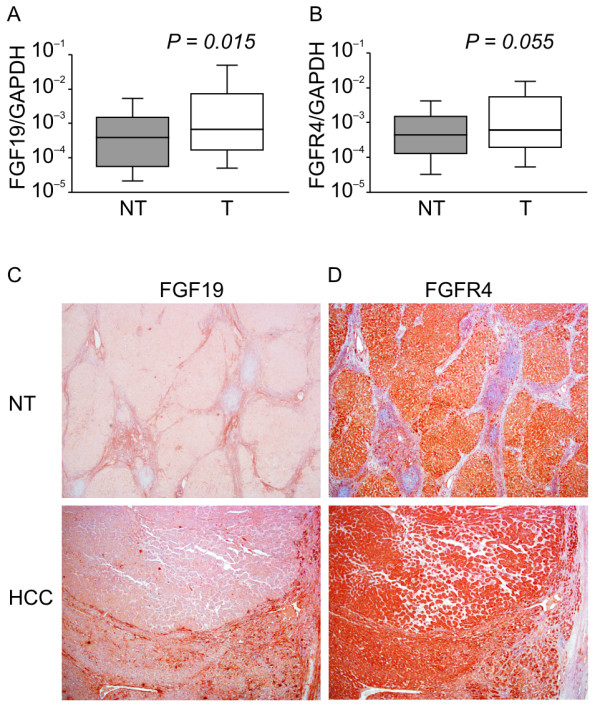
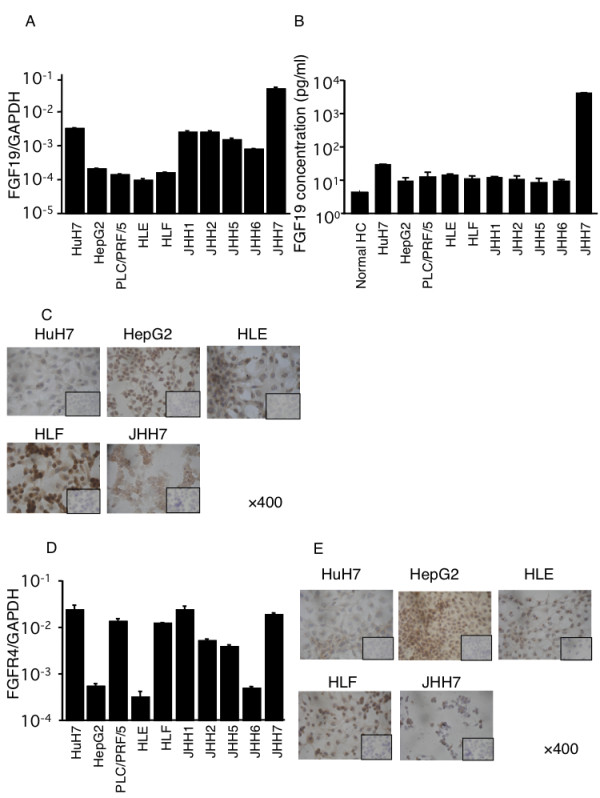
We investigated human FGF19 and FGFR4 expression in 40 hepatocellular carcinoma specimens using quantitative real-time reverse transcription polymerase chain reaction (RT-PCR) analysis and immunohistochemistry. Moreover, we examined the expression and the distribution of FGF19 and FGFR4 in 5 hepatocellular carcinoma cell lines (HepG2, HuH7, HLE, HLF, and JHH7) using RT-PCR and immunohistochemistry. To test the role of the FGF19/FGFR4 system in tumor progression, we used recombinant FGF19 protein and small interfering RNA (siRNA) of FGF19 and FGFR4 to regulate their concentrations.
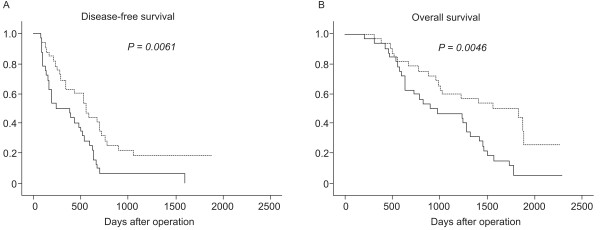
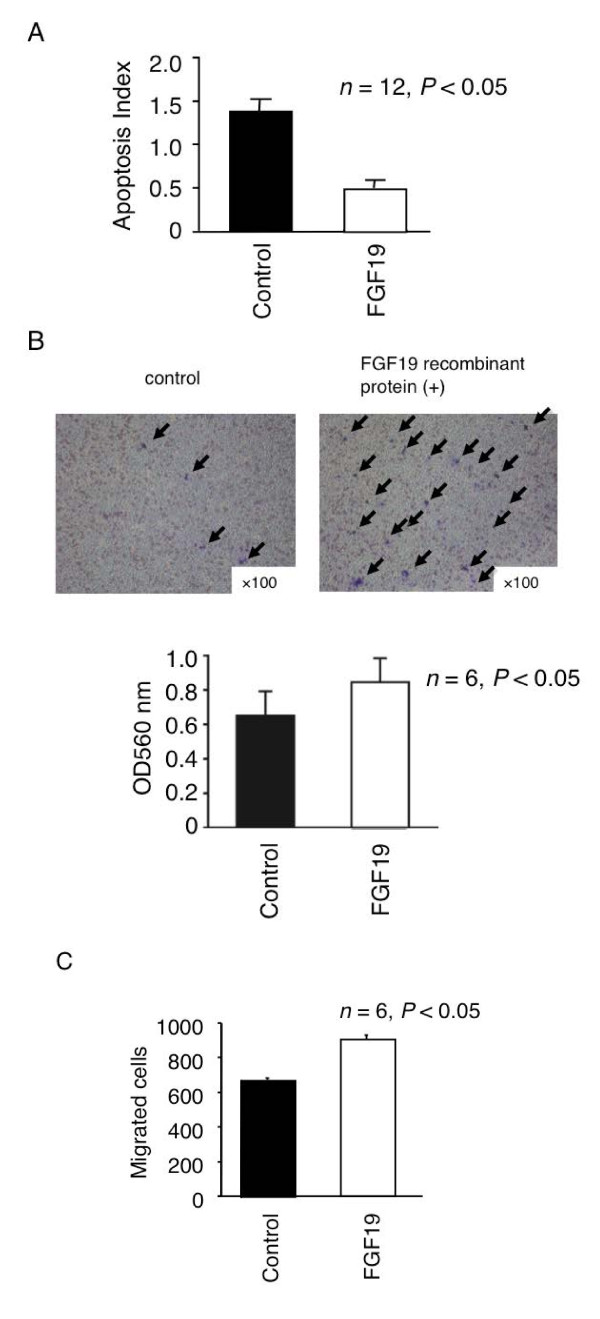
We found that FGF19 was significantly overexpressed in HCCs as compared with corresponding noncancerous liver tissue (P < 0.05). Univariate and multivariate analyses revealed that the tumor FGF19 mRNA expression was an independent prognostic factor for overall and disease-free survival. Moreover, we found that the FGF19 recombinant protein could increase the proliferation (P < 0.01, n = 12) and invasion (P < 0.01, n = 6) capabilities of human hepatocellular carcinoma cell lines and inhibited their apoptosis (P < 0.01, n = 12). Inversely, decreasing FGF19 and FGFR4 expression by siRNA significantly inhibited proliferation and increased apoptosis in JHH7 cells (P < 0.01, n = 12). The postoperative serum FGF19 levels in HCC patients was significantly lower than the preoperative levels (P < 0.01, n = 29).
FGF19 is critically involved in the development of HCCs. Targeting FGF19 inhibition is an attractive potential therapeutic strategy for HCC.
尽管成纤维细胞生长因子 19(FGF19)可在小鼠中促进肝癌的发生,但它在人类肝细胞癌(HCC)中的作用尚未得到充分研究。FGF19 是 FGF 家族的成员,对其受体 FGFR4 具有独特的特异性。本研究旨在阐明 FGF19 在 HCC 发展中的作用。
我们使用定量实时逆转录聚合酶链反应(RT-PCR)分析和免疫组织化学方法研究了 40 例肝癌标本中的人 FGF19 和 FGFR4 表达。此外,我们使用 RT-PCR 和免疫组织化学方法检查了 5 种肝癌细胞系(HepG2、HuH7、HLE、HLF 和 JHH7)中 FGF19 和 FGFR4 的表达和分布。为了测试 FGF19/FGFR4 系统在肿瘤进展中的作用,我们使用重组 FGF19 蛋白和 FGF19 和 FGFR4 的小干扰 RNA(siRNA)来调节它们的浓度。
我们发现 FGF19 在 HCC 中明显过表达,与相应的非癌性肝组织相比(P <0.05)。单因素和多因素分析显示,肿瘤 FGF19 mRNA 表达是总生存期和无病生存期的独立预后因素。此外,我们发现 FGF19 重组蛋白可以增加人肝癌细胞系的增殖(P <0.01,n=12)和侵袭(P <0.01,n=6)能力,并抑制其凋亡(P <0.01,n=12)。相反,通过 siRNA 降低 FGF19 和 FGFR4 的表达显著抑制了 JHH7 细胞的增殖并增加了其凋亡(P <0.01,n=12)。肝癌患者术后血清 FGF19 水平明显低于术前水平(P <0.01,n=29)。
FGF19 参与 HCC 的发展。靶向 FGF19 抑制可能是 HCC 的一种有吸引力的潜在治疗策略。