Li Yan, Zhang Weizhong, Doughtie Anne, Cui Guozhen, Li Xuanyi, Pandit Harshul, Yang Yingbin, Li Suping, Martin Robert
Division of Surgical Oncology, Department of Surgery, School of Medicine, University of Louisville, Louisville, KY, 40202, USA.
Department of Hand Surgery, China-Japan Union Hospital, Jilin University, Changchun, Jilin, 130022, China.
Oncotarget. 2016 Aug 9;7(32):52329-52339. doi: 10.18632/oncotarget.10750.
Human fibroblast growth factor 19 (FGF19), its receptor (FGFR4) and EpCAM play an important role in cell proliferation, differentiation, motility, and overexpression have been linked to hepatocellular carcinoma (HCC). The aim of this study was to evaluate the FGF19 signals responsible for the progression of HCC arising from fatty liver.
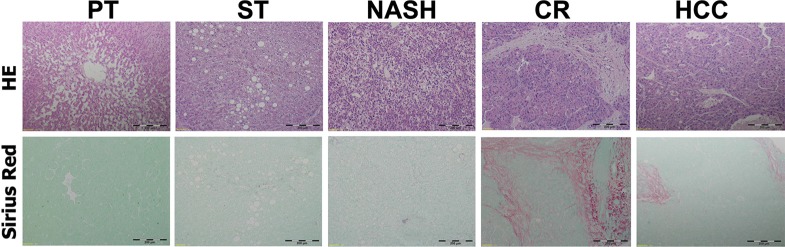
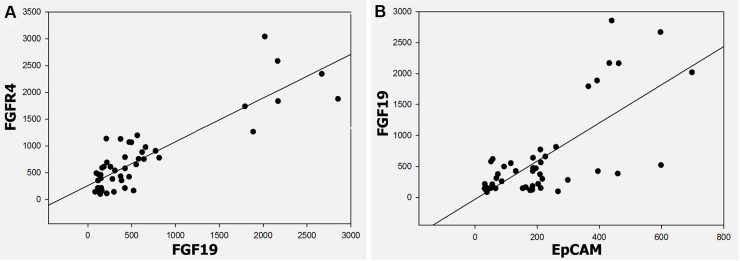
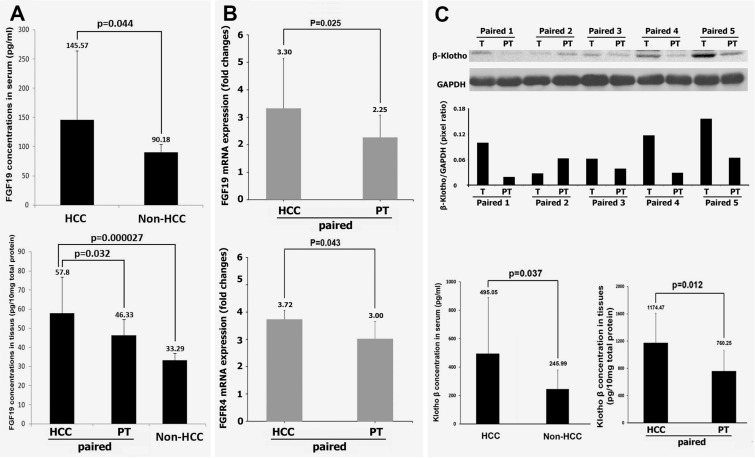
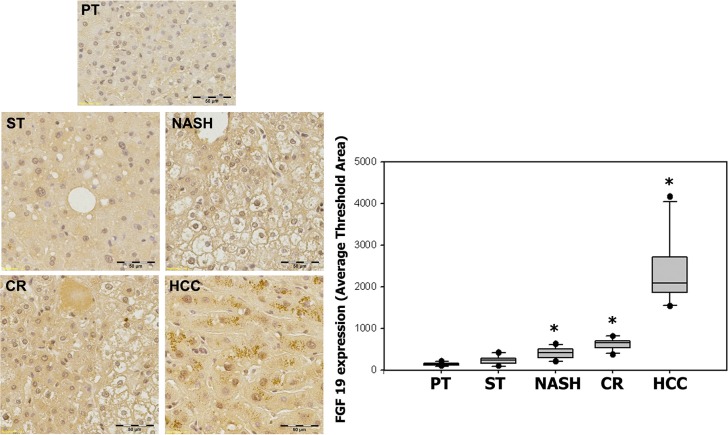
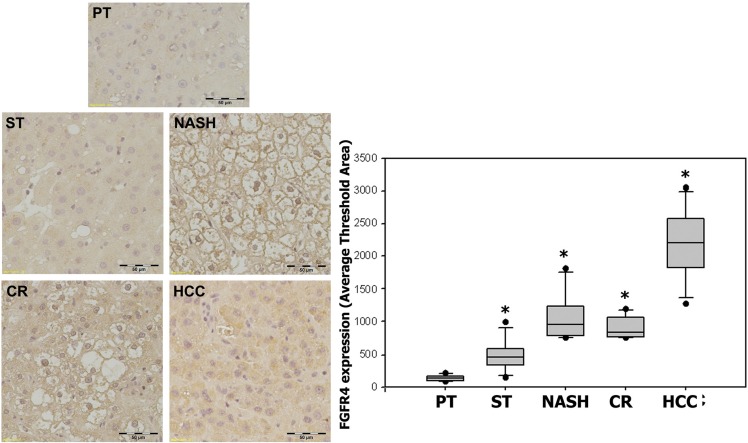
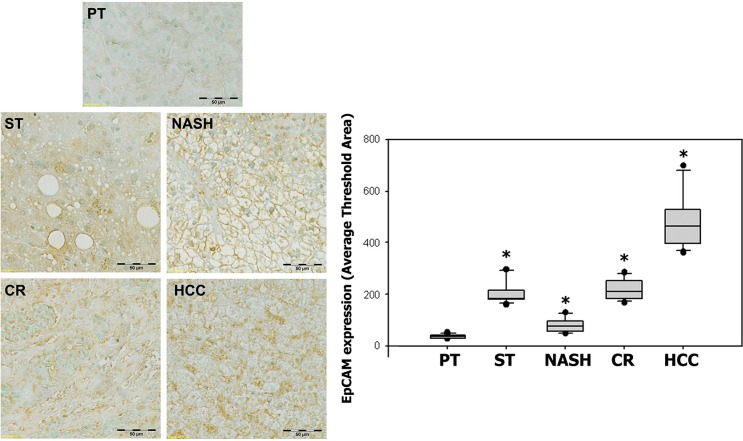
FGF19 level was significantly increased in the HCC patients' serum compared to non-HCC controls. The IHC results demonstrated significant increases of protein expressions of FGF19, FGFR4 and EpCAM in specimens with fatty liver, NASH, cirrhosis, and HCC compared to healthy liver tissue. There was a significant positive correlation between the protein expressions (FGF19, FGFR4, and EpCAM) and histopathologic changes from FL to HCC. Furthermore, FGF19 was positively correlated with FGFR4 and with EpCAM.
FGF19 protein levels in serum and tissues were determined by ELISA assay. The FGFR4, and EpCAM expression and tissue distribution were further evaluated by immunohistochemical staining in tissue array samples. FGF19, FGFR4 and EpCAM expressions between the different histologic stages of fatty liver steatohepatitis-cirrhosis-HCC carcinogenesis sequence were compared to healthy hepatic tissue.
Overexpression of FGF19/FGFR4 significantly correlated with EpCAM as a marker of hepatic cancer stem cells within the fatty liver-steatosis-cirrhosis-HCC sequence.
This is the first study to elucidate FGF19/FGFR4 signaling in favor of HCC cells developing as indicated by increased EpCAM within the carcinogenesis sequence from fatty liver to hepatocellular carcinoma. Our study has the potential to yield novel and cost effective screening strategies for HCC patients.
人成纤维细胞生长因子19(FGF19)、其受体(FGFR4)和上皮细胞粘附分子(EpCAM)在细胞增殖、分化和运动中起重要作用,其过表达与肝细胞癌(HCC)有关。本研究旨在评估导致脂肪肝来源的HCC进展的FGF19信号。
与非HCC对照组相比,HCC患者血清中FGF19水平显著升高。免疫组化结果显示,与健康肝组织相比,脂肪肝、非酒精性脂肪性肝炎、肝硬化和HCC标本中FGF19、FGFR4和EpCAM的蛋白表达显著增加。蛋白表达(FGF19、FGFR4和EpCAM)与从脂肪肝到HCC的组织病理学变化之间存在显著正相关。此外,FGF19与FGFR4以及与EpCAM呈正相关。
采用酶联免疫吸附测定法测定血清和组织中的FGF19蛋白水平。通过组织芯片样本的免疫组化染色进一步评估FGFR4和EpCAM的表达及组织分布。将脂肪肝-脂肪性肝炎-肝硬化-HCC致癌序列不同组织学阶段的FGF19、FGFR4和EpCAM表达与健康肝组织进行比较。
FGF19/FGFR4的过表达与EpCAM显著相关,EpCAM是脂肪肝-脂肪变性-肝硬化-HCC序列中肝癌干细胞的标志物。
这是第一项阐明FGF19/FGFR4信号传导有利于HCC细胞发展的研究,如在从脂肪肝到肝细胞癌的致癌序列中EpCAM增加所示。我们的研究有可能为HCC患者产生新的且具有成本效益的筛查策略。