Institute of Molecular Biosciences, Lipidomics Research Center LRC Graz, University of Graz, 8010 Graz, Austria.
J Biol Chem. 2012 Mar 30;287(14):11164-73. doi: 10.1074/jbc.M111.316794. Epub 2012 Feb 6.
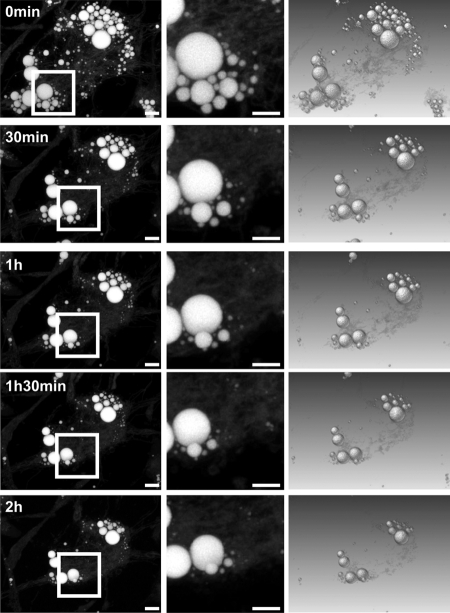
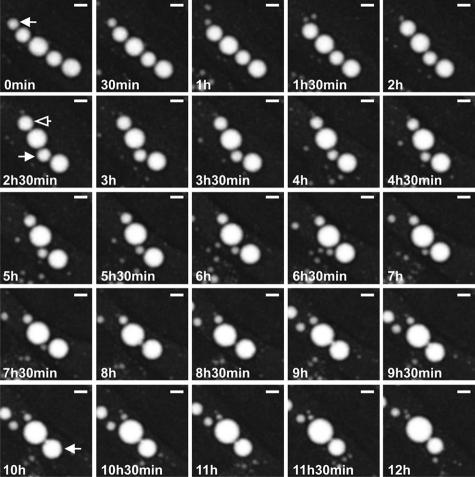
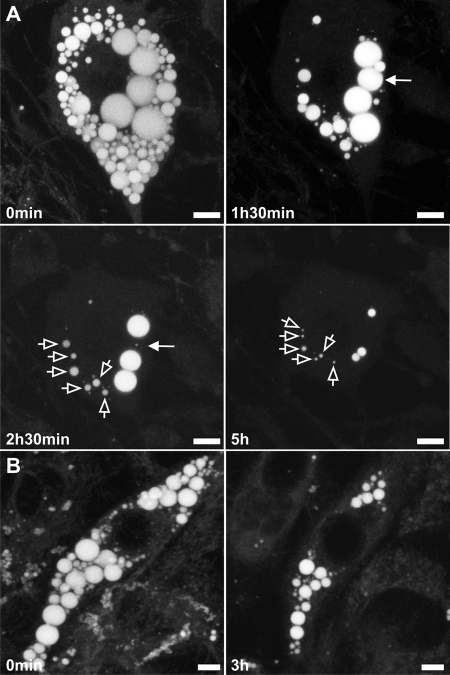
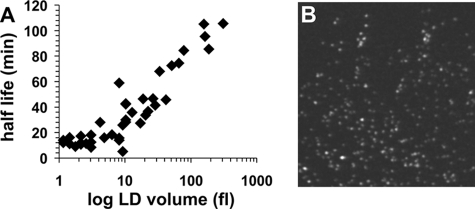
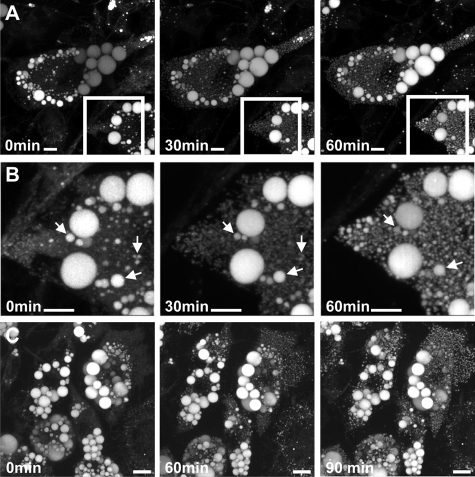
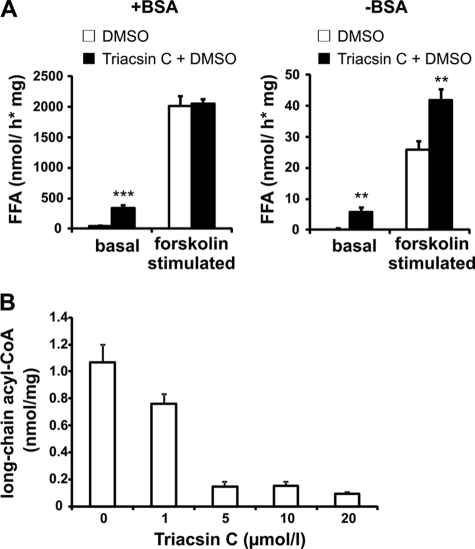
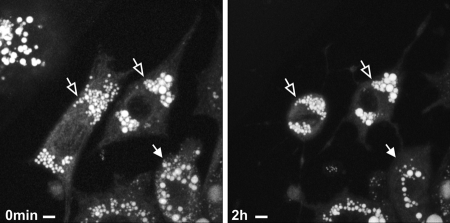
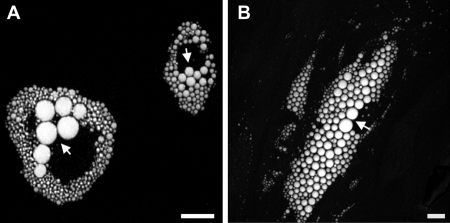
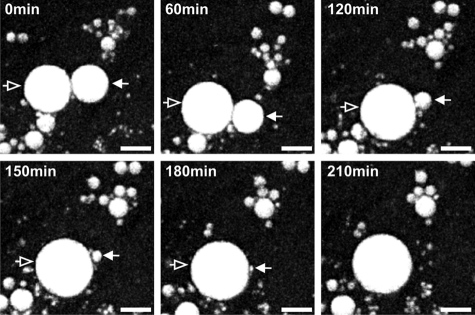
Synthesis, storage, and turnover of triacylglycerols (TAGs) in adipocytes are critical cellular processes to maintain lipid and energy homeostasis in mammals. TAGs are stored in metabolically highly dynamic lipid droplets (LDs), which are believed to undergo fragmentation and fusion under lipolytic and lipogenic conditions, respectively. Time lapse fluorescence microscopy showed that stimulation of lipolysis in 3T3-L1 adipocytes causes progressive shrinkage and almost complete degradation of all cellular LDs but without any detectable fragmentation into micro-LDs (mLDs). However, mLDs were rapidly formed after induction of lipolysis in the absence of BSA in the culture medium that acts as a fatty acid scavenger. Moreover, mLD formation was blocked by the acyl-CoA synthetase inhibitor triacsin C, implicating that mLDs are synthesized de novo in response to cellular fatty acid overload. Using label-free coherent anti-Stokes Raman scattering microscopy, we demonstrate that LDs grow by transfer of lipids from one organelle to another. Notably, this lipid transfer between closely associated LDs is not a rapid and spontaneous process but rather occurs over several h and does not appear to require physical interaction over large LD surface areas. These data indicate that LD growth is a highly regulated process leading to the heterogeneous LD size distribution within and between individual cells. Our findings suggest that lipolysis and lipogenesis occur in parallel in a cell to prevent cellular fatty acid overflow. Furthermore, we propose that formation of large LDs requires a yet uncharacterized protein machinery mediating LD interaction and lipid transfer.
脂肪细胞中三酰甘油(TAG)的合成、储存和周转是维持哺乳动物脂质和能量稳态的关键细胞过程。TAG 储存在代谢上高度动态的脂滴(LD)中,据信在脂肪分解和脂肪生成条件下分别发生碎裂和融合。延时荧光显微镜显示,刺激 3T3-L1 脂肪细胞中的脂肪分解导致所有细胞 LD 的渐进性收缩和几乎完全降解,但没有任何可检测到的微 LD(mLD)碎裂。然而,在培养基中没有 BSA 的情况下诱导脂肪分解后,mLD 会迅速形成,BSA 作为脂肪酸清除剂。此外,酰基辅酶 A 合成酶抑制剂三辛精 C 阻断了 mLD 的形成,表明 mLD 是为了应对细胞脂肪酸过载而从头合成的。使用无标记相干反斯托克斯拉曼散射显微镜,我们证明 LD 通过从一个细胞器向另一个细胞器转移脂质来生长。值得注意的是,这种密切相关的 LD 之间的脂质转移不是一个快速和自发的过程,而是在几个小时内发生,似乎不需要在大的 LD 表面积上进行物理相互作用。这些数据表明,LD 生长是一个高度调节的过程,导致单个细胞内和细胞间的 LD 大小分布不均匀。我们的发现表明,脂肪分解和脂肪生成在细胞中同时发生,以防止细胞脂肪酸溢出。此外,我们提出形成大 LD 需要尚未表征的蛋白质机制来介导 LD 相互作用和脂质转移。