Department of Plastic and Reconstructive Surgery, Kyungpook National University College of Medicine, Daegu, Korea.
J Breast Cancer. 2011 Dec;14(4):253-61. doi: 10.4048/jbc.2011.14.4.253. Epub 2011 Dec 27.
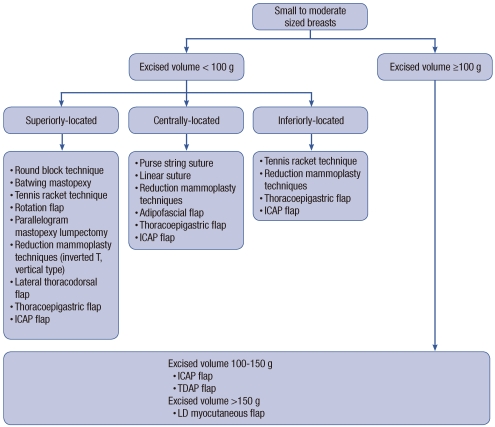
Oncoplastic surgery has revolutionized the field of breast conserving surgery (BCS). The final aims of this technique are to obtain an adequate resection margin that will reduce the rate of local recurrence while simultaneously improving cosmetic outcomes. To obtain successful results after oncoplastic surgery, it is imperative that patients be risk-stratified based on risk factors associated with positive margins, that relevant imaging studies be reviewed, and that the confirmation of negative margins be confirmed during the initial operation. Patients who had small- to moderate-sized breasts are the most likely to be dissatisfied with the cosmetic outcome of surgery, even if the defect is small; therefore, oncoplastic surgery in this population is warranted. Reconstruction of the remaining breast tissue is divided into volume displacement and volume replacement techniques. The use of the various oncoplastic surgeries is based on tumor location and excised breast volume. If the excised volume is less than 100 g, the tumor location is used to determine which technique should be used, with the most commonly used technique being volume displacement. However, if the excised volume is greater than 100 g, the volume replacement method is generally used, and in cases where more than 150 g is excised, the latissimus dorsi myocutaneous flap may be used to obtain a pleasing cosmetic result. The local recurrence rate after oncoplastic surgery was lower than that of conventional BCS, as oncoplastic surgery reduced the rate of positive resection margins by resecting a wider section of glandular tissue. If the surgeon understands the advantages and disadvantages of oncoplastic surgery, and the multidisciplinary breast team is able to successfully collaborate, then the success rate of BCS with partial breast reconstruction can be increased while also yielding a cosmetically appealing outcome.
肿瘤整形手术已经彻底改变了保乳手术(BCS)领域。该技术的最终目的是获得足够的切缘,从而降低局部复发率,同时改善美容效果。为了在肿瘤整形手术后获得成功的结果,必须根据与阳性切缘相关的危险因素对患者进行风险分层,对相关影像学研究进行评估,并在初次手术中确认阴性切缘。乳房中等或较小的患者最有可能对手术的美容效果不满意,即使缺陷很小;因此,在这类人群中进行肿瘤整形手术是合理的。剩余乳房组织的重建分为体积移位和体积置换技术。各种肿瘤整形手术的使用基于肿瘤位置和切除的乳房体积。如果切除的体积小于 100g,则根据肿瘤位置来确定应使用哪种技术,最常用的技术是体积移位。然而,如果切除的体积大于 100g,则通常使用体积置换方法,并且如果切除超过 150g,则可以使用背阔肌肌皮瓣来获得满意的美容效果。肿瘤整形手术后的局部复发率低于传统的 BCS,因为肿瘤整形手术通过切除更宽的腺体组织来降低阳性切缘的发生率。如果外科医生了解肿瘤整形手术的优缺点,并且多学科乳腺团队能够成功合作,那么部分乳房重建的 BCS 成功率可以提高,同时也能获得美容效果。