Department of Pharmaceutical Sciences, College of Pharmacy, University of New Mexico Health Sciences Center, Albuquerque, NM 87131, USA.
Toxicol Appl Pharmacol. 2012 Apr 1;260(1):65-9. doi: 10.1016/j.taap.2012.01.025. Epub 2012 Feb 2.
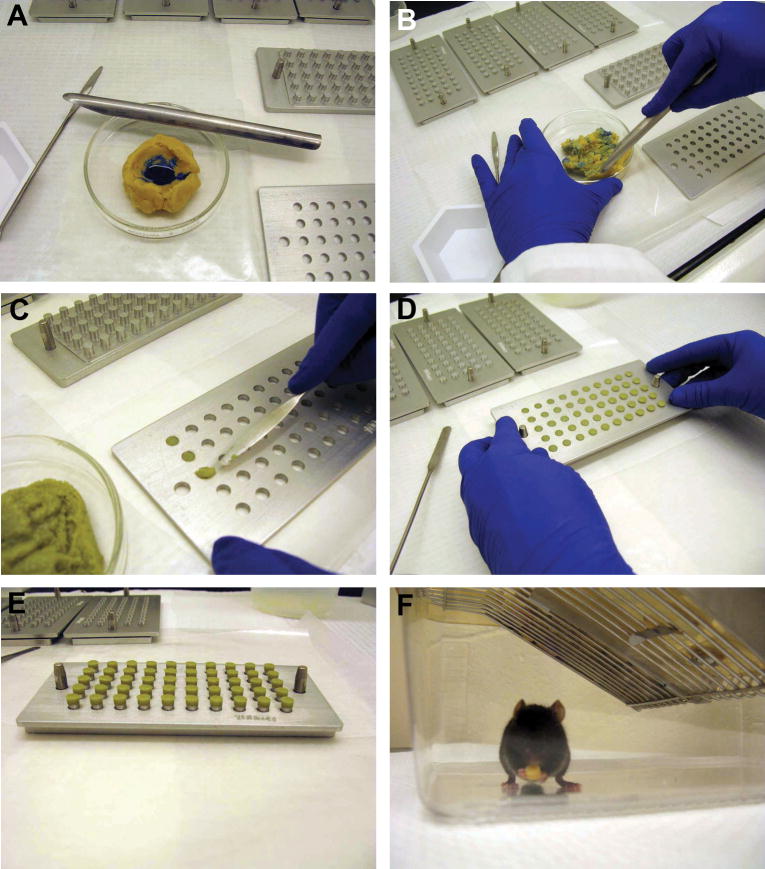
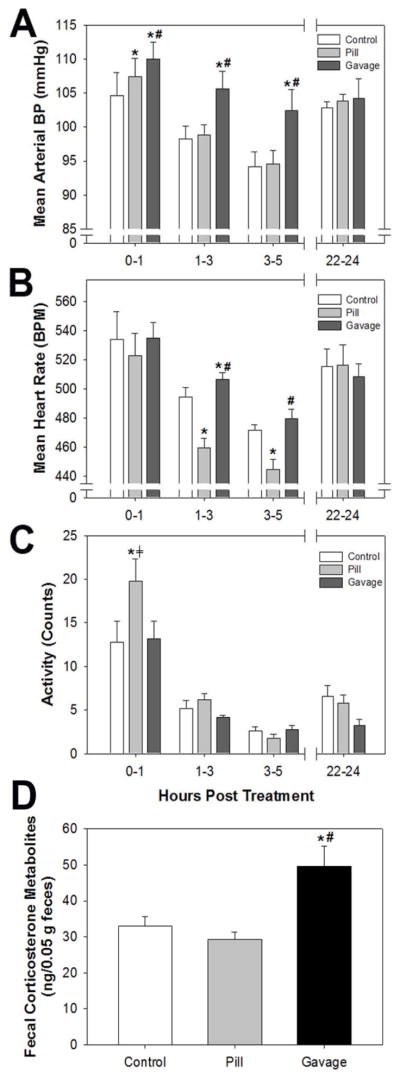
Oral gavage dosing can induce stress and potentially confound experimental measurements, particularly when blood pressure and heart rate are endpoints of interest. Thus, we developed a pill formulation that mice would voluntarily consume and tested the hypothesis that pill dosing would be significantly less stressful than oral gavage. C57Bl/6 male mice were singly housed and on four consecutive days were exposed to an individual walking into the room (week 1, control), a pill being placed into the cage (week 2), and a dose of water via oral gavage (week 3). Blood pressure and heart rate were recorded by radiotelemetry continuously for 5h after treatment, and feces collected 6-10h after treatment for analysis of corticosterone metabolites. Both pill and gavage dosing significantly increased mean arterial pressure (MAP) during the first hour, compared to control. However, the increase in MAP was significantly greater after gavage and remained elevated up to 5h, while MAP returned to normal within 2h after a pill. Neither pill nor gavage dosing significantly increased heart rate during the first hour, compared to control; however, pill dosing significantly reduced heart rate while gavage significantly increased heart rate 2-5h post dosing. MAP and heart rate did not differ 24h after dosing. Lastly, only gavage dosing significantly increased fecal corticosterone metabolites, indicating a systemic stress response via activation of the hypothalamic-pituitary-adrenal axis. These data demonstrated that this pill dosing method of mice is significantly less stressful than oral gavage.
灌胃给药可能会引起应激,并可能干扰实验测量,尤其是当血压和心率是感兴趣的终点时。因此,我们开发了一种药丸制剂,老鼠会自愿服用,并测试了这样一个假设,即药丸给药的应激程度明显低于灌胃。雄性 C57Bl/6 小鼠单独饲养,在连续 4 天内,分别暴露于一个人走进房间(第 1 周,对照组)、将药丸放入笼子中(第 2 周)和口服灌胃给予水(第 3 周)。在治疗后 5 小时内通过无线电遥测连续记录血压和心率,在治疗后 6-10 小时收集粪便,用于分析皮质酮代谢物。与对照组相比,灌胃和丸剂给药均显著增加了治疗后第一个小时的平均动脉压(MAP)。然而,灌胃后的 MAP 增加更为显著,并且持续升高至 5 小时,而丸剂给药后 2 小时内 MAP 恢复正常。与对照组相比,灌胃和丸剂给药在治疗后第一个小时均未显著增加心率;然而,丸剂给药显著降低了心率,而灌胃给药显著增加了 2-5 小时后的心率。给药后 24 小时,MAP 和心率没有差异。最后,只有灌胃给药显著增加了粪便皮质酮代谢物,表明通过激活下丘脑-垂体-肾上腺轴产生了全身性应激反应。这些数据表明,这种给小鼠喂药丸的方法明显比灌胃给药的应激程度低。